Chinese property content for Bangkok condo projects should help readers understand the property, evaluate its relevance, and decide what to ask next. Start with verified project information, organize it around buyer questions, and adapt the language and context for the market you want to reach. Translating a Thai brochure word for word is not enough to accomplish that.
This guide is for Thai developers, property marketing teams, agencies, and sales managers preparing to communicate with Taiwanese and other Chinese-speaking audiences. It focuses on writing and managing useful content, not on recommending a particular property or making legal, tax, or investment claims.
Choose the buyer decision before translating
A project page cannot answer every question equally well. Someone discovering Bangkok neighborhoods needs orientation; someone comparing two units needs precise information. Before writing, identify the decision the page should support and the evidence readers will need to make it.
For a first-time overseas buyer, a useful article might explain how to compare location, layout, and ongoing management arrangements. A returning visitor may instead need a project-specific page that connects those criteria to verified documents. Keeping these purposes separate makes both pages easier to write and maintain.
Use real inquiry records to build the brief. Ask sales colleagues which explanations they repeat, where conversations stall, and what buyers misunderstand after reading the existing brochure. Remove names and other identifying details before sharing examples with writers or AI tools. Treat these records as evidence about your audience, not proof that all Taiwanese buyers share one preference.
For a more structured starting point, develop a Taiwan buyer persona before commissioning the copy. Then give each page a primary audience, one central question, and a useful next step. That small brief prevents a polished translation from becoming a disconnected sales document.
Build a verified project source sheet
Writers should not have to guess which price, floor plan, or completion update is current. Create one approved source sheet before producing the Chinese version. Record the project name, developer identity, location, unit details, included items, document references, and the date each item was checked. Assign an internal owner who can resolve conflicting information.
Distinguish facts from interpretations. A measured distance is different from a travel-time estimate. A photograph of a completed space is different from an architectural rendering. An available unit is different from an example layout. State the relevant conditions in the text and captions so readers do not have to discover them during a sales call.
For example, instead of writing “minutes from everything,” describe the named destination, route, transport mode, and basis for any estimate. If a claim has not been checked, omit it or ask the project team to supply evidence. Do not let confident Chinese wording conceal an uncertain source.
Keep purchase eligibility, taxes, financing, rental arrangements, and ownership conditions on a separate review track with appropriately qualified advisers. Marketing copy should direct readers toward project-specific verification rather than present a generic statement as personal advice. If a financial illustration is necessary, distinguish its assumptions, expenses, and uncertainty; never turn a projection into a promised return.
Make Bangkok context understandable to unfamiliar readers
Local knowledge often disappears during translation. A Thai reader may recognize a district name immediately, while a Taiwanese reader may need help understanding what that location means for a planned stay. Explain the practical context without assuming familiarity with Bangkok.
Describe the questions a reader could investigate: access to a relevant destination, the route between the building and transport, nearby services, and how the layout supports an intended use. Avoid declaring a neighborhood universally convenient or suitable. A location can work well for one routine and poorly for another.
Organize unit descriptions around use rather than adjectives. Explain where storage is located, how the living area connects to the bedroom, and what a floor-plan label refers to. Use approved dimensions and consistent units. If you add a unit conversion, explain the basis and check that it represents the same area measurement as the source.
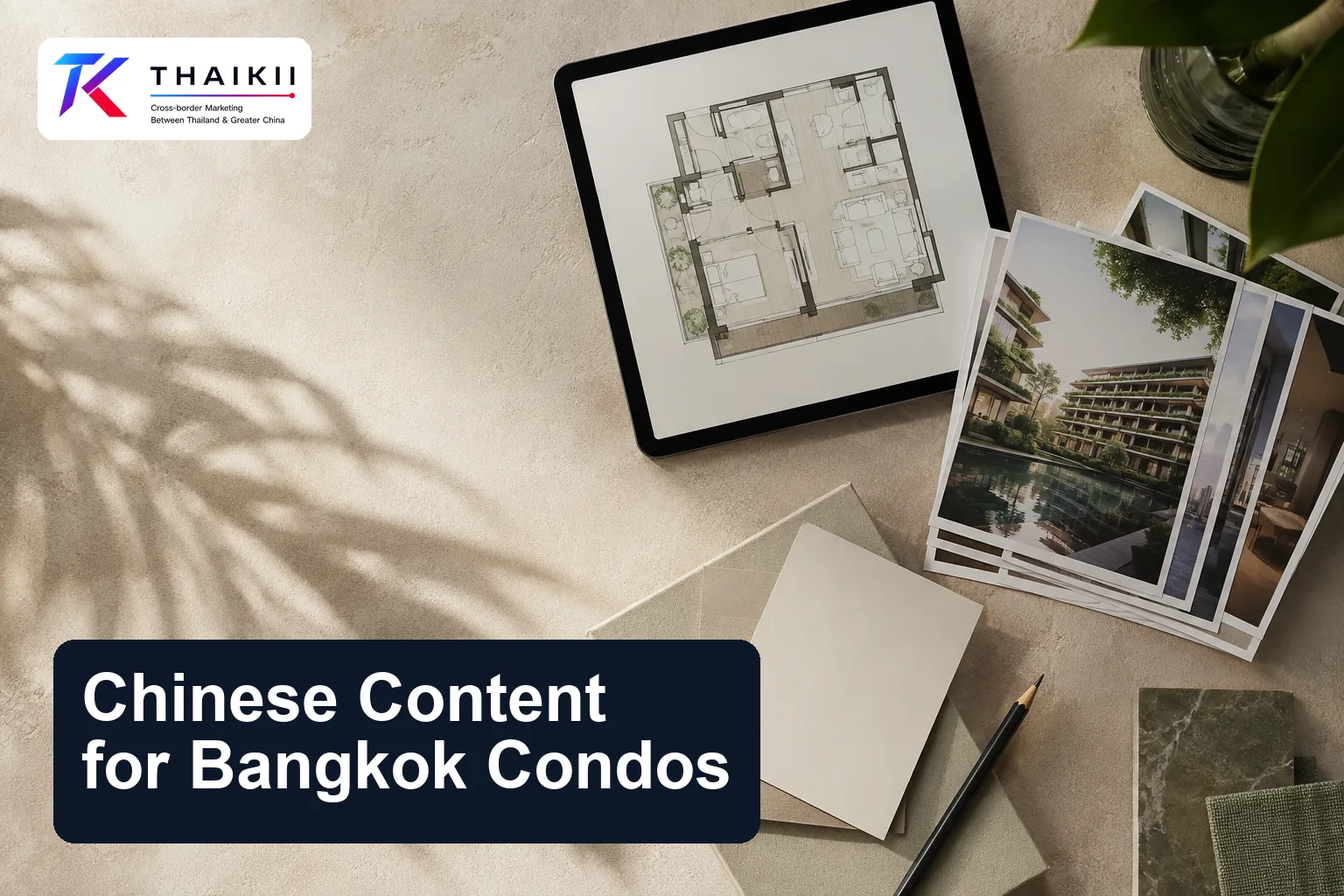
Images should support those explanations. Pair a verified plan with a concise caption, and label renderings clearly. A decorative skyline cannot replace information about the actual unit. Content becomes more persuasive when it makes a comparison easier, not when it adds more superlatives.
Localize meaning, terminology, and evidence
For a Taiwan-focused campaign, write in Traditional Chinese and use terminology that a Taiwan-based editor has checked for naturalness. Localization also means choosing the right explanations, examples, information order, and consultation language. Character conversion alone does not provide that judgment.
Build a short terminology guide for project names, districts, room types, area descriptions, management arrangements, and recurring sales terms. Where a Thai or English name is necessary for identification, introduce it consistently and explain it once. Avoid switching among several Chinese versions of the same project name across the website, brochure, and follow-up messages.
Consider the difference between “a perfect investment destination” and a paragraph explaining the property's characteristics, intended use, and questions still requiring verification. The second version gives a reader something concrete to evaluate. It also allows the sales team to discuss limitations honestly instead of defending a sweeping promise.
Have the Chinese reviewer check both meaning and reader experience against the source sheet. The Thai project team should confirm facts; the market editor should confirm clarity and context. AI can help compare versions or flag inconsistent terminology, but it should not become the authority for project facts, legal interpretations, or invented testimonials.
Chinese-speaking markets are not interchangeable. If the campaign later expands beyond Taiwan, review audience assumptions, language conventions, platform choices, and service expectations again. Reusing a source sheet is efficient; reusing every market assumption is not.
Give each SEO page a distinct question
A useful Chinese SEO plan separates broad learning from project evaluation. An educational article can explain how to read a condo floor plan; a project page can present the approved plan for a specific development. Link them where the connection helps the reader rather than repeating the same promotional paragraph everywhere.
Choose a main query theme for each page and use a clear title, descriptive headings, and concise opening answer. Build the body around related questions that genuinely belong to that topic. Do not insert an exact keyword into every heading or create many near-identical pages for slight wording variations.
Google's people-first content guidance emphasizes usefulness, reliability, and a clear purpose for the intended audience. For a developer, the practical application is to add project evidence and explanations that an unaffiliated reader can use, rather than simply extending a generic property article.
If the website has several languages, plan their structure with the web team. Google recommends separate language URLs and appropriate language-version annotations, while keeping the language of each page clear. Its multilingual-site guidance provides the technical reference. A Chinese headline above an otherwise Thai page is not a complete localized experience.
Connect every channel to a relevant next step
A website article, social post, KOL collaboration, and sales message should contribute to the same reader journey without carrying identical copy. Use the longer article to explain a topic thoroughly, then adapt one useful idea for each distribution channel.
For example, a short post could introduce a common floor-plan misunderstanding and direct interested readers to the full explanation. A creator-led walkthrough could demonstrate the approved layout, with a clear distinction between observed features and promotional interpretation. The linked page should answer the promised question rather than drop the visitor onto an unrelated homepage.
Match the call to action to the reader's readiness. Someone learning about Bangkok may welcome a planning conversation; someone examining a development may want an approved project information pack. Explain what the team will provide and what details would make the response useful. Avoid forcing an immediate purchase conversation on every visitor.
Make the inquiry path usable in the language of the content. Confirm that the form, confirmation message, and follow-up contact can support the advertised experience. Collect only the information needed for that next step, and explain how it will be used. Chinese content marketing loses credibility when a carefully localized article leads to a confusing or unresponsive handoff.
Review content after the first inquiries arrive
Publishing is the beginning of a feedback loop. Look beyond page views to understand whether the content helps readers make progress. Useful signals include relevant inquiry topics, requests for the promised information, consultation readiness, and recurring questions that the article failed to answer.
Define those signals with the sales team before a campaign starts. Track which page or campaign brought an inquiry where your approved analytics setup permits it, and compare that context with the questions received. An increase in visits alone does not establish commercial value or prove that the content caused a sale.
Keep a lightweight editorial record: the page owner, approved source version, last factual review, and links to related assets. When project information changes, check the website, downloadable brochure, social content, and response templates together. A current project page cannot correct an outdated document that is still being sent to prospects.
Improve the smallest useful part first. Clarify a confusing paragraph, add a missing explanation, or adjust the next-step offer based on observed needs. Thaikii's role in this process is to connect Thai project knowledge with Chinese-language content, website planning, SEO, and cross-border communication—not to replace the developer's responsibility for accurate project information.
Frequently Asked Questions
What should Chinese property content for a Bangkok condo project include?
Include verified project details, practical location context, clear unit explanations, appropriately labeled images, and a relevant inquiry path. Organize the information around a specific buyer question, and separate confirmed facts from estimates, illustrations, and matters requiring professional verification.
Is translating a Thai property brochure into Chinese enough?
No. Translation transfers language, while localization also adapts terminology, explanations, information order, and the next step. A Taiwan-focused version should be reviewed for natural Traditional Chinese and checked against the approved project source, not merely converted from another Chinese version.
Should every project article use the same Chinese SEO keyword?
Give each page a distinct main question or purpose. Related articles can share terminology naturally, but an educational guide and a project page should offer different information. Connect them with relevant internal links instead of producing near-duplicate pages.
Can AI write the entire Chinese property page without review?
AI can help draft and organize content, but a responsible workflow checks project facts against approved sources and uses a qualified language reviewer. Legal, financial, and ownership statements need appropriate specialist review; fluent output alone does not establish accuracy.
Build a Clearer Chinese Content Journey with Thaikii
If your team is preparing a Bangkok condo project for Taiwanese or other Chinese-speaking audiences, contact Thaikii to discuss a practical content and market-entry plan. Thaikii can support Chinese websites, SEO, social content, KOL collaboration, market-entry strategy, and Chinese-speaking market promotion.
The starting point can be a focused review of your project information, current content, and inquiry path. From there, build a localized experience that helps readers understand the offer and gives your team a clearer basis for useful conversations.
Discover more from Thaikii 泰奇行銷
Subscribe to get the latest posts sent to your email.