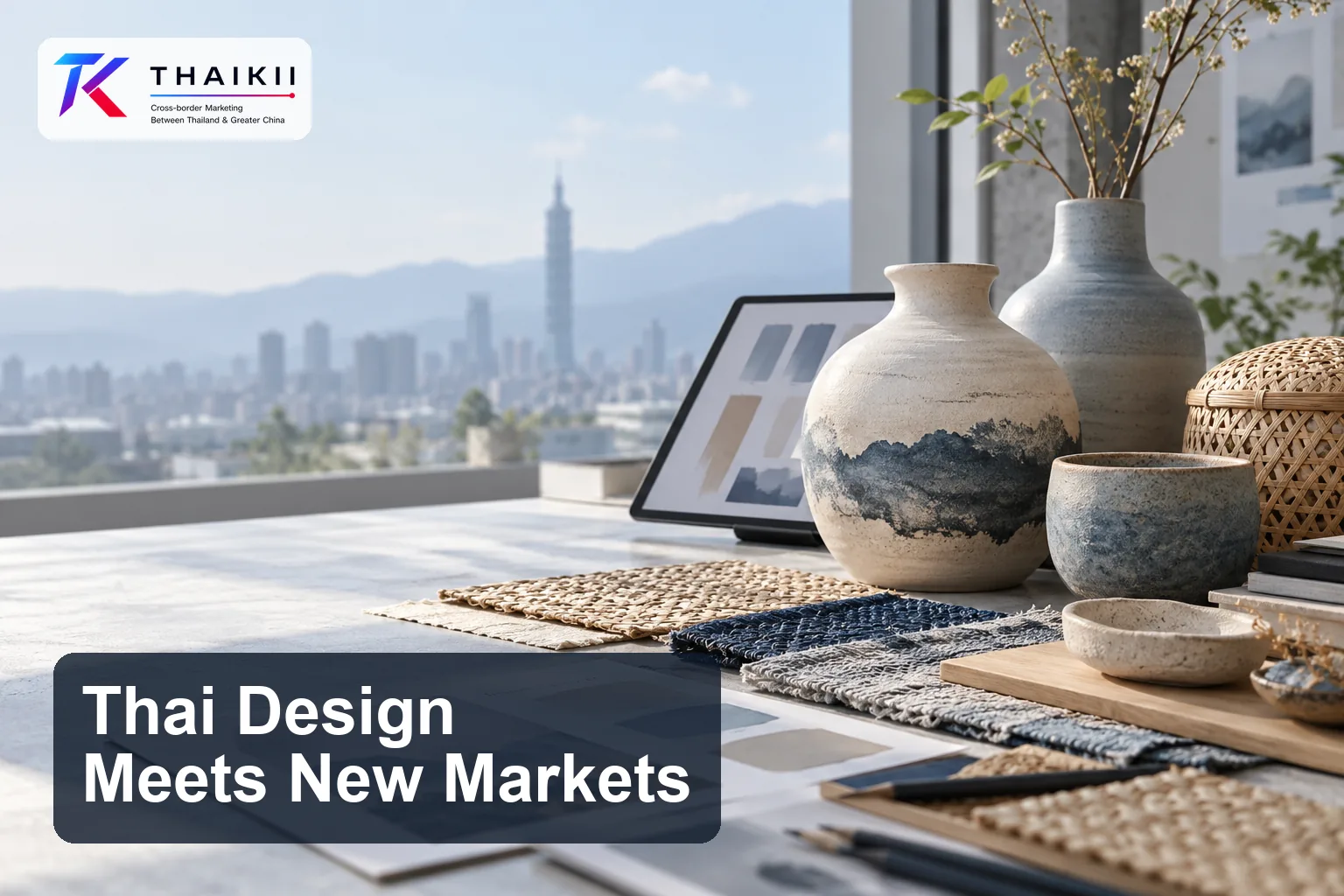
Thai design brands can enter the Chinese-speaking market by choosing a specific buyer and destination, explaining their design value in locally relevant language, and building a dependable path from discovery to purchase. Start with a focused collection and a testable market-entry plan. A translated catalog helps, but customers also need reasons to trust the materials, understand the price, and feel confident about ordering.
This guide is for Thai founders, creative directors, and export teams selling furniture, home accessories, textiles, lifestyle products, or other design-led collections. It uses Taiwan as a practical planning example while treating other Chinese-speaking destinations as separate markets that require their own research and commercial arrangements.
Choose a market and buyer before choosing channels
Define the first customer precisely enough to make product and content decisions. “Chinese-speaking consumers” is too broad to guide a launch. An independent homeware retailer evaluating wholesale margins needs different information from a homeowner choosing a decorative object or an interior designer specifying furniture for a project.
For a Taiwan market entry pilot, choose one initial buying situation: a compact home, a considered gift, a boutique retail assortment, or a hospitality project. Then interview potential customers or trade partners about their selection process. Ask what they compare, what information they need before requesting a quotation, and what makes them hesitate about ordering from an overseas brand.
Use those conversations to define your first offer. A small collection with clear dimensions, consistent photography, and reliable availability is easier to explain than an entire catalog. Identify the products that express the brand's design perspective while fitting the delivery and service capabilities you can actually support.
Treat expansion beyond Taiwan as a new decision. Hong Kong, Mainland China, and other Chinese-speaking audiences should not inherit the same checkout, service promises, channel plan, or vocabulary automatically. A shared written language does not establish identical buying behavior. Record which assumptions you have tested in each destination and which remain open questions.
Make Thai design value tangible and relevant
Keep the brand's Thai identity, but explain how it affects the product rather than relying on a broad cultural claim. Show the designer's choices, the making process, the material finish, or the way an object works in daily life. These details help buyers understand why a piece deserves consideration alongside familiar alternatives.
For example, an illustrative woven storage collection could explain its construction, show its scale beside everyday objects, and demonstrate how the lid and handles work. If a piece is handmade, describe the variation customers can expect. Avoid implying that every natural material or handmade process is automatically sustainable, exceptionally durable, or ethically certified.
Build a concise evidence file for each product. Include accurate dimensions and weight, material composition, care instructions, available finishes, packaging details, and verified production information. Separate measurable facts from aesthetic descriptions. Terms such as “warm,” “sculptural,” and “playful” can express a point of view, but they cannot replace the information needed to judge suitability.
Localization should then connect those facts to a buyer's questions. A story about a workshop may create interest; photographs showing texture and scale help turn that interest into understanding. Let Chinese-language copy explain both the creative intent and the practical experience of owning the product. Do not remove the brand's character merely to imitate competitors.
Before approving a Chinese product name, check whether local readers understand what the item is and how it is used. A poetic collection name can remain, supported by a clear product category. Keep naming consistent across the website, catalog, social posts, and quotations so interested buyers can find the same item again.
Build a Chinese website that supports a real decision
Create a focused Chinese-language destination where visitors can evaluate the brand without searching across disconnected posts. For a Taiwan-focused pilot, use Traditional Chinese written and reviewed for Taiwan. Review terminology, tone, dimensions, currency presentation, and contact instructions together; changing the character set alone is not a complete localization process.
The first version does not need every page from the Thai website. Prioritize the collection overview, individual product information, a credible brand story, delivery and service information, and a clear inquiry path. Trade buyers may also need a downloadable line sheet or a dedicated contact route for stockist and project inquiries.
Give product photography a specific job. Include an overall view, details of material and finish, a scale reference, and a relevant use setting. When color or texture varies, say so near the images. If a photograph shows accessories that are not included, make the scope of the offer clear.
For Chinese SEO, organize pages around real questions and product categories rather than repeating a broad market-entry keyword. A useful page might explain how to choose a surface finish, compare the intended uses of two collections, or maintain a particular material. Have a local-language reviewer check whether your proposed search phrases match the buyer's actual vocabulary.
Google recommends identifying localized page versions with appropriate hreflang annotations. Its guidance on localized versions explains how these annotations describe language and regional alternatives. Ask your web team to implement and validate the relevant relationships between published pages; this technical work supports clarity but does not guarantee rankings.
Make the next step concrete. If buyers must request a shipping quotation, tell them which details to provide. If online ordering is available, review the complete journey in Chinese, including confirmation and support information. A polished landing page cannot compensate for uncertainty at the point of purchase.
Select partners and content around product experience
Choose distribution and promotion partners according to how the product needs to be evaluated. A visually distinctive accessory might be understandable through strong photography and a short demonstration. A larger furniture piece may need physical inspection, material samples, or a detailed conversation with a retailer or specifier.
For retail outreach, prepare a short Chinese introduction and a trade pack that answers operational questions. Explain the collection, intended customer, order process, packaging, and available support. Share only commercial terms that the business has approved. Ask potential partners how they would present the collection and what would prevent them from placing an initial order.
Use Chinese content marketing to address those same concerns publicly. A product demonstration, a care explanation, and a designer interview serve different purposes. Plan them as connected answers: what makes the product distinctive, how it fits into a setting, and what ownership involves. Link each piece to a relevant page rather than sending every visitor to the homepage.
KOL collaboration should demonstrate a genuine fit between creator, audience, and product. Review the creator's actual content and audience questions before discussing deliverables. For a design brand, thoughtful explanations of materials and use can be more useful than a visually attractive mention with no product detail.
Agree on the scope of any collaboration in advance, including factual accuracy, usage rights, disclosure responsibilities, and how interested viewers can find the product. Check applicable requirements for the destination and platform before launch. Do not ask creators to present an untested product claim as a personal experience or to promise results the brand cannot substantiate.
Resolve delivery and service questions before promotion
Map the customer journey after the inquiry as carefully as the campaign itself. Identify who responds in Chinese, who prepares quotations, who confirms stock, and who handles delivery issues. Assign ownership so questions do not disappear between the Thai team and a local partner.
Prepare an internal checklist for the specific products and destination. This should identify which import, labeling, safety, tax, and consumer-service questions require professional confirmation before selling. Requirements depend on the product and sales arrangement; a decorative object and an electrical lighting product should not be assumed to follow the same process.
Avoid publishing a single delivery promise unless your operations can support it. If timing depends on production, destination, or order size, explain the quotation process clearly. Distinguish items available for dispatch from items made to order. Confirm what happens when a package arrives damaged and what evidence the customer should provide.
Use customer support as a source of content improvements. Repeated questions about assembly, scale, color, or care indicate gaps in product information. Updating the relevant page can help future buyers and reduce unnecessary back-and-forth. Keep public information aligned with the terms actually used by the people taking orders.
Run a focused pilot and learn from buyer behavior
Set a pilot objective that matches the business model. A wholesale launch might aim to generate qualified conversations with suitable retailers. A direct sales pilot might test whether visitors understand the offer and complete the available purchase or quotation process. These objectives require different measures.
Track the path from content to meaningful action. Review which pages bring relevant inquiries, which products prompt repeat questions, and where interested visitors stop. If using analytics or inquiry forms, collect only the information needed for the stated purpose and have the relevant privacy requirements checked before launch.
Do not judge the pilot from traffic or social reactions alone. A smaller audience producing detailed questions about quantities and delivery can reveal more commercial interest than a larger audience engaging only with attractive images. Read the questions as well as the numbers.
At the end of the pilot, decide what to keep, change, or pause. Weak response might reflect unclear positioning, an unsuitable offer, missing information, or operational friction; it does not automatically prove that the whole market is unsuitable. Test the most plausible explanation with a specific change, such as better scale photography or clearer trade inquiry information, before expanding the campaign.
Frequently Asked Questions
Should a Thai design brand translate its entire catalog before testing Taiwan?
Usually, a focused pilot collection is a more manageable starting point. Localize the pages and sales materials needed to evaluate those products thoroughly. Expand the catalog after buyer questions and operational experience show what additional information and products are useful.
Can the same Chinese copy serve Taiwan and Mainland China?
Some brand facts can be shared, but each market needs its own language review and commercial context. Check vocabulary, character usage, customer support, sales channels, and the actual offer. Treat a Taiwan launch as evidence about that pilot, not proof that identical materials will work everywhere.
How can a small design brand build trust without local customer reviews?
Provide accurate specifications, detailed photographs, transparent ordering information, and a responsive contact route. Show the actual design and production process when you can document it. Explain what customers can verify today rather than inventing testimonials or presenting an illustrative scenario as a completed project.
What should be measured before expanding the launch?
Review the quality of inquiries, recurring product questions, progress toward orders, and the team's ability to fulfill its promises. Compare results with the pilot's stated objective. Expand when the evidence supports a workable offer and customer journey, rather than using reach alone as the decision.
Plan a Clearer Market Entry with Thaikii
A design-led launch needs a consistent connection between the collection, its Chinese-language story, and the next step for interested buyers. Thaikii helps bridge Thai brands and Taiwan or other Chinese-speaking audiences through Chinese websites, SEO, social content, KOL collaboration, market-entry strategy, and Chinese-speaking market promotion.
To discuss a focused starting point, contact Thaikii with your collection, target destination, intended buyer, and current sales setup. These details provide a practical basis for identifying the content and customer journey your first launch needs.