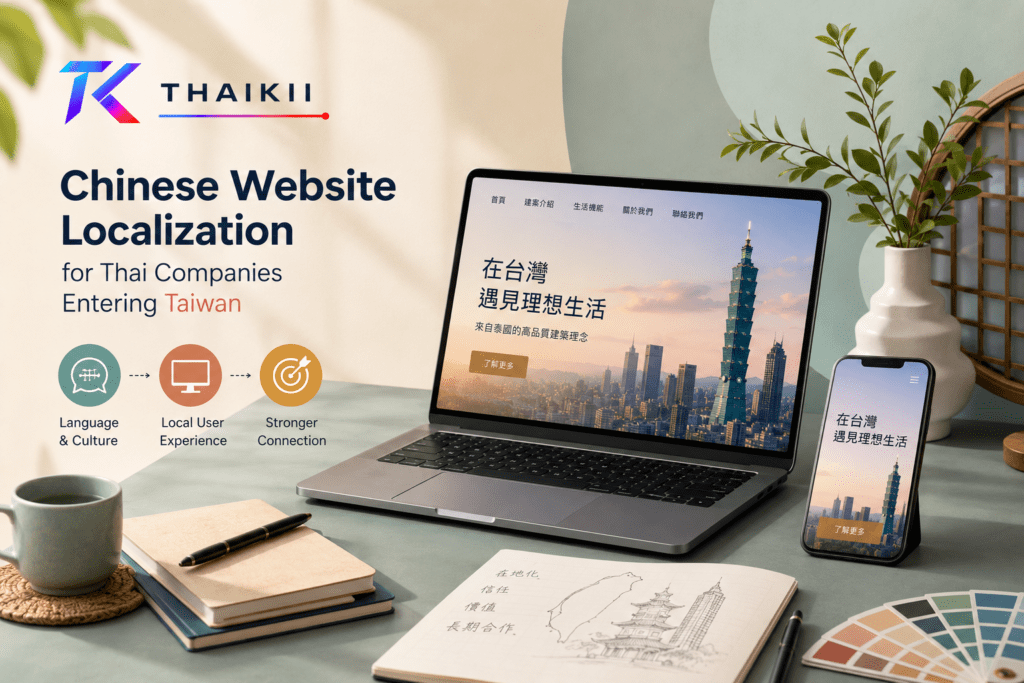
For Thai companies entering Taiwan, Chinese website localization is not just about translating Thai or English content into Traditional Chinese. It is a market-entry strategy that helps your brand communicate clearly, build trust with Taiwanese customers, and prepare for long-term digital marketing across Taiwan and the broader Chinese-speaking market.
Chinese website localization is the process of adapting your website language, structure, messaging, search keywords, visuals, user journey, and call-to-action design for Chinese-speaking users. For Thai brands, this means your website should not only sound natural in Traditional Chinese, but also reflect how Taiwanese customers search, compare, evaluate, and decide.
This article is especially useful for Thai real estate developers, hospitality groups, wellness brands, lifestyle companies, education providers, medical tourism businesses, and consumer brands that want to enter Taiwan or use Taiwan as a bridge to reach Mandarin-speaking buyers.
Why Chinese Website Localization Matters for Thai Companies Entering Taiwan
Taiwan is a highly digital market. Before customers submit an inquiry, book a consultation, purchase a product, or visit a brand in Thailand, they usually search online, compare information, read social media content, and check whether the brand feels reliable. For Thai companies, this means a Chinese website is often the first formal touchpoint between your brand and a Taiwanese customer.
Many Thai companies already have beautiful websites in Thai or English. However, when those websites are shown to Taiwanese users, the communication gap can still be obvious. The language may be understandable, but not persuasive. The visuals may look premium, but not locally relevant. The product description may be accurate, but not aligned with how Taiwanese customers make decisions.
This is where website localization becomes important.
A properly localized Chinese website helps Thai companies answer three key questions from Taiwanese users:
- Can I understand this brand easily?
- Can I trust this company?
- Can I take the next step without uncertainty?
For Thai companies entering Taiwan, the goal is not only to be visible online. The deeper goal is to become understandable, searchable, and trustworthy in a new cultural context.
Translation Is Not Enough: Localization Builds Market Relevance
A common mistake among companies expanding into Taiwan is treating website localization as a translation task. Translation changes words from one language to another. Localization changes the entire communication experience.
For example, a Thai real estate developer may describe a condominium project by focusing on lifestyle, facilities, location atmosphere, and investment potential. These are all important. However, Taiwanese buyers may also want to understand ownership structure, payment schedule, management fee, rental demand, nearby transportation, legal process, and whether there is Mandarin-speaking support.
If the Chinese website only translates the original Thai or English website, the content may still feel incomplete to Taiwanese users. A localized website should reorganize information based on local decision-making logic.
For example, Taiwanese users often prefer clear comparisons, transparent explanations, practical examples, and structured buyer guidance. They may not respond well to overly vague luxury phrases if the website does not also provide practical reasons to believe the brand.
This is why Chinese website localization should include:
- Language adaptation
- SEO keyword research
- Landing page structure
- Customer journey design
- Brand trust signals
- Market-specific calls to action
- Content that answers real buyer concerns
For Thai companies, localization is not only a technical website project. It is part of business development.
Taiwan Uses Traditional Chinese, Not Simplified Chinese
One of the most important details for Thai companies entering Taiwan is language usage. Taiwan uses Traditional Chinese, while Mainland China uses Simplified Chinese. Although both are Chinese-language markets, the reading habits, tone, terminology, and platform ecosystems are different.
A website prepared for Taiwan should use Traditional Chinese with Taiwan-style wording. This affects more than the written characters. It also affects how people describe services, pricing, locations, customer support, lifestyle, real estate, hospitality, beauty, wellness, education, and business cooperation.
For example, Taiwanese readers usually expect a tone that is clear, professional, and informative. Overly direct sales language may feel aggressive. On the other hand, a website that is too abstract may feel unreliable.
Thai brands often have strong emotional value: warmth, hospitality, lifestyle, food culture, wellness, tourism, design, and service experience. These strengths can work very well in Taiwan, but they need to be communicated in a way that feels natural to Taiwanese readers.
A localized Traditional Chinese website should help your brand sound like it understands the market, not like it is speaking through a machine translation tool.
How Taiwanese Customers Search Before They Trust a Thai Brand
SEO is one of the most important reasons to invest in Chinese website localization. Taiwanese customers do not only search for brand names. In many cases, they search by problem, destination, product type, service category, or comparison.
- A Thai company entering Taiwan should consider how Taiwanese users might search for its products or services. For example:
- A Thai real estate developer may need Chinese content around Thailand property, Bangkok condo, overseas property, Thailand rental market, and buying property in Thailand.
- A Thai wellness brand may need content around Thai spa, aromatherapy, massage products, wellness travel, and premium Thai lifestyle.
- A Thai tourism business may need content around Bangkok travel, family travel in Thailand, luxury hotels in Thailand, private tours, and travel planning.
- A Thai food brand may need content around Thai snacks, Thai tea, authentic Thai food, gift boxes, and Taiwan distribution.
- A Thai B2B company may need content around Thailand market entry, Taiwan distribution partner, Chinese marketing, and cross-border branding.
The key point is that SEO localization should not be limited to translating existing service pages. Thai companies should create Chinese content that matches Taiwanese search behavior.
At THAIKII, our experience with Chinese-language content, real estate marketing, cross-border brand positioning, and Taiwan audience communication helps Thai companies avoid one of the most common problems: having a website that looks complete but cannot generate meaningful traffic or inquiries.
What a Localized Chinese Website Should Include
A Chinese website for Taiwanese users should be built around clarity. Thai companies should not assume that Taiwanese customers already understand the brand, the market, or the product. The website needs to guide the user step by step.
A strong Chinese website usually includes a few essential pages.
The homepage should quickly explain who the company is, what it offers, why Taiwanese customers should care, and how to take the next step. It should not only be visually attractive. It should also reduce confusion.
The about page should build credibility. For Thai companies, this may include company background, local experience, licenses, project history, media exposure, partner network, awards, and service philosophy. Taiwanese customers often want to know whether the company is stable, responsible, and experienced.
The service or product pages should explain details in a structured way. Instead of only describing features, they should answer customer concerns. For example, who is this suitable for? What problem does it solve? What makes it different? What is the process? What should customers prepare before contacting you?
The case study or project page is especially important for industries such as real estate, hospitality, education, design, beauty, medical tourism, and B2B services. Taiwanese customers often trust examples more than slogans.
The contact page should be simple and localized. If a Thai company wants inquiries from Taiwan, it should offer clear contact methods such as email, LINE, contact form, WhatsApp, or Mandarin-speaking support if available.
The blog or insights section should support SEO growth. This is where the website can attract users who are still researching. Instead of only promoting the company, the content should help users understand the market, compare options, and build confidence.
For Thai Real Estate Developers: Chinese Localization Is a Sales Funnel
For Thai real estate developers, a Chinese website can become a powerful sales funnel for reaching Taiwanese and Chinese-speaking buyers. However, the website must be designed differently from a general project brochure.
Taiwanese buyers considering Thailand real estate often need more education before they make an inquiry. They may be interested in Bangkok, Phuket, Pattaya, Chiang Mai, or emerging lifestyle destinations, but they may not fully understand foreign ownership rules, rental management, payment process, taxes, project location, or resale liquidity.
A localized Chinese website should therefore provide more than attractive renderings. It should present information in a way that supports the buyer journey.
At the awareness stage, users may search for general topics such as buying property in Thailand, Bangkok property market, Thailand retirement lifestyle, or overseas property options.
At the comparison stage, users may look for Bangkok vs. Pattaya, condo near BTS, Thailand property price, rental yield, developer reputation, or long-term holding potential.
At the inquiry stage, users want project brochures, floor plans, pricing, payment schedule, Mandarin consultation, and clear next steps.
This is why real estate localization requires both content strategy and market understanding. THAIKII’s past experience in Chinese-language real estate content and overseas property marketing allows us to help Thai developers present projects in a way that is easier for Taiwanese buyers to understand and trust.
Tone Matters: Taiwanese Users Prefer Clear, Professional, and Useful Content
A localized website should not sound like a direct advertisement. Taiwanese customers often respond better to content that explains value logically.
For example, instead of saying “the best luxury residence in Bangkok,” a localized version may explain why the project is relevant: location, transport access, surrounding lifestyle, rental demand, building management, developer background, and long-term market position.
This does not mean the website should be boring. Thai brands have strong emotional appeal, and that should be preserved. But emotional storytelling needs to be supported by useful information.
- A good localization strategy balances three layers:
- Brand emotion: why the brand feels attractive
- Market logic: why the product makes sense
- Action design: why the user should contact the company now
For Thai companies entering Taiwan, this balance is essential. A website that only focuses on beauty may not convert. A website that only focuses on facts may not inspire. A localized Chinese website should do both.
Visual Localization: Images Should Match the Market Story
Chinese website localization is not only about words. Visual design also affects trust.
Thai brands often have strong visual assets: hotels, villas, condominiums, restaurants, spas, wellness products, cultural experiences, and lifestyle scenes. These assets are valuable, but they should be arranged with the Taiwanese audience in mind.
For example, a Taiwanese customer may want to see not only the product itself, but also the usage scenario. A real estate project should show location, building design, common facilities, lifestyle convenience, and neighborhood context. A tourism brand should show how a Taiwanese traveler might actually experience the service. A wellness brand should show product quality, safety, routine usage, and brand atmosphere.
The visual story should make the customer feel: “This brand understands what I need.”
It is also important to avoid overcrowding the website with too many visual effects. Taiwanese users often value easy navigation and clear information. A premium website does not need to be complicated. It needs to feel polished, fast, and trustworthy.
Localized Calls to Action: Make the Next Step Easy
A strong website does not end with information. It guides users toward action.
For Thai companies entering Taiwan, the call to action should be clear and low-friction. Depending on the industry, suitable calls to action may include:
- Request a Chinese brochure
- Book a Mandarin consultation
- Ask for Taiwan partnership details
- Get project pricing
- Contact our Greater China marketing team
- Schedule a brand expansion discussion
For high-value products such as real estate, hospitality partnerships, education services, and medical tourism, the CTA should not feel too transactional. Taiwanese users often need to ask questions before making a decision. Therefore, the website should make consultation feel natural and professional.
For consumer brands, the CTA may focus on where to buy, how to become a distributor, how to request samples, or how to collaborate with the brand.
The key is to design the website around the user’s next step, not only the company’s introduction.
Why Thai Companies Should Prepare for Both Taiwan and the Greater China Market
Taiwan is not only a single market. For many Thai companies, Taiwan can also become a strategic entry point for broader Chinese-speaking brand communication.
A well-localized Traditional Chinese website can help Thai brands test messaging, build Mandarin-language content assets, generate search traffic, and develop case studies before expanding deeper into other Chinese-speaking markets.
However, Taiwan and Mainland China should not be treated as identical. The platforms, regulations, media behavior, wording, and consumer expectations can differ significantly. A brand that wants to reach both markets needs a flexible content system.
THAIKII helps Thai companies build this foundation by combining Chinese-language content, Taiwan market understanding, and cross-border marketing strategy. Instead of simply translating websites, we help brands think about how to communicate, how to position, and how to convert attention into business opportunities.
How THAIKII Supports Thai Companies with Chinese Website Localization
THAIKII is built around a clear cross-border mission: helping Thai brands reach Taiwan and the Greater China market, while also helping Taiwanese brands understand and enter Thailand. This dual-market perspective allows us to see both sides of the communication gap.
For Thai companies, we can support Chinese website localization from several angles.
First, we help clarify the brand message for Taiwanese users. This includes identifying what the brand should emphasize, what information may be unclear, and what kind of trust signals should be added.
Second, we adapt the website content into natural Traditional Chinese for Taiwan. This is not direct translation. We restructure the content so that Taiwanese users can read it smoothly and understand the value quickly.
Third, we plan SEO content that can support long-term search visibility. A localized website should not only serve people who already know the brand. It should also attract people who are searching for related products, destinations, services, or business opportunities.
Fourth, we help create landing pages and article structures that match user intent. For example, a Thai real estate company may need separate pages for project introduction, buyer guide, market insight, and inquiry conversion. A Thai lifestyle brand may need pages for product story, Taiwan distribution, media collaboration, and consumer education.
Finally, we support cross-border brand communication between Thailand and Chinese-speaking audiences. This is especially important for companies that want not only website traffic, but also leads, partnerships, media exposure, and brand recognition.
Common Mistakes Thai Companies Should Avoid
When entering Taiwan, many companies make the same website mistakes. The first is relying too heavily on English. English may work for international positioning, but many Taiwanese customers still prefer detailed information in Traditional Chinese when making serious decisions.
The second mistake is using Simplified Chinese for Taiwan. This can make the website feel less localized and may reduce trust among Taiwanese users.
The third mistake is translating content without changing the structure. If the original website was designed for Thai customers or international tourists, the same structure may not fit Taiwanese decision-making behavior.
The fourth mistake is ignoring SEO. A website without localized keywords may look good but remain invisible.
The fifth mistake is having no clear next step. If users cannot easily contact the company, request information, or understand the process, they may leave without taking action.
For Thai companies, these problems are avoidable. With the right localization strategy, your website can become a serious business asset.
A Localized Chinese Website Is a Long-Term Brand Investment
Entering Taiwan is not only about launching a website. It is about building a Chinese-language brand presence.
A localized website can support advertising, social media, SEO, public relations, sales presentations, business development, and distributor communication. Over time, the website becomes a reference point that helps customers, partners, and media understand your company.
For Thai companies, this is especially valuable because Thailand already has strong appeal in Taiwan. Thai food, travel, wellness, real estate, hospitality, culture, and lifestyle all have market potential. The challenge is not whether Taiwanese people are interested in Thailand. The challenge is whether your brand can communicate clearly enough to turn that interest into action.
Chinese website localization helps close that gap.
Work with THAIKII to Localize Your Website for Taiwan
If your Thai company is preparing to enter Taiwan, your Chinese website should not be treated as an afterthought. It should be one of the first foundations of your market-entry strategy.
THAIKII helps Thai brands build Chinese-language websites and digital marketing content that speak naturally to Taiwanese users, support SEO visibility, and create a stronger path from awareness to inquiry.
Whether you are a real estate developer, hotel group, wellness brand, lifestyle company, tourism business, education provider, or B2B service company, a localized Chinese website can help your brand become more visible, more understandable, and more trusted in Taiwan.
Taiwanese customers are already searching for Thai products, services, experiences, and opportunities. The next step is making sure they can find your brand, understand your value, and feel confident enough to contact you.
With years of cross-border marketing experience, THAIKII Marketing helps brands build meaningful connections with Chinese-speaking audiences across Taiwan, China, Hong Kong, and other key Asian markets.
From SEO strategy and social media management to Chinese website development, local offline events, and KOL collaborations, we provide flexible support based on each brand’s market goals, industry background, and target customers. Whether you are planning your first market entry or looking to strengthen your existing presence, our team can help you create a localized, practical, and results-oriented marketing approach.
Frequently Asked Questions (FAQs)
English can support international branding, but Traditional Chinese is still much more effective for detailed communication, SEO, and customer trust in Taiwan. When users are comparing services, projects, prices, or cooperation opportunities, they usually prefer information in their local language.
Thai companies should use Traditional Chinese for Taiwan. Simplified Chinese is mainly used in Mainland China. For Taiwanese users, Traditional Chinese with Taiwan-style wording feels more local, professional, and trustworthy.
No. Translation changes the language, while localization adapts the content, structure, tone, SEO keywords, visuals, and user journey for a specific market. For Taiwan, localization should reflect how Taiwanese users search, compare, and make decisions.
Discover more from Thaikii 泰奇行銷
Subscribe to get the latest posts sent to your email.