
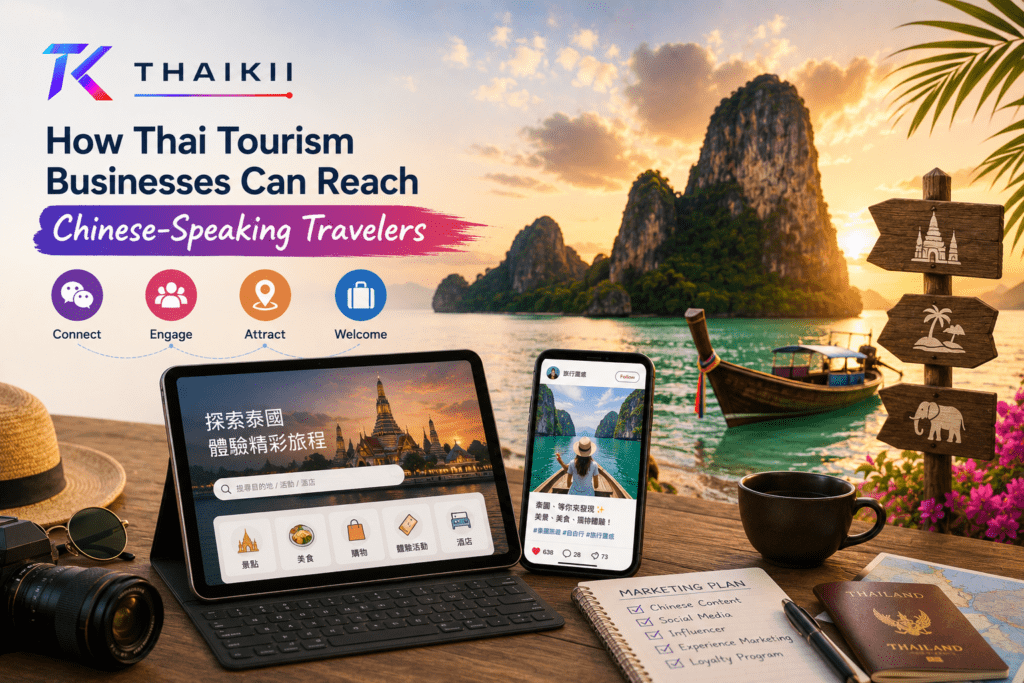
Thai tourism businesses can reach Chinese-speaking travelers more effectively by localizing their brand message, building trust through Chinese-language content, and choosing the right digital channels for Taiwan, Hong Kong, and Mandarin-speaking communities.
Chinese-speaking traveler marketing is not only translation. It is a complete localization strategy that adjusts language, travel motivation, booking behavior, content format, social media style, and customer service flow for Mandarin-speaking audiences.
This approach is especially suitable for Thai hotels, resorts, wellness brands, tour operators, restaurants, lifestyle businesses, tourism attractions, medical wellness providers, and local experience brands that want to attract travelers from Taiwan and the broader Greater China market.
Why Chinese-Speaking Travelers Matter to Thai Tourism Businesses
Thailand has always been one of the most attractive destinations in Asia. From Bangkok’s urban lifestyle and Chiang Mai’s cultural depth to Phuket’s resort economy and Pattaya’s leisure tourism, Thai tourism businesses have a natural advantage: the country already has strong destination appeal.
However, destination appeal alone is no longer enough.
Chinese-speaking travelers today are more selective, more digital, and more dependent on online content before making travel decisions. They do not only search for “where to go in Thailand.” They compare hotel design, food experiences, spa quality, transportation convenience, safety, language support, social media reviews, and whether the brand feels trustworthy before booking.
For Thai tourism businesses, this creates a major opportunity. Many hotels, restaurants, travel agencies, wellness centers, and activity providers already have excellent products, but their Chinese-language visibility remains limited. Their English content may be polished, and their Thai-language branding may be strong, yet Chinese-speaking travelers may not fully understand the value of the experience.
This is where ThaiKii Marketing plays a practical role. With experience in cross-border marketing, Chinese-language content strategy, Thailand-related media communication, and Taiwanese consumer behavior, ThaiKii helps Thai businesses translate not only their words, but also their brand meaning.
Chinese-Speaking Travelers Are Not One Single Market
One common mistake in tourism marketing is assuming that all Chinese-speaking travelers behave the same way. In reality, travelers from Taiwan, Hong Kong, Singapore, Malaysia, and Mainland China may all understand Chinese, but their expectations, platforms, and decision-making habits can be very different.
Taiwanese travelers often care about lifestyle quality, independent travel convenience, authentic local experiences, food safety, photography-friendly spaces, and whether the brand feels reliable. They are highly influenced by blog articles, social media recommendations, Google search results, YouTube content, Instagram posts, Facebook communities, and word-of-mouth discussions.
Mainland Chinese travelers may rely more heavily on platforms such as Xiaohongshu, WeChat, Douyin, Ctrip, Fliggy, Mafengwo, and Baidu search. Their content environment is different, and the style of persuasion also differs. They often respond well to strong visual content, social proof, influencer recommendations, clear booking instructions, and practical travel notes.
Hong Kong and Singapore travelers may use a mix of English and Chinese content. They may compare Thailand with Japan, Korea, Taiwan, Vietnam, and other leisure destinations, making positioning especially important.
For Thai tourism brands, this means a simple Chinese translation of an English website is not enough. A hotel in Bangkok, a spa in Chiang Mai, or a tour operator in Phuket needs a strategy that understands which Chinese-speaking audience it wants to attract first.
A Taiwan-focused strategy may prioritize Google SEO, Facebook, Instagram, YouTube, blog articles, and LINE-friendly customer communication. A Mainland China-focused strategy may need Xiaohongshu-style content, simplified Chinese localization, KOL seeding, platform-specific storytelling, and a different conversion funnel.
ThaiKii Marketing helps tourism businesses define these differences clearly before launching campaigns, so marketing budgets are not wasted on content that looks Chinese but does not truly connect with Chinese-speaking travelers.
Translation Is Not Enough: Tourism Brands Need Localization
Many Thai tourism businesses begin their Chinese marketing journey by translating their website, menu, brochure, or booking page. This is a good first step, but it is only the beginning.
Tourism is emotional. Travelers do not choose a hotel or travel experience based only on technical information. They imagine how the trip will feel. They want to know whether the place is relaxing, beautiful, convenient, safe, memorable, and worth recommending to friends.
This is why localization matters.
For example, an English hotel description may say:
“Our resort offers a peaceful retreat surrounded by tropical nature.”
This sentence is understandable, but for a Taiwanese traveler, a stronger localized message might emphasize:
a relaxing tropical holiday without long-haul travel, a quiet environment suitable for couples or family trips, convenient access from the airport, photogenic poolside spaces, and nearby cafés, markets, or cultural attractions.
The information is similar, but the persuasion angle is different.
Chinese-speaking travelers often respond to practical emotional value. They want to know how the experience fits into their travel plan. Is it suitable for couples? Is it family-friendly? Is it convenient for first-time visitors to Thailand? Is it easy to book? Is there Chinese-language support? Is it popular among Taiwanese travelers? Is it a hidden gem?
A localized Chinese marketing strategy should answer these questions naturally through website copy, blog content, landing pages, social media posts, travel guides, influencer collaborations, and customer service scripts.
The Role of SEO in Reaching Chinese-Speaking Travelers
For tourism businesses, Chinese SEO is one of the most valuable long-term marketing assets.
Paid ads can create short-term exposure, but SEO helps a brand continue to appear when travelers are actively searching for destinations, hotels, restaurants, tours, spas, and travel experiences. When a Taiwanese traveler searches for “Bangkok boutique hotel,” “Phuket family resort,” “Chiang Mai spa recommendation,” or “Thailand private tour,” the businesses that appear with useful Chinese-language content are more likely to be trusted.
This is especially important for Thai businesses that do not yet have strong brand awareness in Taiwan or the Chinese-speaking market. Travelers may not search for your brand name at first. They search for needs, destinations, comparisons, and questions.
A strong Chinese SEO strategy may include:
- destination-based content, such as Bangkok travel planning, Chiang Mai wellness trips, Phuket resort guides, or Pattaya family travel;
- service-based content, such as Thai massage, private tours, island hopping, luxury hotel stays, wedding travel, wellness retreats, and food experiences;
- problem-solving content, such as transportation tips, safety concerns, booking guidance, language support, family travel planning, and seasonal travel recommendations.
However, SEO should not be written only for algorithms. Good tourism SEO needs to feel like a helpful travel consultant. It should explain, compare, reassure, and guide.
ThaiKii Marketing’s experience in Chinese-language content and cross-border SEO allows Thai tourism businesses to build content that is not only searchable, but also persuasive. The goal is not simply to rank on Google. The goal is to help travelers feel confident enough to click, inquire, book, and share.
Building Trust Before Travelers Arrive in Thailand
Trust is one of the most important factors in tourism marketing.
For Chinese-speaking travelers, especially those booking from overseas, trust is built before they arrive. They may not know the local area. They may worry about transportation, communication, payment methods, cancellation policies, or whether the actual experience matches the photos.
This is why Chinese-language content should reduce uncertainty.
A hotel should not only show beautiful rooms. It should explain who the hotel is suitable for, how far it is from major transportation points, whether it is convenient for families, couples, business travelers, or first-time visitors, and what nearby experiences can be combined with the stay.
A restaurant should not only show food photos. It should explain signature dishes, atmosphere, reservation methods, location convenience, group dining suitability, and why travelers should choose it instead of another restaurant nearby.
A tour company should not only list itinerary details. It should explain pacing, safety, guide language, transportation, flexibility, local knowledge, and what kind of traveler would enjoy the route most.
A wellness or spa business should not only describe treatments. It should communicate hygiene, professionalism, relaxation value, staff training, privacy, atmosphere, and whether the service is suitable for couples, solo travelers, or premium travel groups.
The more clearly a business answers these concerns in Chinese, the easier it becomes for travelers to trust the brand.
Social Media Strategy for Thai Tourism Brands
Chinese-speaking travelers are heavily influenced by social media, but each platform plays a different role.
Instagram is effective for visual storytelling, especially for hotels, cafés, restaurants, spas, scenic attractions, and lifestyle experiences. It helps create desire. Beautiful visuals, short captions, reels, and traveler-friendly angles can make a brand feel modern and attractive.
Facebook remains important for Taiwanese audiences, especially for travel communities, family travelers, event promotions, and article sharing. Many Taiwanese travelers still use Facebook to discover travel tips, read recommendations, and ask for opinions.
YouTube is powerful for deeper travel storytelling. A hotel, tour, wellness center, or destination brand can benefit from video content that shows real atmosphere, transportation routes, room tours, food experiences, and recommended itineraries.
Blogs and SEO articles are still valuable because many travelers search on Google before making decisions. Long-form Chinese content can support organic visibility and provide more detailed persuasion than short social posts.
For Mainland China-focused campaigns, Xiaohongshu is especially important for lifestyle discovery. It works well for tourism, beauty, wellness, food, hotels, and photo-friendly experiences. However, Xiaohongshu content must feel native to the platform. Direct advertising language often performs poorly. Travelers prefer personal experience notes, practical recommendations, visual storytelling, and authentic reviews.
ThaiKii Marketing helps Thai tourism businesses choose the right platform mix instead of simply posting the same content everywhere. A Bangkok hotel targeting Taiwanese travelers may need a different content plan from a Phuket resort targeting Mainland Chinese families. A Chiang Mai wellness brand may need educational storytelling, while a restaurant may need stronger visual content and influencer-style recommendations.
Why Taiwanese Travelers Are a High-Value Audience for Thai Tourism
Taiwanese travelers are especially important for Thai tourism businesses because Thailand is close, familiar, and highly attractive as a repeat travel destination. Many Taiwanese travelers do not visit Thailand only once. They may return for Bangkok shopping, Chiang Mai relaxation, Phuket holidays, wellness retreats, food exploration, music festivals, weddings, or seasonal vacations.
This repeat-travel behavior creates long-term value.
A business that successfully builds trust with Taiwanese travelers can benefit from repeat bookings, referrals, social media sharing, and group travel opportunities. Taiwanese consumers also tend to research carefully before purchasing. If your Chinese-language content is helpful, transparent, and professional, it can influence not only one traveler, but also their family, friends, and online communities.
For Thai tourism businesses, Taiwan can be a strategic entry point into the broader Chinese-speaking market. Compared with larger and more complex markets, Taiwan is relatively accessible for testing Chinese-language branding, SEO content, social media messaging, and travel product positioning.
ThaiKii Marketing understands both Thai market characteristics and Taiwanese consumer expectations, making it easier for Thai businesses to avoid messaging gaps. We help businesses adjust their content so it feels natural to Taiwanese readers while preserving the original charm of the Thai brand.
From Awareness to Booking: A Complete Chinese Marketing Funnel
Reaching Chinese-speaking travelers requires more than visibility. A successful campaign should guide travelers from awareness to decision.
At the awareness stage, travelers may discover your brand through Google, Instagram, Facebook, Xiaohongshu, YouTube, or travel blogs. The content should focus on inspiration: why this destination, why this experience, and why now.
At the consideration stage, travelers compare options. They want more details about price, location, quality, convenience, safety, language support, and reviews. This is where localized website pages, FAQ sections, blog articles, itinerary suggestions, and customer testimonials become important.
At the conversion stage, the booking process must be clear. If the Chinese-language content attracts interest but the booking page is confusing, the customer may leave. Businesses should make inquiry methods, reservation steps, payment options, cancellation rules, and response channels easy to understand.
After the visit, the marketing process continues. Travelers can become content creators for your brand through reviews, social media tags, user-generated photos, and referrals. Chinese-language follow-up messages, review requests, and loyalty campaigns can turn one-time visitors into long-term brand advocates.
ThaiKii Marketing helps tourism businesses design this full funnel, not just isolated social media posts. The goal is to build a system where content, channels, search visibility, and customer communication all support each other.
What Thai Tourism Businesses Should Prepare Before Entering the Chinese-Speaking Market
Before launching Chinese-language marketing, Thai tourism businesses should clarify their brand position. Are you targeting luxury travelers, family travelers, couples, young independent travelers, wellness visitors, business travelers, or group tours? Different audiences require different messages.
A luxury resort should emphasize privacy, service quality, design, exclusivity, and emotional experience. A family-friendly hotel should highlight convenience, safety, room types, nearby attractions, and child-friendly facilities. A tour operator should communicate reliability, local expertise, flexibility, and clear itinerary value. A restaurant should focus on signature flavors, atmosphere, location, and traveler-friendly ordering guidance.
Businesses should also prepare high-quality visual assets. Chinese-speaking travelers rely strongly on photos and videos when evaluating travel experiences. Clear images of rooms, facilities, food, staff, surroundings, transportation points, and guest experiences can significantly improve trust.
Finally, businesses should be ready to respond to inquiries professionally. Chinese-language marketing may generate questions through email, LINE, Facebook Messenger, Instagram, WeChat, or website forms. If the response is slow or unclear, marketing performance will be limited.
ThaiKii Marketing can support Thai businesses from strategy to execution, including Chinese website localization, SEO article planning, social media content, campaign messaging, influencer collaboration direction, and cross-border market communication.
How ThaiKii Marketing Helps Thai Tourism Brands Grow
ThaiKii Marketing is built for cross-border brand communication between Thailand and Chinese-speaking markets. Our work is not only about language. It is about helping Thai businesses present their value in a way that Taiwanese and Chinese-speaking audiences can understand, trust, and act on.
Our experience includes Thailand-focused content development, Chinese-language media positioning, digital marketing strategy, SEO article planning, social media communication, and audience localization. We understand how Taiwanese readers consume information, how Chinese-language travel content should be structured, and how tourism brands can turn cultural appeal into measurable marketing assets.
For Thai tourism businesses, this means we can help answer practical questions such as:
- Which Chinese-speaking market should we target first?
- Should our website use Traditional Chinese, Simplified Chinese, or both?
- What kind of blog articles can attract travelers from Taiwan?
- How should we present our hotel, restaurant, tour, spa, or destination experience in Chinese?
- Which platforms should we prioritize?
- How can we make our brand feel trustworthy before travelers arrive in Thailand?
The answer is rarely one single tactic. The right strategy depends on brand position, target audience, budget, content assets, and long-term growth goals.
A Stronger Bridge Between Thailand and Chinese-Speaking Travelers
Thailand already has strong tourism appeal. The next step is making sure Chinese-speaking travelers can clearly understand why your brand is worth choosing.
In a competitive tourism market, the businesses that win are not always the ones with the biggest advertising budget. Often, they are the ones that explain their value most clearly, build trust earlier, and appear consistently when travelers are searching for answers.
For Thai hotels, resorts, restaurants, spas, tour companies, and lifestyle travel brands, Chinese-language marketing can become a long-term growth engine. With the right localization strategy, your business can reach travelers before they arrive, influence their planning process, increase booking confidence, and build stronger brand recognition across Taiwan and the broader Chinese-speaking market.
ThaiKii Marketing helps Thai tourism businesses turn local Thai experiences into market-ready Chinese-language brand stories. If your business is ready to attract more Chinese-speaking travelers, the next step is not only to translate your content, but to build a complete communication strategy designed for the people you want to reach.
With years of cross-border marketing experience, THAIKII Marketing helps brands build meaningful connections with Chinese-speaking audiences across Taiwan, China, Hong Kong, and other key Asian markets.
From SEO strategy and social media management to Chinese website development, local offline events, and KOL collaborations, we provide flexible support based on each brand’s market goals, industry background, and target customers. Whether you are planning your first market entry or looking to strengthen your existing presence, our team can help you create a localized, practical, and results-oriented marketing approach.
Frequently Asked Questions (FAQs)
No. Translation is only the first step. Tourism businesses need localization, which includes adapting tone, travel motivations, platform strategy, customer questions, booking behavior, and cultural expectations for Chinese-speaking travelers.
Hotels, resorts, restaurants, spas, wellness centers, tour operators, local attractions, medical wellness providers, shopping destinations, lifestyle brands, and cultural experience providers can all benefit from Chinese-language marketing.
ThaiKii Marketing helps Thai tourism businesses with Chinese website localization, SEO content strategy, social media planning, brand messaging, market positioning, and cross-border communication for Taiwan and Chinese-speaking travelers.
Discover more from Thaikii 泰奇行銷
Subscribe to get the latest posts sent to your email.