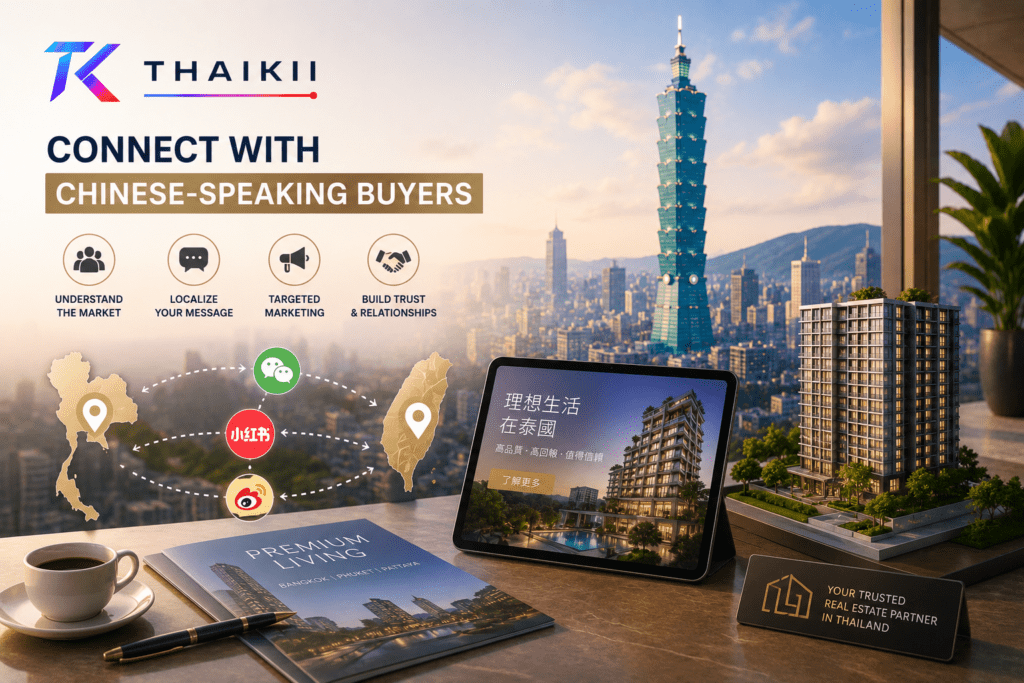
For Thai real estate developers, Chinese-speaking buyers are no longer a single audience. A buyer from Taiwan, a buyer from Mainland China, and a Chinese-speaking investor based in Hong Kong, Singapore, or overseas may all be reading Chinese content, but their search habits, trust signals, preferred platforms, and purchase concerns can be very different.
This is why successful cross-border real estate marketing is not simply about translating a Thai or English brochure into Chinese. It requires market positioning, localized messaging, digital channel planning, content credibility, and a sales funnel that fits how Chinese-speaking buyers actually research overseas property.
Thailand remains one of the most recognizable Southeast Asian property markets for international buyers. In 2025, foreign condominium transfers in Thailand increased in unit terms, and Chinese buyers remained the largest foreign buyer group, even as total transfer value softened year over year. This shows that demand has not disappeared, but the market has become more selective. Developers now need stronger brand communication, clearer product explanation, and more precise digital marketing to convert attention into serious inquiries.
At THAIKII, our role is to help Thai brands and real estate developers communicate with Chinese-speaking markets in a way that feels local, credible, and commercially effective. For property developers, this means building a strategy that connects Thailand’s project value with the expectations of buyers in Taiwan and Greater China.
Why Chinese-Speaking Buyers Still Matter for Thai Real Estate
Chinese-speaking buyers continue to matter because Thailand offers a combination that is difficult to find in many mature property markets: lifestyle appeal, tourism familiarity, relatively accessible entry prices, rental potential in selected locations, and strong emotional recognition among Asian buyers.
For Taiwanese buyers, Thailand is often viewed through the lens of lifestyle, retirement planning, second-home ownership, business expansion, and regional diversification. Bangkok, Phuket, Pattaya, and Chiang Mai each carry different buyer expectations. A Bangkok condominium may be evaluated for urban convenience and rental demand, while a Phuket villa or branded residence may be considered for vacation use, hospitality appeal, or long-term lifestyle planning.
For Mainland Chinese buyers, Thailand has historically been associated with overseas education, tourism, healthcare, retirement, and property diversification. However, this audience is also more sensitive to policy changes, capital movement, platform restrictions, and trust issues. They often require more detailed explanation before entering the sales conversation.
The opportunity is still there, but the old marketing approach is no longer enough. Generic messages such as “high return,” “good location,” or “luxury project” are not persuasive by themselves. Buyers want to know who the developer is, why the location matters, how the project compares with alternatives, what the ownership structure looks like, and whether the information is reliable.
Start with Buyer Segmentation, Not Translation
Many Thai developers begin with the assumption that Chinese marketing means creating a Chinese-language landing page. That is only the first step. The more important task is to define which Chinese-speaking buyer group the project is trying to reach.
A Taiwan-based buyer may respond better to detailed articles, Facebook content, LINE communication, YouTube videos, and seminar-style education. Taiwan has a very mature digital environment: DataReportal reported that Taiwan had 22.3 million internet users at the end of 2025, with internet penetration reaching 96.7%, and 18.1 million social media user identities in October 2025. This means Taiwanese buyers are highly reachable online, but they are also used to comparing information across multiple sources before making decisions.
Mainland Chinese buyers may require a different channel mix, including WeChat ecosystem content, Chinese search visibility, short video platforms, private community management, and possibly platform-specific content formats. However, developers must also be careful about compliance, platform limitations, and message control when targeting different Chinese-speaking markets.
A Hong Kong or Singapore Chinese-speaking buyer may have a more international investment mindset. They may care more about legal structure, project yield, exit liquidity, branded management, and developer reputation.
This is why a serious marketing plan should not begin with language. It should begin with buyer intent.
The key questions are simple but important: Is this project for lifestyle buyers, rental-focused buyers, second-home buyers, retirement buyers, or regional asset allocation buyers? Is the main conversion goal a site visit, a private consultation, a webinar registration, or a qualified sales lead? Once the buyer type is clear, the Chinese-language strategy becomes much more powerful.
Build Trust Before Asking for Leads
Real estate is a high-consideration product. Chinese-speaking buyers rarely submit an inquiry only because they see a beautiful building image. They need trust before they share contact information.
For Thai developers, trust can be built through three layers.
The first layer is developer credibility. Buyers want to know the company history, completed projects, delivery record, construction quality, management capability, and whether the developer has experience serving foreign buyers. A strong “About the Developer” page in Chinese can often be more important than a promotional landing page.
The second layer is location education. Many foreign buyers may know Bangkok or Phuket as travel destinations, but they may not understand the difference between specific districts, transit lines, future infrastructure, rental demand, and neighborhood lifestyle. Developers should not assume that overseas buyers already understand the local market. Clear location storytelling can make the project easier to evaluate.
The third layer is process transparency. Buyers need to understand foreign ownership rules, reservation process, payment schedule, contract flow, property management, rental management, tax considerations, and after-sales service. The goal is not to overwhelm buyers with legal details, but to reduce uncertainty. In overseas property marketing, uncertainty is often the biggest reason a lead does not move forward.
This is where localized content becomes commercially valuable. A well-written Chinese article about “How Taiwanese Buyers Evaluate Bangkok Condominiums” or “What Foreign Buyers Should Know Before Buying Property in Phuket” can generate more trust than a direct sales advertisement.
Use SEO to Capture High-Intent Buyers
Search behavior is one of the most valuable signals in real estate marketing. A person searching for “Thailand property for Taiwanese buyers,” “Bangkok condo for foreign buyers,” or “Phuket villa investment guide” is already showing intent. They may not be ready to buy immediately, but they are actively researching.
For Thai developers, SEO should not only target broad keywords such as “Thailand property” or “Bangkok condo.” Those keywords are competitive and often too general. A more practical strategy is to build topic clusters around buyer questions.
For example, a developer targeting Taiwanese buyers could create English and Traditional Chinese content around topics such as:
- “Can foreigners buy property in Thailand?”
- “Bangkok condo buying guide for Taiwanese buyers”
- “Phuket property market for overseas lifestyle buyers”
- “Thailand property taxes and ownership process”
- “Bangkok vs Phuket: which location fits overseas buyers?”
However, the content should not become a thin keyword article. Chinese-speaking buyers are increasingly cautious. They can quickly identify generic AI-style content, duplicated sales copy, or exaggerated claims. Good SEO content should combine search intent, market explanation, buyer concerns, and practical next steps.
At THAIKII, we view SEO not just as traffic generation, but as a trust-building system. The goal is to help Thai developers become searchable, understandable, and credible in Chinese-speaking markets.
Localize the Message for Taiwan and China Separately
One of the most common mistakes in cross-border real estate marketing is treating all Chinese content as the same. Traditional Chinese and Simplified Chinese are not only different writing systems. They often reflect different media habits, vocabulary, emotional tone, and trust expectations.
For Taiwan, the content should usually use Traditional Chinese, Taiwan-friendly terms, clear article structure, and a tone that feels informative rather than overly aggressive. Taiwanese buyers often respond well to educational content, comparison-based articles, Facebook posts, LINE consultation flows, and seminar-style communication. They may appreciate a more rational explanation of lifestyle value, city development, ownership process, and long-term holding logic.
For Mainland China, content may need to fit the platform environment more carefully. The language may be more direct, and the buyer journey may rely more on closed-loop communication inside specific platforms. Developers should also consider how content is distributed, what claims are acceptable, and how to manage inquiries across different regulatory and platform conditions.
There are also platform risks to consider. For example, Taiwan announced a one-year suspension of Xiaohongshu access in late 2025 over fraud and security concerns, which reminds marketers that platform strategy cannot rely on one channel alone.
A resilient strategy should include owned media, search content, social media, community touchpoints, and direct lead management. Developers should not build their Chinese-speaking buyer strategy entirely on one app or one advertising channel.
Social Media Should Educate, Not Only Promote
Real estate social media often fails because it only repeats project features: location, price, facilities, unit size, and campaign offers. These details are important, but they are not enough to build buyer confidence.
For Chinese-speaking audiences, social media should help buyers understand the project in context. A strong content plan might include neighborhood explanations, buyer Q&A, short videos introducing project lifestyle, interviews with sales consultants, construction updates, local area guides, and comparison content.
A Bangkok project, for example, can be introduced through daily life: commuting routes, nearby malls, schools, hospitals, restaurants, office districts, and rental demand. A Phuket project can be explained through tourism flow, villa management, lifestyle use, sea-view positioning, and hospitality services.
The most effective content is often not “Buy this project now.” It is “Here is why this location matters, how buyers should evaluate it, and what makes this project different.”
This approach is especially important for developers targeting Taiwan. Taiwanese audiences are very familiar with Facebook, Instagram, YouTube, LINE, and search-based research. They often need repeated exposure before they move from awareness to inquiry. A developer that only runs short-term ads may generate traffic, but not enough trust.
Create a Lead Funnel That Matches the Buyer Journey
A real estate lead funnel should not stop at collecting names and phone numbers. For cross-border buyers, the funnel must guide people from curiosity to confidence.
The first stage is awareness. Buyers discover the project through SEO articles, social media posts, short videos, advertisements, media exposure, or referral content.
The second stage is education. Buyers read guides, compare districts, understand the ownership process, and evaluate whether Thailand fits their goals.
The third stage is qualification. The marketing team identifies whether the buyer is looking for lifestyle use, rental income, long-term holding, relocation, retirement planning, or business-related needs.
The fourth stage is consultation. This may happen through LINE, email, WeChat, video call, online seminar, or private meeting.
The final stage is conversion support. Buyers may need site visit planning, document explanation, payment schedule clarification, and after-sales communication.
For developers, the biggest opportunity is to design content for every stage. A project landing page alone cannot handle the entire buyer journey. A high-performing funnel needs articles, videos, downloadable guides, automated follow-up messages, retargeting ads, and human consultation.
This is where a localized marketing partner becomes valuable. THAIKII can help developers connect content planning, Chinese copywriting, digital advertising, landing pages, social media operations, and lead nurturing into one coherent system.
Use Seminars and Private Events to Increase Serious Inquiries
For high-value property products, online marketing should often lead to a more personal experience. Chinese-speaking buyers may browse online, but many still prefer to ask questions directly before making a decision.
Online webinars, private consultation sessions, Taiwan roadshows, and small-scale buyer events can help developers turn digital interest into serious conversations. The format does not always need to be large. In many cases, a small event with the right audience can produce higher-quality leads than a broad advertising campaign.
For Taiwan, seminar-style education can work especially well when the topic is positioned around buyer questions rather than pure project promotion. Instead of using a title like “Thailand Property Sales Event,” a more effective angle may be “How Taiwanese Buyers Should Evaluate Bangkok and Phuket Property in 2026.” This creates a more educational entry point and reduces resistance.
The same logic applies to China-facing communication. Buyers are more likely to engage when the content helps them understand the market, not just when it asks them to purchase.
Highlight Thailand’s Lifestyle Value with Practical Detail
Thailand’s real estate advantage is not only price. For Chinese-speaking buyers, the emotional appeal of Thailand is closely connected to lifestyle.
Buyers may be attracted by warm weather, hospitality, tourism, medical services, international schools, retirement lifestyle, food culture, beach destinations, and the convenience of regional travel. However, lifestyle marketing must be specific to be convincing.
A vague statement like “Thailand is a great place to live” is not enough. A stronger message explains what kind of lifestyle the project supports. Is it for urban professionals who want a Bangkok base? Is it for families considering international education? Is it for retirees who want healthcare access and a slower pace? Is it for entrepreneurs who travel between Thailand, Taiwan, China, and Southeast Asia?
When developers clarify the lifestyle scenario, the project becomes easier to remember. Buyers do not only compare unit size. They imagine how the property fits into their future life.
Why Thai Developers Need a Cross-Border Marketing Partner
Thai developers often have strong local market knowledge, beautiful projects, and professional sales teams. However, entering Chinese-speaking markets requires more than project strength. It requires cultural translation, content localization, platform strategy, buyer psychology, and long-term trust building.
A cross-border marketing partner helps developers avoid three common problems.
The first problem is direct translation. A Chinese page that simply translates Thai or English sales copy may be grammatically correct but commercially weak.
The second problem is fragmented marketing. A developer may run ads, post on social media, and create a landing page, but if these elements do not connect into one buyer journey, leads may be wasted.
The third problem is weak follow-up. Chinese-speaking buyers often need repeated communication. Without localized nurture content and proper lead qualification, many inquiries will go cold.
THAIKII was built to help bridge this gap. Our experience combines cross-border brand communication, Chinese-language content strategy, real estate market understanding, and digital marketing execution. We understand that property marketing is not only about visibility. It is about credibility, education, and conversion.
How THAIKII Helps Thai Real Estate Developers
THAIKII supports Thai real estate developers that want to reach Taiwan, China, and broader Chinese-speaking buyers through a structured marketing approach.
We can help developers define target buyer segments, create Traditional Chinese and Simplified Chinese content, build SEO article strategies, manage social media communication, design lead-generation landing pages, plan digital advertising campaigns, and support seminar-style market education.
More importantly, we help developers communicate in a way that Chinese-speaking buyers can understand and trust. A good project should not be hidden behind language barriers, unfamiliar sales materials, or disconnected marketing channels. With the right strategy, Thai developers can turn their existing project strengths into a clear market message for overseas buyers.
Turning Chinese-Speaking Attention into Qualified Real Estate Leads
The Chinese-speaking buyer market is still important for Thai real estate, but it is becoming more selective, more research-driven, and more trust-sensitive. Developers that rely only on translated brochures or short-term ads may struggle to stand out. Developers that invest in localized content, buyer education, platform strategy, and lead nurturing will be better positioned to attract serious inquiries.
For Thai real estate developers, the next stage of growth is not only about reaching more people. It is about reaching the right buyers with the right message, in the right language, through the right channels.
THAIKII helps Thai developers build that bridge — from Thailand’s real estate strengths to Chinese-speaking buyers who are actively looking for lifestyle, opportunity, and long-term value in Southeast Asia.
With years of cross-border marketing experience, THAIKII Marketing helps brands build meaningful connections with Chinese-speaking audiences across Taiwan, China, Hong Kong, and other key Asian markets.
From SEO strategy and social media management to Chinese website development, local offline events, and KOL collaborations, we provide flexible support based on each brand’s market goals, industry background, and target customers. Whether you are planning your first market entry or looking to strengthen your existing presence, our team can help you create a localized, practical, and results-oriented marketing approach.
Frequently Asked Questions (FAQs)
No. Translation is only one part of the strategy. Developers also need buyer segmentation, localized messaging, platform planning, trust-building content, lead nurturing, and sales follow-up designed for Chinese-speaking markets.
Educational content usually performs better than direct sales copy. Buyers respond to location guides, ownership process explanations, project comparisons, buyer Q&A, lifestyle scenarios, investment risk explanations, and developer credibility stories.
THAIKII helps Thai developers localize their brand message, create Chinese-language content, plan digital marketing funnels, and connect with Taiwan and Greater China buyers through a strategy that balances visibility, trust, and conversion.
Discover more from Thaikii 泰奇行銷
Subscribe to get the latest posts sent to your email.