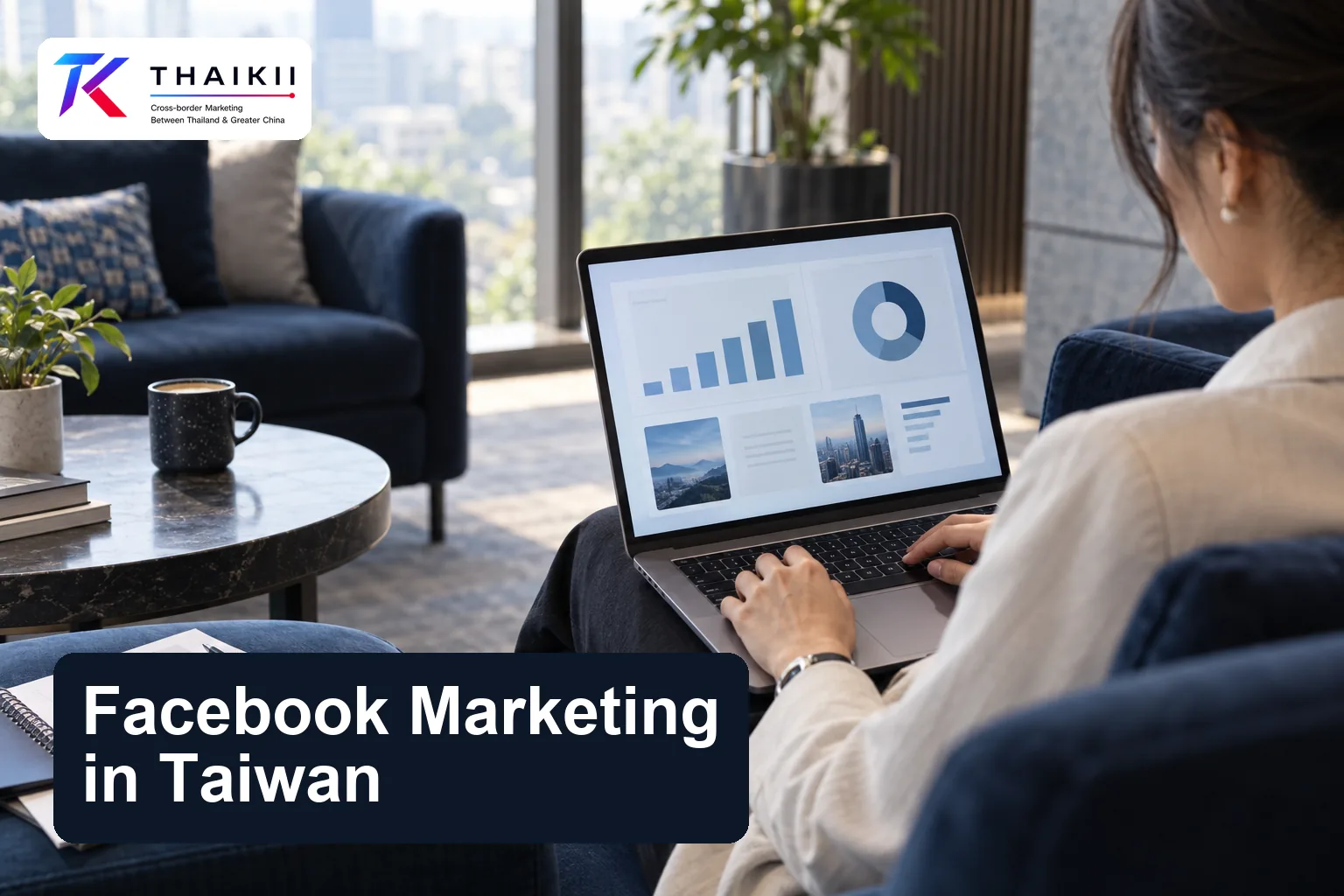
Facebook marketing in Taiwan works best when a Thai business connects relevant Traditional Chinese content with a clear next step: explore an offer, ask a practical question, or contact a team that can respond. A translated post and a larger advertising budget cannot compensate for unclear availability, unfamiliar buying terms, or a landing page that leaves the visitor uncertain.
This guide is for Thai brand owners, hotel and tourism teams, food and beverage companies, wellness businesses, and property marketing teams preparing to reach customers in Taiwan. It explains how to turn Facebook into one part of a coordinated market-entry strategy, with content, website planning, customer service, and measurement supporting the same business goal.
Start With a Taiwan-Specific Customer Decision
Begin by defining one audience and one decision, not a broad ambition to reach Chinese-speaking consumers. A Taiwanese traveler choosing a Bangkok hotel needs different reassurance from a distributor considering a Thai food brand. The traveler may want location details and booking conditions; the distributor may need product documentation, supply capacity, and a reliable commercial contact.
Write a short audience brief describing the customer's situation, questions, objections, and likely next action. Use existing inquiries, sales conversations, and feedback from local partners as evidence. If these sources are limited, label the first brief as a hypothesis and test it. Do not present assumptions about Taiwanese consumers as established facts.
Choose a business outcome before choosing content formats. For a tourism business, that might be qualified booking inquiries for a specific experience. For a manufacturer, it could be conversations with suitable distribution partners. A useful inquiry should meet agreed criteria, such as product interest, timing, service location, or buyer role, rather than simply adding to a lead count.
Taiwan should also have its own content and service plan within a broader Greater China strategy. Sharing a language does not make markets interchangeable. Treat local terminology, purchase expectations, channel choices, and support arrangements as decisions to research, not details to copy from another regional campaign.
Localize the Offer, Not Just the Facebook Caption
Useful localization answers the questions that prevent action. A hotel post should make it easy to understand where the property is, what the package includes, how to confirm availability, and which language the team can use for follow-up. A food brand should clarify where customers can actually buy the product before inviting them to purchase.
Use Traditional Chinese suitable for readers in Taiwan, with a consistent brand glossary reviewed by someone familiar with the market. Keep the Thai brand's identity where it adds meaning: ingredients, craftsmanship, hospitality, design, or a distinctive service approach. Explain unfamiliar concepts instead of replacing the brand's character with generic international marketing language.
A practical review can compare the original Thai message with the intended customer response. Does the localized version communicate the same offer? Are dates, currencies, locations, inclusions, and exclusions clear? Are captions and image text consistent with the linked page? A fluent sentence is not enough if it creates the wrong expectation.
For example, imagine a Thai wellness retreat promoting a three-day program. A localized story might explain the daily schedule, language support, room options, and how to ask about suitability. This is an illustrative planning example, not a client result or a claim that a particular campaign will succeed. The useful lesson is to make the service understandable before asking for an inquiry.
Build a Content System Around Real Questions
Create a small set of recurring content themes connected to the buying decision. One theme can explain the offer, another can show how the service works, and a third can answer common objections. This gives the team a repeatable editorial system without forcing every post into the same visual template or promotional tone.
For a Thai restaurant brand exploring Taiwan partnerships, useful topics might include the brand concept, menu adaptation considerations, operating support, and what an initial partner conversation involves. For a hotel, they might include neighborhood orientation, room selection, arrival logistics, and different trip purposes. The themes should come from the audience brief rather than a generic social calendar.
Choose formats according to what the audience needs to understand. A short video can demonstrate a space or process. A small image sequence can explain a service package. A concise written post can answer a specific question and lead to a more detailed Chinese-language page. Avoid assuming that one format will always outperform another.
Balance helpful explanations with commercial invitations. Readers should be able to tell what the business offers and how to learn more, but repeated requests to book, buy, or message can become repetitive without new information. Give each post a distinct job and one clear next step.
Customer-facing teams should contribute to the content cycle. If several people ask the same question in messages, review whether the answer belongs in a pinned explanation, a future post, or a website FAQ. With permission and appropriate privacy safeguards, aggregated inquiry themes can guide content without exposing individual customer details.
Connect Facebook to a Clear Chinese Website Journey
The destination after a click matters as much as the post. Send visitors to a page that continues the same topic, language, and offer. A specific hotel package should not lead to an unrelated corporate homepage. A partnership post should reach a page that explains the opportunity and what information the business needs to begin a conversation.
A focused Chinese landing page usually needs a clear offer, evidence the business can substantiate, practical details, common questions, and a contact route. Keep forms proportionate to the inquiry. An early-stage visitor may be willing to share an email address and a question but not complete a long commercial questionnaire.
Test the journey on a phone before promoting it. Check whether the page loads, text is readable, images support the explanation, and the contact action works. Confirm that the message sent by the visitor reaches an accountable team member. A page that looks complete internally can still fail at the handoff between marketing and service.
Chinese SEO and social content can support each other through shared customer questions. Detailed website explanations give Facebook posts useful destinations; social conversations reveal language and concerns worth addressing on the website. This does not mean Facebook engagement automatically improves search rankings. The benefit is a more coherent content system and better information for prospective customers.
Keep access and responsibilities clear. The company should retain appropriate control of its business assets while giving staff and partners only the access needed for their roles. Review who publishes content, manages inquiries, approves offers, and responds when an account or workflow problem interrupts a campaign.
Use Advertising and Creators to Test Specific Hypotheses
Paid distribution should extend a clear offer, not conceal uncertainty about it. Before a test, write down the audience hypothesis, message, destination, and desired outcome. For instance, a tourism team could compare two explanations of the same experience while keeping the destination page consistent. This makes the results easier to interpret.
Set a test budget the business can evaluate without relying on an assumed universal cost per lead. Costs and lead quality depend on the offer, audience, creative, timing, and campaign setup. Review both the marketing data and the sales team's assessment before deciding whether to expand investment.
Creator or KOL collaboration can add a useful perspective when the creator's audience and content fit the business. Start with the questions the audience needs answered, then agree on the deliverables, review process, usage permissions, and commercial disclosure expectations. Do not choose a partner only because the follower count is large.
A Thai hospitality brand, for example, may benefit from a creator who can explain a stay in a way that helps the intended traveler make a decision. A beautiful room video alone may leave important questions unanswered. Plan how the content will direct interested viewers to accurate information and a staffed inquiry route.
Review current platform options in the business's own account before launch. Available campaign settings and eligibility can change. A market-entry plan should remain useful even when an interface label changes, so document the objective and decision logic rather than relying entirely on screenshots of a particular advertising menu.
Measure Qualified Inquiries and Improve the Handoff
Define success across the whole journey: exposure to the message, visits to the relevant page, inquiries, qualified conversations, and the business outcome those conversations support. Not every stage will be directly attributable to one post. Record known limitations instead of presenting a neat but unsupported story about every customer.
Use consistent campaign links where appropriate. Google Analytics guidance on campaign URLs explains how UTM parameters identify referring campaigns and appear in acquisition reporting. A shared naming convention helps the team compare content and campaigns without splitting similar activity across inconsistent labels.
Combine those reports with a simple inquiry review. Record the source when known, the requested service, whether the inquiry matches the intended audience, who owns the reply, and its current stage. Collect only information needed for the business purpose and apply the organization's relevant privacy processes.
Assign a realistic response standard before increasing traffic. If a Chinese-language inquiry arrives but nobody can clarify the offer or arrange the next step, the campaign has an operational gap. Prepare response guidance for common questions while allowing staff to address the customer's actual situation.
During each review, choose a small number of evidence-based changes. If visitors ask about availability repeatedly, improve that explanation. If inquiries come from the wrong buyer type, revisit the message and targeting hypothesis. If qualified conversations stall after the first reply, review the offer and follow-up process before assuming more reach is the solution.
Frequently Asked Questions
Does a Thai business need a separate Facebook Page for Taiwan?
Not always. Decide based on language, audience differences, publishing capacity, and who will handle inquiries. A dedicated presence may support clearer local communication, but it also needs consistent maintenance. Establish the operating plan before creating another account or Page.
Is translating Thai posts into Chinese enough for Taiwan marketing?
Translation is only one part of the work. The offer, terminology, examples, practical details, destination page, and response process must also make sense to the intended Taiwan audience. Review the entire customer journey, not just the accuracy of individual sentences.
How much should a Thai company spend on Facebook marketing in Taiwan?
There is no reliable universal budget. Start with a defined audience, a testable offer, and an amount the team can assess against inquiry quality and commercial capacity. Include content, localization, website work, and follow-up resources, not only advertising spend.
Can Facebook replace a Chinese-language website?
Facebook can support discovery and conversation, but a website provides a controlled place for detailed explanations, service information, search-oriented content, and contact journeys. The appropriate balance depends on the business, but the two should support the same offer and customer questions.
Build a Connected Taiwan Marketing Plan With Thaikii
Thaikii helps Thai brands communicate with Chinese-speaking audiences through localized content, SEO, website planning, social media strategy, and cross-border marketing support. For Facebook activity, that means connecting the message people see with the information and service they receive afterward.
If your team is planning Taiwan market entry, contact Thaikii to discuss Chinese websites, SEO, social content, KOL collaboration, market-entry strategy, and promotion to Chinese-speaking audiences. Bring your offer, intended customer, and current inquiry process so the conversation can focus on practical priorities.