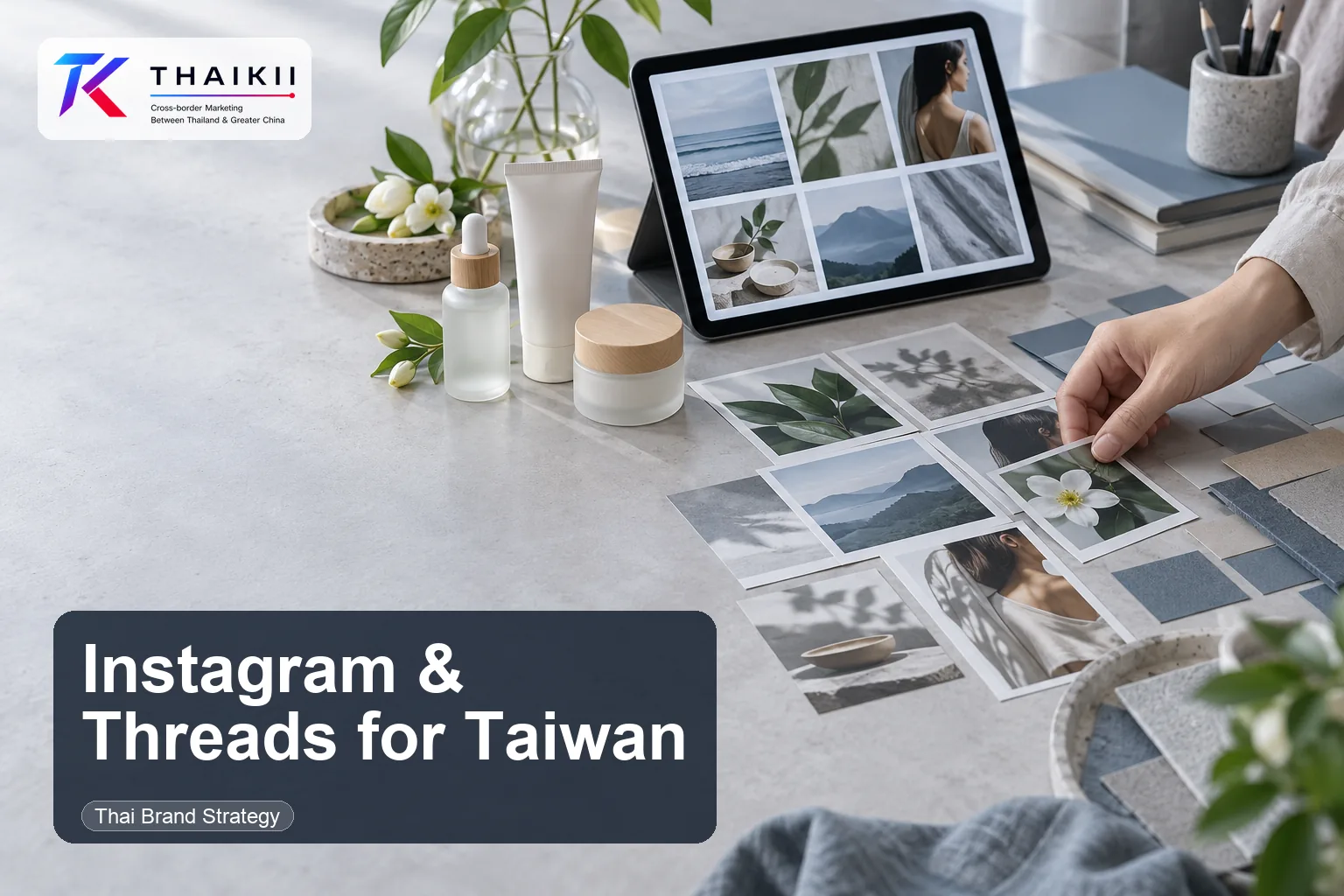
Instagram and Threads marketing works best for Thai brands targeting Taiwan when each channel has a clear purpose: use Instagram to demonstrate the experience or product, use Threads to discuss the questions behind a purchase, and connect both to useful Traditional Chinese information. Start with one audience, one offer, and a measurable next step before expanding production.
This guide is for Thai founders, marketing managers, hotels, food and beverage businesses, and consumer brands planning to reach Taiwan. It explains how to build a practical publishing and response system, choose local creative partners, and evaluate whether attention is turning into relevant inquiries.
Define the Taiwan customer and the job of each channel
“People in Taiwan” is too broad to guide a campaign. A Bangkok hotel seeking independent weekend travelers needs different content from a Thai food brand looking for Taiwan distributors. Write a short audience brief naming the buyer, purchase occasion, main hesitation, and action you want the person to take.
Choose one primary conversion for the first campaign. A hotel might measure inquiries about a specific package; a consumer brand might measure qualified visits to a Taiwan retailer page. A distributor campaign could prioritize business inquiries that include a company name and product category. Followers alone cannot distinguish those outcomes.
Give each platform a role without assuming customers move through them in a fixed order. Instagram can provide a recognizable collection of demonstrations, details, and customer experiences. Threads can support discussion, explain decisions, and reveal questions that deserve fuller answers. Either may introduce the brand or help someone already considering it.
Record what the team needs to learn. Useful hypotheses include whether customers understand the offer, whether delivery information is sufficiently clear, and whether a local creator explains a product more effectively than brand content. These are testable questions; a vague ambition to “go viral in Taiwan” is not an operating plan.
Localize the buying experience before the caption
Traditional Chinese copy should sound natural to the intended Taiwan audience and accurately reflect the offer. Work with a Taiwan editor on vocabulary, tone, subtitles, and customer service replies. Keep a small glossary of product names and approved descriptions so the website, social accounts, and sales team use consistent language.
Localization also requires checking the practical details a customer needs. State the applicable currency, purchase location, service area, booking process, and actual delivery or response expectations. A visually appealing post creates unnecessary friction if its landing page leaves readers guessing whether the product is available to them.
Use Thai identity as meaningful context. Explain a design choice, ingredient origin, hospitality practice, or founder decision when it helps someone evaluate the offer. Avoid filling every post with generic scenery or treating Thai culture as a decorative theme. Specific, verifiable details give the creative team stronger material.
Create a reusable brief with the customer's question, one supported claim, supporting visual evidence, the desired action, and any limitations. For example, a hypothetical Thai tea brand could explain flavor differences and preparation methods, then direct readers to confirmed Taiwan purchase options. It should not imply local availability before those arrangements exist.
Build Instagram content around visible proof
Plan Instagram content around questions that benefit from being shown. What does the product look like in use? What comes with a booking? How much space does an item occupy? What should a first-time customer expect? Those questions create more useful production briefs than repeatedly asking for something beautiful.
A simple content system can contain three recurring themes: product or service demonstration, decision support, and people behind the brand. A hotel could show the actual room layout, explain the distinction between two packages, and introduce the team handling guest requests. Each piece should make one point clearly.
Choose the format after deciding what needs explaining. A short video can demonstrate a sequence, while a carousel can organize a comparison or checklist. Use readable Traditional Chinese text where it helps, and make the essential message understandable without relying entirely on spoken audio. Check the finished asset on a phone before publishing.
Pair the creative with a specific next step that matches the customer's readiness. An introductory post might invite a relevant question; a detailed offer post can point toward booking information. Keep an identifiable visual style, but allow the opening frame and examples to change as the team learns which questions attract suitable prospects.
Use Threads as a conversation with a purpose
Threads content should give readers a reason to respond beyond agreeing with a slogan. Explain a tradeoff, ask a question grounded in an actual product decision, or share an observation that your team can discuss intelligently. Replies should add information, acknowledge uncertainty, and answer the person's question in context.
Meta's creator guidance emphasizes replies, original content made for Threads, and posts that encourage conversation. Treat this as platform guidance for shaping an experiment, not evidence that a particular approach will generate sales in Taiwan. The brand still needs to test audience fit and business outcomes. See Meta's Threads educational insights.
For a hypothetical boutique hotel, a useful prompt might ask which arrival detail travelers wish hotels explained more clearly. The team could share its own check-in information and use recurring questions to improve a website page. Repeatedly posting room discounts under unrelated conversations would offer little help to those readers.
Assign response coverage before raising publishing volume. Set an internal target the team can meet, identify who handles product or booking questions, and prepare an escalation route for complaints. Avoid copying personal booking details into public replies. When a question requires private information, explain how the customer can reach the appropriate service channel.
Connect social content, creators, and the website
Both social accounts should lead to an experience that continues the same promise. A Taiwan campaign landing page needs a clear offer, relevant Traditional Chinese information, a mobile-friendly layout, and an obvious next step. Send a product-specific post to the corresponding product information rather than making every visitor search the homepage.
Keep important explanations on the website as well as in social content. Stable pages about product selection, booking conditions, or service availability give customers something they can revisit and share. Social questions can help identify useful page topics, but they do not automatically establish search demand; verify search intent before building an SEO content plan.
When assessing Taiwan KOL partners, examine audience relevance, the quality of recent discussions, and the creator's ability to explain comparable products. Ask for recent audience information and a clear proposed concept. A large follower count cannot establish that the audience includes your intended customers or that a collaboration will produce inquiries.
Agree on deliverables, factual claims, usage rights, paid amplification permissions, and how the commercial relationship will be identified. Give creators room to communicate naturally while ensuring that prices, availability, and product details are accurate. Use a dedicated campaign link where practical, and review the questions generated by the collaboration alongside traffic and conversions.
Run a manageable pilot and measure useful progress
Start with a four-week learning cycle that the team can support. During preparation, confirm the audience brief, offer page, link tracking, response ownership, and reusable creative components. An illustrative starting cadence might be two Instagram posts and three Threads posts weekly, with scheduled time for replies. Adjust it to capacity; this is a planning example, not a promised growth formula.
In the first two weeks, test a small number of distinct content questions. Keep the audience and offer reasonably consistent so the results are interpretable. In the following weeks, develop the strongest themes and address repeated objections. Avoid changing the creative, landing page, offer, and targeting simultaneously if you want to understand what caused a difference.
Use platform reporting to examine distribution and interaction, then use website analytics and inquiry records to assess the next step. Meta has described Threads insights covering interactions, follower information, link visits, and discovery across its apps. Check which reporting is available in the actual account before designing a dashboard. See Meta's Threads feature and insights updates.
Keep a compact weekly scorecard with four groups: relevant audience signals, meaningful interactions, tracked website visits, and qualified outcomes. Define a qualified outcome before launch, such as a booking inquiry for an available package or a retailer request containing basic company details. This prevents the team from moving its success criteria after seeing the results.
Compare each channel against its assigned job and its own baseline. Views, visits, and people are different measures, and a small sample can change sharply after one successful post. Campaign links help identify some traffic, but customers may return later or ask through another channel. Combine analytics with a simple inquiry-source question without claiming perfect attribution.
At the end of the pilot, make a specific decision: continue a promising theme, improve a weak landing page, adjust the audience brief, or stop an offer that attracts irrelevant interest. Increase production only when the team can explain what it learned and handle the additional responses. A repeatable learning process gives expansion a firmer basis than one unusually popular post.
Frequently Asked Questions
Should a Thai brand open separate Taiwan accounts?
Consider a separate account when the Taiwan offer, language, service arrangements, or publishing needs differ substantially from the existing audience. First confirm that someone can maintain it and respond consistently. A separate account with little useful content may create more work than value; a dedicated landing page can support an initial test.
Can we use the same material on Instagram and Threads?
You can reuse the underlying research, product photography, and verified facts. Adapt the presentation to its purpose: a visual explanation on Instagram might become a focused question and supporting context on Threads. Avoid publishing identical promotional copy by default, and evaluate the responses each version receives.
Is paid advertising necessary at the beginning?
It depends on the campaign objective, available budget, and readiness of the destination page. Establish a clear offer and working measurement first. Paid activity can support a defined audience test, but it cannot resolve unclear availability, weak localization, or unanswered inquiries. Keep organic and paid results identifiable when reviewing performance.
How soon should we judge whether the strategy works?
A four-week pilot can reveal operational issues and early audience signals, but it may not establish reliable acquisition costs or long-term demand. The appropriate evaluation period depends on traffic volume and the buying cycle. Agree on an initial review date and minimum evidence requirements before committing to a larger rollout.
Build a coordinated Taiwan market entry plan
For Thai brands, the strongest social program connects the offer, language, creative work, and customer response process. Thaikii can help bring Chinese websites, SEO, social content, KOL collaboration, and market entry strategy into one plan for Chinese-speaking market promotion.
Contact Thaikii to discuss your target customers, current channels, and the questions a Taiwan pilot should answer. Bring your product or service details and existing materials so the conversation can focus on practical priorities, suitable resources, and a clear next step.