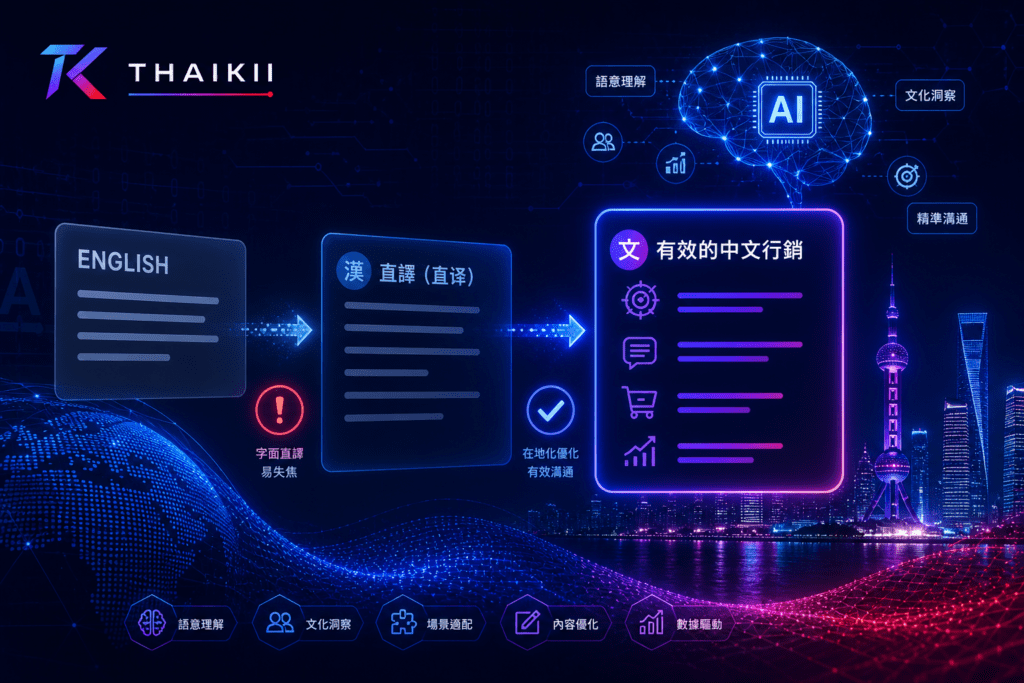
For Thai companies planning to enter Taiwan, Mainland China, or the broader Chinese-speaking market, direct translation is rarely enough. A Chinese marketing strategy needs more than accurate words. It needs cultural context, market positioning, platform logic, consumer psychology, and a localized brand story that Chinese-speaking audiences can immediately understand and trust.
Chinese marketing is the process of adapting a brand’s message, content, product value, and communication style for Chinese-speaking consumers. It is not only about translating Thai or English content into Chinese. It is about rebuilding the message so that it fits the expectations of Taiwanese and Chinese audiences.
This article is especially useful for Thai brands in lifestyle, food, beauty, tourism, hospitality, real estate, wellness, retail, education, and professional services that want to expand into Taiwan and China with a more strategic, localized, and commercially effective approach.
Direct Translation Can Explain Your Product, But It Cannot Build Market Trust
Many Thai businesses begin their Chinese marketing journey by translating their existing Thai or English website, brochure, product description, or social media content into Chinese. This is a natural first step. However, after the translation is completed, many brands quickly discover one problem: the words are readable, but the message does not sell.
The reason is simple. Translation transfers language, but marketing transfers meaning.
A Thai brand may describe itself as “premium,” “natural,” “authentic,” or “high quality,” but Chinese-speaking consumers may not respond to those words unless the message is supported by the right proof, emotional appeal, product context, and usage scenario. In Taiwan and China, consumers often want to know why a product matters, how it compares with alternatives, what lifestyle it represents, and whether the brand looks reliable enough to try.
For example, a Thai skincare brand may directly translate “made with natural Thai herbs” into Chinese. The sentence is correct, but it may not be persuasive enough. A better Chinese marketing approach would explain the origin of the ingredients, the climate and cultural background of Thailand, the specific skin concerns the product addresses, and why Thai botanical care is different from Korean, Japanese, or local beauty products.
The goal is not only to make the audience understand. The goal is to make them feel that the brand is relevant to their life.
Chinese-Speaking Markets Are Not One Single Market
Another common misunderstanding is treating all Chinese-speaking audiences as the same. Taiwan, Mainland China, Hong Kong, Malaysia, and Singapore may all use Chinese in different ways, but their consumer behavior, media habits, cultural preferences, and purchasing logic are not identical.
For Thai brands, Taiwan and Mainland China are especially important but very different markets.
Taiwanese consumers usually respond well to clear explanations, lifestyle storytelling, professional credibility, transparent pricing, and friendly brand communication. They often appreciate brands that feel trustworthy, practical, warm, and culturally refined. A successful message in Taiwan may need to explain the product carefully and connect it to daily life.
Mainland Chinese consumers, on the other hand, may react more strongly to trend-driven content, social proof, platform-native campaigns, short video storytelling, KOL influence, community commerce, and fast-moving consumer topics. The market is larger and more competitive, which means the message often needs to be sharper, more differentiated, and more platform-specific.
This is why direct translation often fails. A translated sentence may be grammatically correct in both markets, but the selling angle may not match either market’s consumer mindset.
For example, a Thai hotel brand may promote itself in English as “a peaceful escape in the heart of Bangkok.” For Taiwanese audiences, the content may work better if it emphasizes convenience, safety, travel planning, nearby food and shopping, and a refined stay experience. For Mainland Chinese audiences, the message may need stronger visual storytelling, shareable check-in value, influencer-style itinerary content, and lifestyle status appeal.
The language is only the surface. The real work is market adaptation.
Good Chinese Marketing Rebuilds the Brand Story
When Thai brands enter a Chinese-speaking market, they often already have strong local advantages: Thai hospitality, food culture, design aesthetics, wellness traditions, travel appeal, natural resources, entertainment culture, and a warm lifestyle image. However, these strengths need to be translated into a story that Chinese-speaking consumers can easily recognize.
This is where localization becomes more important than direct translation.
A direct translation may say:
“Our brand brings authentic Thai lifestyle products to international customers.”
A stronger Chinese marketing strategy may rebuild the message around a clearer positioning:
“We help consumers experience the warmth, relaxation, and refined everyday beauty of Thailand through carefully selected lifestyle products.”
The second version does not merely translate. It reframes the brand.
This matters because Chinese-speaking consumers are surrounded by choices. Whether the brand sells food, cosmetics, travel experiences, property services, wellness products, fashion, or professional solutions, the message must answer three questions quickly:
What is special about this brand?
Why should consumers trust it?
How does it fit into their lifestyle or business needs?
At THAIKII Marketing, our work focuses on helping brands move beyond word-by-word translation. We help Thai companies reshape their brand message for Chinese-speaking audiences, especially when they want to communicate with customers in Taiwan and China more effectively. Through our experience in cross-border content, Chinese-language media, SEO writing, brand positioning, and market storytelling, we understand that the most effective marketing is not always the most literal one. It is the one that makes the audience feel: “This brand understands me.”
SEO Translation Is Different from Marketing Localization
Many companies also believe that translating a website into Chinese automatically creates Chinese SEO value. In reality, SEO translation and SEO localization are very different.
A direct translation may preserve the meaning of the original article, but it may not match the keywords that Chinese-speaking users actually search for. A Thai brand may use English terms such as “wellness retreat,” “organic skincare,” “luxury villa,” or “B2B marketing service.” When translated directly into Chinese, the result may not match the search habits of Taiwanese or Chinese users.
For example, Taiwanese users may search with more practical phrases, such as:
泰國保養品推薦
泰國旅遊品牌
泰國伴手禮品牌
泰國房地產
泰國行銷公司
品牌進入台灣市場
中國市場行銷策略
Mainland Chinese users may use different keyword structures, platform terms, and commercial expressions. If a brand only translates its original content, it may miss important search opportunities.
Chinese SEO requires keyword research, article structure, search intent analysis, content depth, internal linking, title optimization, meta description writing, and a clear understanding of what users want when they type a certain phrase into Google, Baidu, Xiaohongshu, WeChat, or other platforms.
This is especially important for Thai companies because many Chinese-speaking customers may not already know the brand. Search content becomes the first point of contact. If the content is too literal, too short, too generic, or too disconnected from consumer intent, it will not build enough trust.
A strong Chinese SEO article should not only introduce the product. It should educate the market, answer common questions, compare alternatives, explain cultural value, and guide the reader toward the next step.
That is why THAIKII Marketing approaches Chinese content as a strategic asset, not just a translation task.
Platform Culture Changes the Way Your Message Should Be Written
Chinese marketing also depends heavily on platform culture. A message that works on a corporate website may not work on Facebook, Instagram, Xiaohongshu, WeChat, LINE, YouTube, TikTok, or search engines.
Each platform has a different rhythm.
A website article needs structure, credibility, search value, and long-term discoverability. A social media post needs a stronger hook, emotional tension, visual appeal, and shareability. A Xiaohongshu-style post may need a more experience-based tone. A WeChat article may require more authority and narrative depth. A short video script needs immediate attention and visual storytelling.
This means that even a well-translated message may still fail if it is placed on the wrong platform in the wrong format.
For example, a Thai restaurant group may want to promote its brand to Taiwanese consumers. A direct translation of the menu and brand story is useful, but not enough. The marketing content may also need:
A website article explaining the brand concept
A social post introducing signature dishes
A short video script showing the dining experience
A media pitch for lifestyle publications
A localized campaign for Taiwanese travelers or food lovers
The same brand message must be adapted into different formats, not simply copied across channels.
This is where cross-border marketing experience becomes valuable. A strong localization team understands not only the language, but also the communication environment. The message must fit the audience, the market, and the platform at the same time.
Thai Brands Have Strong Advantages, But They Need the Right Chinese Positioning
Thailand already has a positive image among many Chinese-speaking consumers. Thai food, tourism, hospitality, wellness culture, beauty products, entertainment, medical services, and lifestyle brands all have strong potential in Taiwan and China.
However, positive country image does not automatically become brand conversion.
Consumers may like Thailand, but they still need a reason to choose one Thai brand over another. This is where positioning becomes critical.
A Thai brand should not only say “we are from Thailand.” It should define what kind of Thai value it represents.
- Is it modern Bangkok lifestyle?
- Is it traditional Thai wellness?
- Is it premium hospitality?
- Is it creative design?
- Is it natural ingredients?
- Is it cross-border business expertise?
- Is it a more relaxed, warmer, and more human lifestyle?
The more clearly a brand defines its Thai identity, the easier it becomes to communicate with Chinese-speaking consumers.
For example, a Thai wellness brand may position itself around natural relaxation and daily balance. A Thai fashion brand may position itself around tropical elegance and urban creativity. A Thai tourism company may position itself around curated local experiences rather than generic travel packages. A Thai B2B company may position itself around regional expertise and ASEAN market knowledge.
Direct translation cannot create this positioning. It can only carry the original words. Strategic localization helps the brand discover which part of its identity should be emphasized for a new market.
Cultural Sensitivity Is a Business Advantage
Chinese-speaking markets are culturally complex. Some expressions that sound natural in Thai or English may feel too direct, too vague, too exaggerated, or too unfamiliar in Chinese. In some industries, the wrong tone can even reduce trust.
For example, luxury consumers may expect refined and understated language. Younger social media users may prefer a more personal and experience-based tone. B2B clients may expect professional clarity and proof of capability. Taiwanese audiences may dislike overly aggressive sales language, while some Mainland Chinese platforms may require stronger hooks and faster value delivery.
This is why Chinese marketing should be handled with cultural sensitivity.
Good localization considers tone, hierarchy, emotional distance, symbolic meaning, visual context, and social expectations. It also avoids common mistakes such as overusing machine-translated phrases, mixing Simplified and Traditional Chinese incorrectly, using Mainland expressions for Taiwanese audiences, or applying Taiwanese wording to Mainland campaigns without adjustment.
For Thai companies, these details may seem small, but they can influence how professional the brand appears. A customer may not consciously analyze every sentence, but they can quickly feel whether the content is natural, trustworthy, and market-ready.
In cross-border marketing, trust is built through details.
From Translation to Market Entry Strategy
The larger issue is that many companies treat translation as the final step before market entry. In reality, language should be part of the market entry strategy from the beginning.
Before entering Taiwan or China, a Thai brand should consider several strategic questions:
- Who is the target audience in this market?
- What problem does the brand solve for them?
- Which product line should be introduced first?
- What price positioning makes sense?
- Which platforms should be prioritized?
- What kind of Chinese content should be created first?
- What proof points can build trust quickly?
- How should the brand story be adjusted without losing its Thai identity?
These questions are not purely linguistic. They are marketing questions.
A direct translator may help the brand say the same thing in another language. A cross-border marketing partner helps the brand decide what should be said, how it should be said, where it should be published, and why the audience should care.
This is the gap THAIKII Marketing aims to fill.
We understand that Thai companies entering Chinese-speaking markets need more than translation support. They need a bridge between Thai brand value and Chinese consumer understanding. Our experience in Chinese-language content, SEO planning, market interpretation, and cross-border brand communication allows us to help brands create messages that are not only correct, but commercially meaningful.
What Thai Companies Should Prepare Before Chinese Marketing
Before working on Chinese marketing, Thai companies can improve the process by preparing several important materials. These do not need to be perfect, but they help the localization team understand the brand more deeply.
The most useful materials include the brand story, product information, target customer profile, existing website or brochure, social media links, product photos, customer reviews, market goals, and any previous campaign results. If the brand already has English or Thai content, that can also become a useful reference.
However, the final Chinese content should not simply copy the original version. The original content should be treated as raw material. The Chinese marketing team should then rebuild the structure, adjust the message, create SEO-friendly titles, refine the tone, and develop platform-specific content.
This process helps the brand maintain its original identity while becoming more relevant to a new audience.
For many Thai businesses, this is the difference between “having Chinese content” and “having a Chinese market strategy.”
How THAIKII Marketing Helps Thai Brands Communicate with Chinese-Speaking Audiences
THAIKII Marketing is positioned as a cross-border marketing partner between Thailand and Chinese-speaking markets. We help Thai brands communicate more effectively with audiences in Taiwan, China, and the broader Greater China region through localized content, SEO strategy, brand messaging, and market-oriented storytelling.
Our approach is practical. We do not believe that every brand needs a complicated campaign at the beginning. Many companies need a clear first step: a better Chinese website, a stronger brand introduction, localized service pages, SEO articles, social media content, or a market entry content plan.
For Thai brands that want to attract Taiwanese customers, the message should usually be clear, trustworthy, informative, and friendly. For brands looking at Mainland China, the content may need a stronger platform strategy, trend awareness, and sharper differentiation. For brands that want to serve both markets, the communication strategy should separate Traditional Chinese and Simplified Chinese content instead of treating them as the same audience.
This is where our past experience becomes important. Through long-term work across Chinese-language content, overseas market communication, SEO article planning, real estate and lifestyle-related content, and cross-border brand interpretation, THAIKII Marketing understands how to turn a foreign brand’s strengths into a message that Chinese-speaking customers can understand and respond to.
We help brands avoid the common trap of “technically correct but commercially weak” translation.
The Real Goal Is Not Translation, But Market Connection
Direct translation is useful, but it is only the beginning. For Thai brands entering Taiwan and China, the real goal is not to produce Chinese words. The real goal is to create market connection.
A good Chinese marketing strategy helps customers understand the brand faster, trust the brand more easily, and remember the brand more clearly. It respects the original Thai identity of the company while adapting the message to the expectations of Chinese-speaking consumers.
In today’s competitive market, brands cannot rely only on product quality. They also need the right story, the right keywords, the right platform strategy, and the right cultural tone.
For Thai companies that want to expand into Taiwan, Mainland China, or the broader Chinese-speaking market, the question is no longer “Can we translate this into Chinese?”
The better question is:
“Can Chinese-speaking customers understand why our brand matters?”
That is where effective Chinese marketing begins.
With years of cross-border marketing experience, THAIKII Marketing helps brands build meaningful connections with Chinese-speaking audiences across Taiwan, China, Hong Kong, and other key Asian markets.
From SEO strategy and social media management to Chinese website development, local offline events, and KOL collaborations, we provide flexible support based on each brand’s market goals, industry background, and target customers. Whether you are planning your first market entry or looking to strengthen your existing presence, our team can help you create a localized, practical, and results-oriented marketing approach.
Frequently Asked Questions (FAQs)
No. Direct translation can make the content understandable, but it usually cannot fully adapt the message to Chinese-speaking consumer behavior, search habits, platform culture, or local market expectations.
It depends on the target market. Taiwan mainly uses Traditional Chinese, while Mainland China uses Simplified Chinese. A professional Chinese marketing strategy should not mix the two without a clear reason.
SEO helps potential customers discover the brand through search. For new market entry, SEO content can build trust, answer questions, explain product value, and create long-term visibility.
Discover more from Thaikii 泰奇行銷
Subscribe to get the latest posts sent to your email.