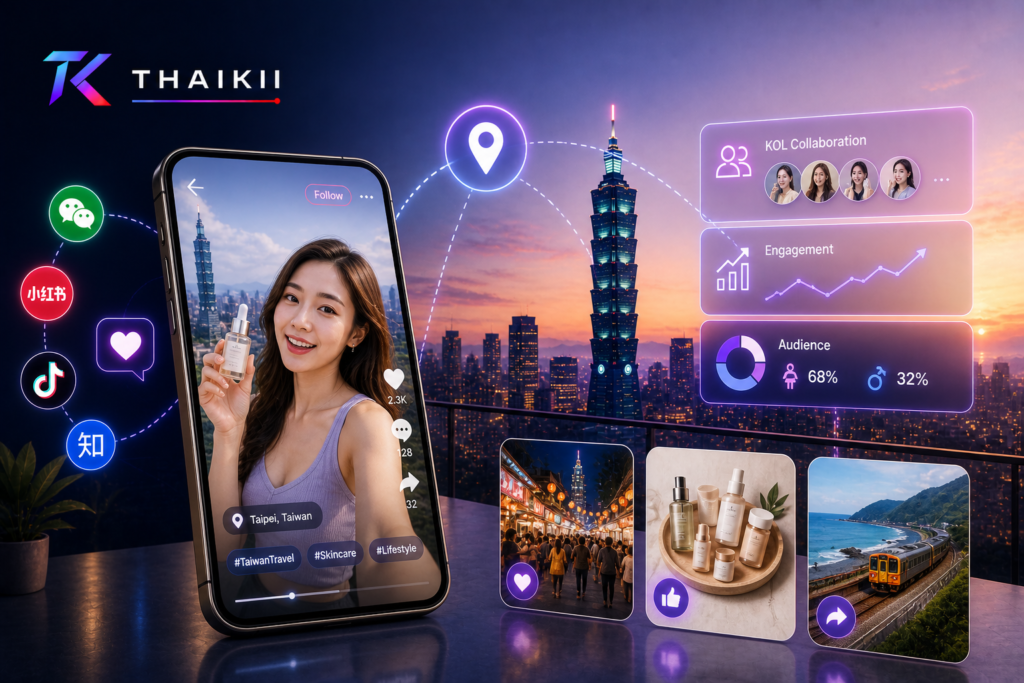
Taiwan KOL marketing is one of the most practical entry strategies for Thai brands that want to build trust, visibility, and sales momentum in a Chinese-speaking market.
For Thai brands, Taiwan KOL marketing means working with local creators, influencers, bloggers, short-form video makers, and community-based opinion leaders who can translate a brand’s value into language, lifestyle context, and consumer trust that Taiwanese audiences understand.
This strategy is especially suitable for Thai beauty brands, wellness products, food and beverage companies, hotels, travel services, real estate projects, lifestyle brands, education services, and any Thai business preparing to expand into Taiwan, Hong Kong, or the wider Chinese-speaking market.
Why Taiwan KOL Marketing Matters for Thai Brands
For many Thai businesses, Taiwan may look like a smaller market compared with China, Japan, or Southeast Asia. However, from a digital marketing perspective, Taiwan plays a very important role. It is a highly connected, trend-sensitive, Mandarin-speaking market with strong consumer purchasing power and a mature social media culture.
According to DataReportal, Taiwan had 18.4 million active social media user identities in January 2025, equivalent to 79.4% of the total population. Taiwan also had a very high level of internet and mobile connectivity, making digital channels a daily part of consumer discovery, comparison, and purchase behavior.
For Thai brands, this creates a clear opportunity. A Thai product or service may already have good quality, strong visual identity, and competitive pricing, but Taiwanese consumers often need something more before they take action: local trust.
This is where KOL marketing becomes valuable. A Taiwanese KOL can explain why a Thai brand matters, how the product fits into daily life, and why consumers should pay attention now. More importantly, the KOL can reduce the psychological distance between a foreign brand and the local buyer.
At THAIKII, our experience in cross-border Chinese-language marketing has shown that many Thai brands underestimate this step. They often prepare English materials, beautiful product photos, and basic translated Chinese copy, but they do not yet have a localized influence strategy. In Taiwan, direct translation is rarely enough. Consumers respond better when content feels natural, relevant, and connected to familiar lifestyle situations.
Taiwan Is Not Just a Translation Market
One of the most common mistakes Thai brands make is treating Taiwan as a simplified version of the Chinese market. This can lead to weak messaging, unsuitable influencer selection, and poor conversion.
Taiwan uses Traditional Chinese, not Simplified Chinese. Taiwanese consumers are also used to different wording, humor, visual tone, platform habits, and buying logic compared with consumers in mainland China. A message that works in Bangkok, Shanghai, or Hong Kong may need to be adjusted carefully before it can work in Taipei, Taichung, Kaohsiung, or other Taiwanese cities.
For example, a Thai skincare brand may want to emphasize natural ingredients, tropical freshness, and affordable luxury. In Taiwan, these ideas can work well, but the wording must feel credible. If the message sounds too exaggerated, too “hard sell,” or too similar to generic e-commerce copy, consumers may hesitate. A local KOL can help reshape the brand story into a more believable experience: how the product feels, when to use it, what skin type it suits, and why it is different from Japanese, Korean, or Taiwanese alternatives.
This is also why KOL marketing should not be treated as a one-time promotional post. For Thai brands entering Taiwan, KOL marketing should be part of a larger market entry strategy that includes Chinese content, SEO, social media operation, landing pages, review content, and conversion planning.
What Makes Taiwan KOL Marketing Different?
Taiwanese consumers tend to care about authenticity, product details, usage experience, and peer recommendations. They may enjoy creative content, but they are also cautious buyers. This is especially true in categories such as beauty, health, food, baby products, real estate, education, financial services, and travel planning.
A strong KOL campaign in Taiwan usually does not rely only on celebrity exposure. In many cases, micro-influencers, niche creators, bloggers, YouTubers, Instagram creators, and short-form video creators may create better trust than a single large celebrity account.
For Thai brands, the key is not simply asking, “Who has the biggest following?” The better question is, “Who can make Taiwanese consumers believe this brand fits their life?”
This means the right KOL should match several conditions. The creator’s audience should overlap with the brand’s target buyers. Their tone should match the brand category. Their content should feel natural rather than forced. Their followers should show real engagement. Most importantly, the creator should be able to explain the product in a way that feels local.
For example, a Thai hotel targeting Taiwanese travelers should not only ask a travel influencer to post beautiful photos. The campaign should help Taiwanese users understand transportation, room type, nearby attractions, family suitability, food options, booking method, and seasonal travel value. A Thai condo project targeting Chinese-speaking buyers should not only show a luxury swimming pool. It should explain location, lifestyle, rental demand, buyer concerns, legal process, and long-term positioning.
This is where strategic content planning matters more than simple influencer placement.
The Role of Short-Form Video in Taiwan
Short-form video has become increasingly important in Taiwan’s digital environment. Recent industry discussions point to short-form video as one of the defining formats in Taiwan’s 2026 social media landscape, especially among younger and mobile-first users.
For Thai brands, this trend is important because Thai products and services are often visually strong. Food, hotels, spas, skincare, fashion, tourism, real estate, and lifestyle products can all benefit from video-first storytelling.
However, short-form video in Taiwan should not be treated only as entertainment. It can also serve as a discovery tool, a trust-building tool, and a conversion bridge. A 30-second video may introduce the product, but the viewer may still search Google, visit the website, read reviews, compare prices, or check social proof before making a decision.
That is why THAIKII usually recommends combining KOL video content with Chinese-language SEO and landing page strategy. The KOL creates awareness and emotional interest, while the website and search content support deeper research and conversion. When these two parts work together, Thai brands can avoid wasting traffic from influencer campaigns.
Choosing the Right KOL for a Thai Brand
Before selecting a KOL in Taiwan, Thai brands should first define the purpose of the campaign. Is the goal brand awareness, product education, lead generation, store traffic, e-commerce sales, travel bookings, or long-term brand reputation?
Different goals require different types of creators.
A beauty brand may need skincare reviewers who can compare texture, ingredients, and skin results. A Thai restaurant or food product may need food creators with strong visual storytelling and credible taste descriptions. A hotel may need travel creators who can explain itinerary value. A real estate brand may need financial, lifestyle, or overseas property content creators who can speak to buyers with higher decision-making needs.
Follower count should not be the only decision factor. In Taiwan, a smaller creator with loyal followers may generate better comments, saved posts, private messages, and sales inquiries than a large account with low audience trust.
Thai brands should also pay attention to audience quality. Some creators may have followers from many countries, but the brand may need Taiwanese buyers specifically. Others may have strong visibility but weak conversion ability. A good KOL plan should consider audience location, content style, engagement quality, comment sentiment, past brand collaborations, and whether the creator’s image matches the brand’s long-term positioning.
Why Chinese-Language Content Must Support KOL Marketing
Many Thai companies think KOL marketing is only about paying creators to post. In reality, a good KOL campaign needs supporting content.
When Taiwanese consumers see a KOL recommending a Thai brand, they may search the brand name in Chinese. They may look for reviews, official websites, product descriptions, service details, price information, or customer experiences. If they cannot find enough Chinese-language information, the campaign may lose momentum.
This is especially important for high-consideration categories. A hotel booking may need more detail than a simple Instagram post. A property project may require trust-building articles, FAQs, legal explanations, and buyer guides. A wellness product may need clear ingredient descriptions and usage guidance. A B2B service may need case studies and localized market insights.
At THAIKII, we see KOL marketing as part of a wider Chinese digital marketing ecosystem. Influencer content can create attention, but SEO content captures search intent. Social media creates familiarity, but a Chinese website creates credibility. Event marketing creates offline trust, while online content keeps the brand discoverable after the event ends.
For Thai brands entering Taiwan and the broader Chinese-speaking market, this integrated approach is often more effective than running isolated campaigns.
Taiwan as a Gateway to Greater China Audiences
Taiwan can also serve as a testing ground for Thai brands that want to understand Chinese-speaking consumers before expanding further.
The market is open, digitally mature, and highly responsive to new lifestyle trends. Taiwanese consumers are familiar with Japanese, Korean, Southeast Asian, European, and American brands, which means Thai brands can enter the conversation if they position themselves clearly.
For example, Thai brands may compete not only on price but also on identity: tropical wellness, Thai hospitality, natural ingredients, emotional warmth, design aesthetics, tourism appeal, or lifestyle freshness. These are brand assets that many Taiwanese consumers can understand when communicated properly.
From Taiwan, a Thai brand can also refine its Chinese messaging before approaching Hong Kong, Macau, Singapore’s Chinese-speaking consumers, or selected mainland Chinese audiences. The same content cannot be copied everywhere, but Taiwan can help Thai brands understand how Mandarin-speaking consumers respond to product benefits, storytelling, visual design, and trust signals.
Common Mistakes Thai Brands Should Avoid
Thai brands entering Taiwan often make several predictable mistakes.
- The first is choosing KOLs only by follower count. This may create visibility but not necessarily trust or sales.
- The second is using direct translation instead of localization. Taiwanese consumers can quickly notice unnatural wording, especially in product descriptions, subtitles, and campaign slogans.
- The third is launching a KOL campaign without a Chinese landing page. If consumers become interested but cannot find enough information, they may not take the next step.
- The fourth is expecting one post to change the market. In Taiwan, trust often grows through repeated exposure, multiple content formats, and consistent messaging.
- The fifth is ignoring comments and community feedback. Taiwanese consumers often ask practical questions. If a brand does not respond quickly or clearly, interest may disappear.
- The sixth is using the same campaign logic for Taiwan and mainland China. These markets share Mandarin-language elements but differ in platforms, tone, regulations, consumer expectations, and cultural references.
For Thai brands, avoiding these mistakes can already improve campaign performance significantly.
How THAIKII Helps Thai Brands Build KOL Marketing in Taiwan
THAIKII is positioned to help Thai brands enter Taiwan and the wider Chinese-speaking market through localized digital marketing, Chinese content strategy, SEO, social media planning, KOL cooperation, and market communication.
Our experience is built around cross-border brand communication. We understand that Thai brands often have strong products, but they need the right language, story, media structure, and trust-building process to reach Chinese-speaking consumers.
For KOL marketing, THAIKII can help Thai brands with several important steps: market positioning, target audience definition, KOL selection, Chinese campaign messaging, content planning, post structure, landing page copy, SEO article support, social media calendar, campaign monitoring, and follow-up conversion strategy.
More importantly, we do not see Taiwan KOL marketing as a standalone transaction. We see it as part of a long-term brand entry system. A KOL post can introduce the brand, but the brand still needs content, search visibility, social proof, and a credible Chinese-language presence.
For Thai companies that want to promote products, hotels, restaurants, real estate projects, tourism services, lifestyle brands, or B2B services in Taiwan and Greater China, THAIKII can act as a bridge between Thai brand value and Chinese-speaking consumer behavior.
A Practical KOL Marketing Framework for Thai Brands
Before launching a Taiwan KOL campaign, Thai brands should prepare three layers of strategy.
The first layer is brand clarity. What does the brand want Taiwanese consumers to remember? Is it quality, design, price, experience, Thai culture, wellness, hospitality, or lifestyle value?
The second layer is content localization. What should be said in Chinese? What should be avoided? Which product benefits need more explanation? What consumer concerns must be answered before conversion?
The third layer is channel integration. Where will users go after seeing the KOL post? Is there a Chinese website? Is there a landing page? Is there a LINE contact point? Is there an e-commerce page? Is there SEO content that supports the campaign?
When these layers are connected, KOL marketing becomes more than exposure. It becomes a market entry tool.
For example, a Thai wellness brand may launch with three types of creators: one lifestyle KOL for brand awareness, one beauty or health creator for product credibility, and one micro-influencer group for authentic usage content. At the same time, the brand can publish Chinese SEO articles explaining product benefits, usage scenarios, and brand background. This gives consumers multiple reasons to trust the brand.
A Thai hotel may work with travel creators while also creating Chinese landing pages for Taiwanese travelers, including itinerary suggestions, room highlights, nearby attractions, booking instructions, and seasonal promotions. This helps transform content interest into actual booking intent.
A Thai real estate project may use KOL content to create initial visibility, but it also needs Chinese buyer guides, FAQ content, market articles, online consultation forms, and possibly offline seminars. For high-value decisions, trust must be built step by step.
Why Thai Brands Should Start Early
Taiwanese consumers are open to Thai culture, travel, food, beauty, wellness, and lifestyle experiences. However, the market is also competitive. Japanese, Korean, Taiwanese, European, and American brands are already active in many categories.
Thai brands that enter early with a serious Chinese-language strategy can build stronger positioning before the market becomes more crowded. KOL marketing can be a powerful first step, but it should be supported by long-term digital assets.
The brands that perform better are usually not the ones that only spend the most. They are the ones that understand local behavior, choose the right creators, prepare strong Chinese content, and build trust over time.
For Thai businesses, Taiwan is not only a sales destination. It is a strategic Chinese-speaking market where brand reputation, consumer insight, and digital credibility can be developed.
Building Trust Before Building Scale
Taiwan KOL marketing is not simply about finding someone famous to introduce a Thai brand. It is about translating brand value into local trust.
For Thai companies preparing to expand, the first question should not be “How many influencers should we hire?” A better question is “What kind of trust do we need to build first?”
Once that question is clear, KOL selection, Chinese content, SEO strategy, landing pages, and social media planning can work together. This is where Thai brands can move from short-term exposure to long-term market presence.
THAIKII helps Thai brands build this bridge. With experience in Chinese-language content, cross-border brand communication, Taiwan market understanding, and digital marketing strategy, we support Thai businesses that want to enter Taiwan, reach Chinese-speaking consumers, and create a stronger presence in Greater China.
For Thai brands, Taiwan can be more than a new market. It can be the first serious step toward Chinese-language brand growth.
With years of cross-border marketing experience, THAIKII Marketing helps brands build meaningful connections with Chinese-speaking audiences across Taiwan, China, Hong Kong, and other key Asian markets.
From SEO strategy and social media management to Chinese website development, local offline events, and KOL collaborations, we provide flexible support based on each brand’s market goals, industry background, and target customers. Whether you are planning your first market entry or looking to strengthen your existing presence, our team can help you create a localized, practical, and results-oriented marketing approach.
Frequently Asked Questions (FAQs)
Taiwan KOL marketing is a strategy that uses Taiwanese influencers, creators, bloggers, video makers, and opinion leaders to promote a brand through localized Chinese-language content. For Thai brands, it helps build trust with Taiwanese consumers who may not yet know the brand.
Yes. It is especially suitable for Thai beauty, wellness, food, hospitality, tourism, real estate, fashion, lifestyle, and education brands. Taiwan has a highly active social media environment, and consumers often rely on creator recommendations, reviews, and online content before making decisions.
Yes. THAIKII supports Thai brands with Chinese digital marketing, Taiwan market entry strategy, KOL marketing, SEO content, social media planning, Chinese website content, localized campaigns, and cross-border brand communication.
Discover more from Thaikii 泰奇行銷
Subscribe to get the latest posts sent to your email.