
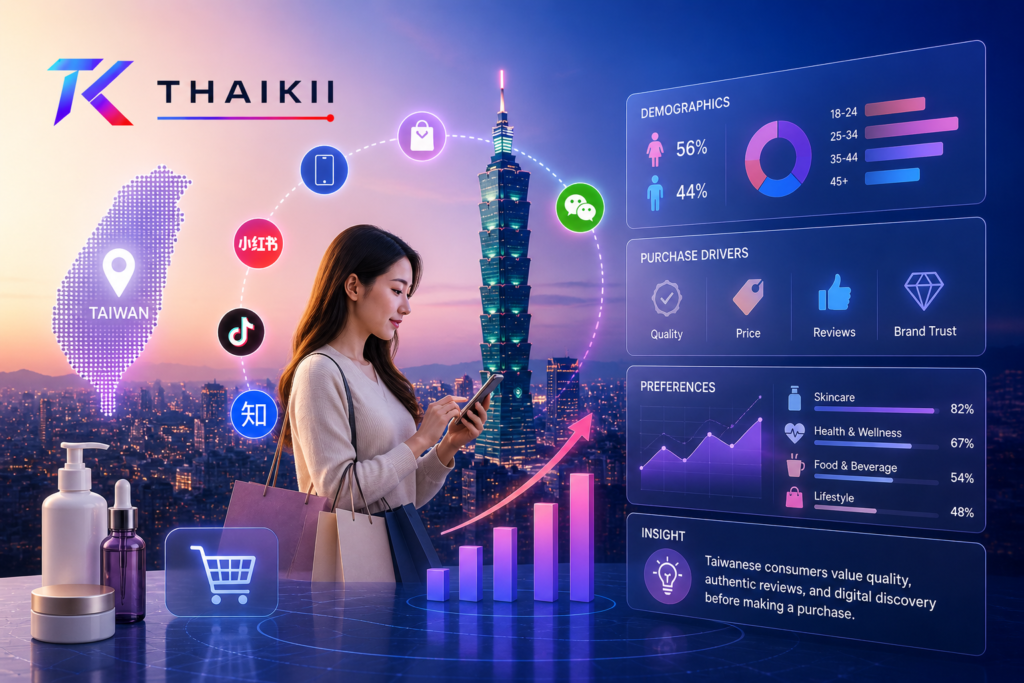
For Thai brands planning to enter Taiwan, the opportunity is real—but the market should not be treated as just another Chinese-speaking destination. Taiwan has a mature digital ecosystem, high social media usage, strong e-commerce adoption, and consumers who are quick to compare, research, and discuss brands before making purchasing decisions. In 2025, Taiwan had 18.4 million active social media user identities, equal to about 79.4% of the population, showing how deeply digital platforms shape consumer discovery and brand perception.
For Thai businesses in hospitality, real estate, food and beverage, beauty, wellness, lifestyle retail, education, and tourism, Taiwan can become a valuable gateway market into the wider Chinese-speaking world. However, successful expansion depends on more than translating Thai or English content into Mandarin. Taiwanese consumers respond to localized storytelling, transparent information, social proof, practical value, and emotional connection.
At THAIKII, our experience in Chinese-language digital marketing, Thailand-related content, and cross-border brand communication allows us to help Thai brands position themselves clearly for Taiwan and Greater China audiences. We understand both sides of the equation: how Thai businesses want to present their strengths, and how Taiwanese consumers actually search, compare, and make decisions online.
Why Taiwan Matters for Thai Brands Entering Chinese-Speaking Markets
Taiwan is often smaller in scale than China, but it is highly valuable as a testing ground for Chinese-language branding. Taiwanese consumers are digitally active, trend-sensitive, and familiar with international brands, yet they also have strong expectations for trust, service quality, and localized communication.
For Thai brands, Taiwan offers several advantages. The two markets already have strong cultural and travel connections. Taiwanese consumers are familiar with Thailand as a tourism destination, and many associate Thailand with hospitality, design, food, wellness, entertainment, lifestyle, and warm service. This creates a natural emotional entry point for Thai brands.
However, familiarity does not automatically create conversion. A Taiwanese traveler may love Bangkok, Chiang Mai, Phuket, or Thai cuisine, but still need a very different level of information before booking a hotel, buying a product, joining a service, or considering a Thai property project. The consumer journey becomes more complex once the brand moves from inspiration to transaction.
This is where Chinese digital marketing becomes essential. A Thai brand must be discoverable on Google, readable in natural Traditional Chinese, persuasive on social media, and consistent across content, landing pages, ads, search results, and customer inquiry channels.
Taiwan Consumers Research Before They Buy
One of the most important characteristics of Taiwan consumer behavior is the habit of research. Taiwanese consumers rarely rely on one message from one brand. Before making a purchase, they often compare multiple sources: Google search results, social media posts, influencer reviews, YouTube videos, forum discussions, blog articles, map reviews, official websites, and recommendations from friends.
This means a Thai brand cannot depend only on paid advertising. Ads may create the first impression, but search results and organic content often influence whether the consumer trusts the brand enough to continue.
For example, a Thai hotel that wants to attract Taiwanese travelers should not only run seasonal promotions. It should also have Chinese content explaining room types, transportation, nearby attractions, family travel suitability, food options, booking policies, and why the location is suitable for Taiwanese visitors. A Thai real estate developer should not only present beautiful renderings. It needs Chinese-language explanations of ownership structure, payment process, rental potential, neighborhood advantages, developer background, and long-term market positioning.
Taiwanese consumers often ask practical questions before emotional ones. They want to know whether the product or service is reliable, whether the price is reasonable, whether other people have tried it, and whether the brand can communicate clearly if something goes wrong. This is why Chinese SEO content is not just a traffic tool. It is a trust-building asset.
Localized Chinese Is Different from Direct Translation
Many Thai brands make the mistake of assuming that Chinese marketing simply means translating existing English or Thai materials. This approach usually fails to capture the nuances of Taiwan consumer behavior.
Taiwan uses Traditional Chinese, but localization goes beyond characters. Word choice, sentence rhythm, tone, cultural references, call-to-action style, and even the order of information can affect how professional or trustworthy a brand feels. Content that sounds too directly translated may create distance. Content that feels too promotional may reduce credibility. Content that lacks practical detail may make consumers hesitate.
For Taiwan, effective marketing often requires a more explanatory and consultative tone. Consumers want brands to help them understand the product, not only tell them it is good. This is especially important for high-consideration categories such as property, hotels, education, wellness, B2B services, medical tourism, luxury goods, and long-stay travel.
A Thai brand entering Taiwan should therefore ask:
- Does our Chinese content sound natural to Taiwanese readers?
- Does it answer the questions consumers actually search for?
- Does it explain why a Thai brand is relevant to their lifestyle or business needs?
- Does it build trust before asking for conversion?
THAIKII helps Thai brands move beyond direct translation. We restructure messages, adapt brand positioning, and create Chinese-language content that reflects how Taiwanese and Greater China audiences read, search, and compare.
Social Media Shapes Awareness, But Trust Requires Depth
Taiwan is a highly social-media-driven market. DataReportal’s 2025 Taiwan report shows that active social media user identities reached 18.4 million, demonstrating the importance of platforms in consumer attention and brand discovery.
However, social media alone is rarely enough. Taiwanese consumers may discover a Thai brand through Instagram, Facebook, YouTube, TikTok, Threads, or influencer content, but they often move to Google or the official website for deeper validation. This creates a two-layer marketing logic.
The first layer is attention. Short videos, attractive visuals, influencer posts, lifestyle photography, travel scenes, and emotional brand stories help consumers notice the brand.
The second layer is trust. SEO articles, landing pages, FAQs, case studies, comparison content, service explanations, and customer inquiry flows help consumers decide whether to take action.
Thai brands should avoid treating these two layers separately. A social media campaign without searchable content may generate short-term attention but lose serious buyers. An SEO strategy without visual storytelling may look informative but fail to create emotional appeal. The strongest approach combines both.
For example, a Thai wellness brand could use social media to show relaxing spa scenes, product rituals, and customer lifestyle moments. At the same time, it should publish Chinese SEO articles explaining ingredients, usage methods, brand story, Thai wellness culture, and differences from other wellness brands. This creates a stronger journey from curiosity to trust.
Taiwanese Consumers Value Quality, Authenticity, and Clear Service
Taiwanese consumers are open to international brands, but they are not easily convinced by vague claims. Words like “premium,” “authentic,” “luxury,” and “best quality” are not enough unless they are supported by details.
For Thai brands, this is both a challenge and an advantage. Thailand already has strong associations with hospitality, culture, food, design, and sensory experience. But to convert Taiwanese consumers, the brand must translate those strengths into clear benefits.
A Thai hotel should not only say it offers “Thai hospitality.” It should explain what that means for Taiwanese travelers: airport transfer, Chinese-speaking service, breakfast options, family-friendly room types, convenient transportation, safety, local neighborhood experience, or flexible booking support.
A Thai food brand should not only emphasize “authentic Thai flavor.” It should explain ingredients, spice level, cooking method, product origin, how Taiwanese consumers can use it at home, and whether it fits local eating habits.
A Thai condo project should not only highlight location and price. It should explain developer credibility, legal framework, payment process, rental management, target tenants, and the lifestyle value of the neighborhood.
In Taiwan, details create confidence. Brands that provide clear information often look more professional than brands that only rely on beautiful visuals.
Search Behavior Is a Major Opportunity for Thai Brands
Taiwanese consumers use search engines to solve practical problems. They search for comparisons, reviews, prices, guides, risks, recommendations, and “how to” content. This makes SEO one of the most important entry strategies for Thai brands.
For a Thai brand, Chinese-language SEO can support several business goals:
- It allows Taiwanese consumers to discover the brand before they are ready to buy.
- It helps the brand explain complex products or services.
- It creates long-term traffic beyond short-term advertising campaigns.
- It builds authority in a category before competitors dominate search results.
- It supports sales teams by answering common customer questions in advance.
This is especially important because many Thai businesses still underinvest in Chinese SEO. They may have strong products, beautiful locations, or excellent services, but their Chinese-language search presence is weak. As a result, Taiwanese consumers may never find them—or may only find fragmented information from third-party platforms.
THAIKII helps Thai brands build article strategies, landing pages, keyword structures, and content systems that match Chinese-speaking search behavior. Instead of producing isolated blog posts, we focus on creating a digital pathway from search intent to inquiry.
Taiwan Is Not the Same as China, Hong Kong, or Singapore
One important point for Thai brands is that Taiwan should not be treated as identical to other Chinese-speaking markets. While there are language overlaps, consumer expectations and platform habits differ.
Taiwanese consumers generally prefer Traditional Chinese content, local wording, clear explanation, and a tone that balances professionalism with warmth. China requires a different platform ecosystem and different regulatory considerations. Hong Kong has its own bilingual and Cantonese-influenced communication style. Singapore’s Chinese-speaking audience is multilingual and shaped by a very different social environment.
This means a single “Chinese marketing” strategy is usually not enough. Thai brands should think in layers: Taiwan strategy, China strategy, Hong Kong strategy, and broader Chinese-speaking content strategy.
Taiwan can be a practical first step because it offers a digitally mature market, strong interest in Thailand, and a useful testing environment for Chinese-language messaging. Once the brand understands which content angles, visuals, keywords, and offers work in Taiwan, it can refine the strategy for other Chinese-speaking audiences.
The Role of Influencers and Word-of-Mouth
Influencer marketing can be powerful in Taiwan, but it works best when paired with credibility. Taiwanese consumers are familiar with sponsored content, so they often look for signs of authenticity. A post that feels too commercial may get attention but not necessarily trust.
For Thai brands, the most effective influencer strategy is usually not just “hire someone with followers.” It is about choosing the right content angle. A travel creator, food reviewer, lifestyle blogger, parent-child travel influencer, real estate commentator, wellness creator, or business-focused KOL may each shape the brand differently.
The message should also match the stage of the consumer journey. If the goal is awareness, lifestyle visuals and emotional storytelling may work well. If the goal is conversion, the content should include useful details, experience-based explanations, price context, location logic, service process, and reasons to trust the brand.
THAIKII can support Thai brands by connecting influencer content with SEO and social media strategy. This helps avoid one common problem: influencer posts create short-term buzz, but the brand has no long-term content structure to capture the traffic afterward.
E-Commerce and Social Commerce Are Changing Expectations
Taiwan’s consumer market is strongly shaped by online shopping and digital payments. The U.S. International Trade Administration notes that social media increasingly influences purchasing decisions in Taiwan, and that social commerce is becoming especially important among younger consumers.
This matters for Thai brands because consumers now expect a smoother journey from discovery to purchase. They may see a product on social media, search for reviews, compare prices, check official information, ask questions through messaging apps, and then purchase through e-commerce, a distributor, a booking system, or a direct inquiry form.
For Thai brands without a physical presence in Taiwan, this digital journey becomes even more important. The website, Chinese content, customer service workflow, and inquiry response all become part of the brand experience.
A Thai brand entering Taiwan should therefore consider:
- Can consumers understand our offer within 10 seconds?
- Can they find detailed Chinese information if they want to research more?
- Can they contact us easily?
- Can they see proof, reviews, examples, or case studies?
- Can the sales or service team respond in a way that matches Taiwanese expectations?
- Expansion is not only about visibility. It is about reducing hesitation.
Why Thai Brands Need a Localized Content System
A single campaign can introduce a brand, but a content system builds market presence. For Thai brands entering Taiwan, a localized content system may include:
- Chinese SEO articles for Google search visibility
- Landing pages for specific services or products
- Social media content adapted to Taiwanese culture
- Influencer collaboration materials
- FAQ pages that answer buyer concerns
- Case studies and customer stories
- Chinese ad copy for different market segments
- Email or inquiry follow-up scripts
This system allows a Thai brand to communicate consistently. It also helps different teams work together: marketing, sales, customer service, distributors, and local partners.
For example, if a Thai hotel wants more Taiwanese guests, its Chinese content should not be limited to room promotions. It should include travel guides, seasonal recommendations, transportation tips, family travel content, couple travel content, and reasons why Taiwanese visitors should choose that hotel over other options.
If a Thai property developer wants Chinese-speaking buyers, it needs a much deeper content structure: area analysis, project explanation, buyer guide, legal notes, rental management overview, lifestyle positioning, and long-term value discussion.
This is where THAIKII’s cross-border experience becomes valuable. We understand how to turn a Thai brand’s strengths into Chinese-language content that is searchable, readable, and commercially useful.
THAIKII’s Experience in Thai-Chinese Market Communication
THAIKII is built around a clear mission: helping Thai brands communicate with Chinese-speaking markets, and helping Taiwanese brands understand Thailand. Our experience is not limited to surface-level translation. We work from market context, consumer psychology, content structure, SEO strategy, and brand positioning.
We understand that Thai brands often have strong visual identity, hospitality culture, product uniqueness, and emotional appeal. But these strengths must be translated into a language and content system that Taiwanese and Greater China audiences can trust.
Our services can support Thai businesses through:
- Chinese-language SEO strategy
- Traditional Chinese content creation
- Chinese website and landing page planning
- Social media localization
- Influencer and KOL campaign support
- Taiwan and Greater China market positioning
- Brand storytelling for Chinese-speaking consumers
- Local offline event and partnership support
For Thai companies, working with THAIKII means gaining a partner that understands both Thailand’s brand value and Taiwan’s consumer expectations. We help brands avoid generic messaging and build communication that fits the real decision-making process of Chinese-speaking customers.
What Thai Brands Should Do Before Entering Taiwan
Before launching in Taiwan, Thai brands should review their current digital presence from the consumer’s point of view. Search your brand in Chinese. Look at what Taiwanese consumers would actually see. Is the information clear? Is it localized? Does it answer practical questions? Does it make the brand look trustworthy?
Then, identify the main consumer segments. A Thai hotel may target independent travelers, couples, families, luxury guests, or corporate groups. A Thai lifestyle brand may target young women, wellness-focused consumers, design lovers, or gift buyers. A Thai real estate project may target overseas buyers, lifestyle investors, retirees, or business owners.
Each audience requires different content. The same product can be positioned differently depending on whether the consumer is seeking emotional value, practical convenience, price advantage, lifestyle upgrade, or long-term planning.
Finally, brands should build content before expecting conversion. Taiwanese consumers need time to understand unfamiliar brands. The earlier a Thai company builds Chinese SEO content and localized digital assets, the stronger its market entry foundation becomes.
Building Trust Before Expansion
Taiwan is a promising market for Thai brands, but it rewards preparation. Consumers are digitally mature, research-oriented, and responsive to brands that communicate clearly. They are open to Thai culture, travel, food, wellness, lifestyle, and hospitality, but they still expect professional information before making decisions.
For Thai brands, the key is not only to be seen. The key is to be understood, trusted, and remembered.
Chinese-language SEO, localized storytelling, social media strategy, and consumer-focused content can help Thai businesses build a stronger path into Taiwan and the wider Greater China market. With the right strategy, Thailand’s brand strengths can become highly attractive to Chinese-speaking consumers.
THAIKII helps make that connection possible.
With years of cross-border marketing experience, THAIKII Marketing helps brands build meaningful connections with Chinese-speaking audiences across Taiwan, China, Hong Kong, and other key Asian markets.
From SEO strategy and social media management to Chinese website development, local offline events, and KOL collaborations, we provide flexible support based on each brand’s market goals, industry background, and target customers. Whether you are planning your first market entry or looking to strengthen your existing presence, our team can help you create a localized, practical, and results-oriented marketing approach.
Frequently Asked Questions (FAQs)
Taiwan is a digitally mature and culturally receptive market with strong interest in Thailand. Taiwanese consumers are familiar with Thai travel, food, hospitality, wellness, and lifestyle culture, making Taiwan a practical entry point for Thai brands that want to reach Chinese-speaking consumers.
Yes. Taiwanese consumers use Traditional Chinese and are sensitive to wording, tone, and local expression. Direct translation from Thai, English, or Simplified Chinese may sound unnatural. Localized Traditional Chinese content helps build trust and improves SEO performance in Taiwan.
Hotels, real estate developers, food and beverage brands, beauty and wellness brands, lifestyle products, tourism services, education providers, entertainment businesses, and B2B companies can all benefit from Taiwan market entry if they have a clear localization strategy.
Discover more from Thaikii 泰奇行銷
Subscribe to get the latest posts sent to your email.