
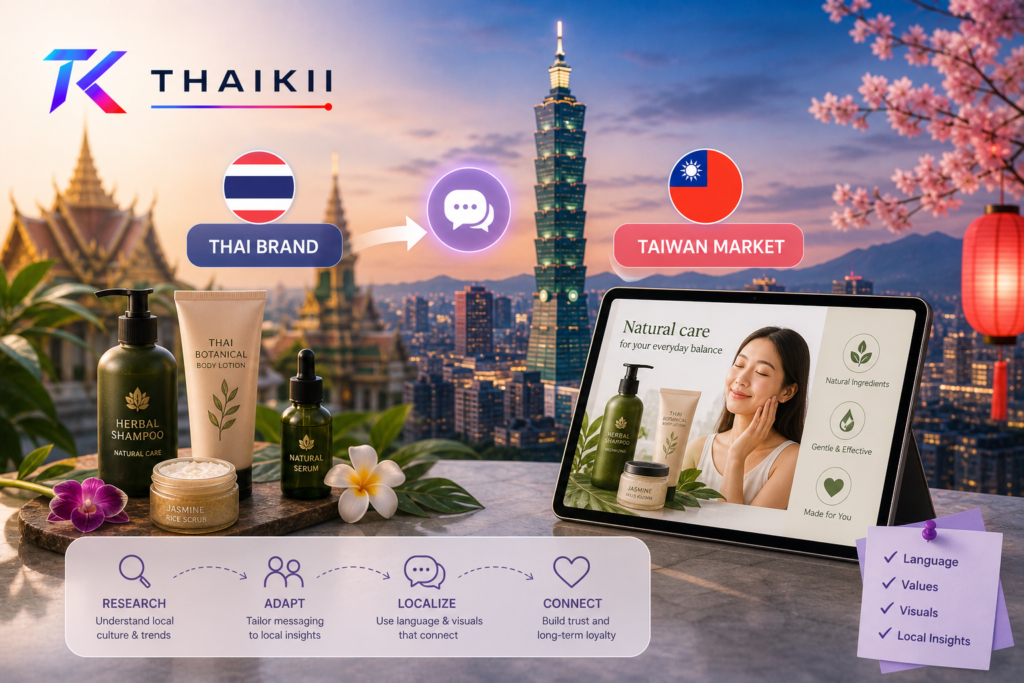
Thai brand localization for Taiwan is not just translation. It is the process of adapting a Thai brand’s message, visuals, product story, customer journey, and digital marketing strategy to match how Taiwanese consumers search, compare, trust, and make purchase decisions.
For Thai companies, Taiwan can be a high-value gateway into the Chinese-speaking market because Taiwanese consumers are familiar with Thailand, travel frequently to Thailand, and respond well to authentic Thai culture when it is presented with the right Chinese content strategy.
THAIKII helps Thai brands localize their message for Taiwan and the Greater China market through Chinese SEO content, social media strategy, brand storytelling, lead generation, and market communication built on practical experience in cross-border marketing between Thailand, Taiwan, and Chinese-speaking audiences.
Why Thai Brands Need More Than Direct Translation for Taiwan
Many Thai companies already understand that Taiwan is an attractive market. Taiwanese consumers love Thai food, Thai travel, Thai wellness, Thai lifestyle products, Thai real estate, and Thai hospitality experiences. Thailand is not a distant or unfamiliar country for Taiwanese people. It is one of the most emotionally connected Southeast Asian destinations for Taiwanese travelers and consumers.
However, this connection does not automatically become sales.
A Thai brand may have a beautiful product, a strong reputation in Bangkok, Chiang Mai, Phuket, Pattaya, or other Thai cities, but still struggle to communicate effectively in Taiwan. The reason is simple: Taiwanese consumers do not only buy based on product features. They buy based on trust, cultural comfort, practical comparison, and clear information in Traditional Chinese.
This is why Thai brand localization is a serious marketing strategy, not a simple language task. A direct translation from Thai or English into Chinese may explain what the product is, but it often fails to answer what Taiwanese customers actually care about.
A Taiwanese customer may ask:
- Is this brand reliable?
- Is this product suitable for Taiwanese preferences?
- Has anyone from Taiwan tried it before?
- Is the price reasonable compared with local alternatives?
- Can I understand the service process clearly?
- Is the brand active on the platforms I use?
- Does the message feel professional, friendly, and trustworthy?
For Thai brands entering Taiwan, the real challenge is not only to be seen. The challenge is to be understood in the right way.
What Thai Brand Localization Means in the Taiwan Market
Brand localization means adapting a brand’s message to the language, culture, decision-making habits, and digital behavior of the target market. For Taiwan, this means using Traditional Chinese, Taiwan-specific wording, local search habits, familiar consumer references, and a tone that feels natural to Taiwanese readers.
A Thai wellness brand, for example, may emphasize herbs, massage traditions, spa rituals, or natural ingredients in Thailand. These are strong selling points, but in Taiwan, the content must also explain safety, usage scenarios, quality standards, customer experience, and lifestyle value.
A Thai restaurant may be famous among locals or tourists in Bangkok, but Taiwanese travelers may search for phrases such as “Bangkok must-eat Thai restaurant,” “Thai restaurant near BTS,” “Thai food recommended by Taiwanese,” or “family-friendly restaurant in Bangkok.” If the restaurant’s online content does not match these search patterns, it may lose potential customers before they even arrive in Thailand.
A Thai real estate developer may promote location, facilities, and investment potential, but Taiwanese buyers may want more explanation about ownership structure, rental management, payment process, surrounding infrastructure, and long-term lifestyle value. Without localized Chinese content, even a strong project can feel distant or difficult to evaluate.
This is where localization becomes valuable. It transforms a Thai brand from “a foreign brand with information” into “a brand Taiwanese customers can understand, compare, and trust.”
Taiwan Is a Familiar but Selective Market for Thai Brands
Taiwanese consumers generally have a positive impression of Thailand. They associate Thailand with travel, food, hospitality, wellness, creativity, affordability, and emotional warmth. This gives Thai brands a strong starting point.
But Taiwan is also a mature consumer market. People are used to comparing brands, reading reviews, checking social media, searching on Google, browsing Facebook, Instagram, YouTube, LINE, and community platforms before making decisions. Even when they already like Thailand, they still expect brands to provide clear and professional information.
For Thai companies, this means that cultural popularity is not enough. A brand must convert positive awareness into structured trust.
In Taiwan, trust often comes from several layers of communication. The first layer is visibility: can the customer find the brand through Google or social media? The second layer is clarity: can the customer quickly understand what the brand offers? The third layer is relevance: does the message connect with the customer’s situation? The fourth layer is proof: are there reviews, stories, media mentions, case studies, or practical explanations that make the brand feel credible?
A Thai brand that localizes well can move Taiwanese customers through these layers smoothly. A brand that only translates its website may stop at the first layer and fail to build deeper confidence.
Why Traditional Chinese Content Matters
For Taiwan, Traditional Chinese is not just a writing system. It is part of local identity, digital behavior, and consumer trust. While many Taiwanese people can understand simplified Chinese, content written specifically in Traditional Chinese usually feels more professional, respectful, and market-ready.
The difference is not only visual. Taiwan has its own word choices, sentence rhythm, search habits, and marketing tone. A phrase that sounds normal in mainland China may feel too aggressive, too commercial, or slightly unnatural in Taiwan. A phrase that works in Singapore or Malaysia may also need adjustment for Taiwanese readers.
For example, Taiwanese consumers often respond better to messages that are informative, practical, and softly persuasive. They may dislike exaggerated claims or overly hard-selling language. This is especially important for sectors such as wellness, hospitality, real estate, education, lifestyle products, and B2B services.
A Thai brand should not only ask, “Is this Chinese correct?” It should ask, “Does this Chinese feel natural to a Taiwanese customer?”
That is the real standard of localization.
Adapting Your Brand Message: From Thai Strengths to Taiwanese Needs
Thai brands have many natural advantages. Thailand is known for hospitality, aesthetics, service quality, food culture, wellness traditions, tourism, and lifestyle creativity. These strengths are attractive to Taiwanese consumers, but they need to be framed through Taiwanese needs.
A Thai hotel should not only say it has beautiful rooms and good service. For Taiwanese travelers, the message may need to highlight location convenience, airport access, nearby shopping areas, family travel suitability, breakfast options, Mandarin-friendly support, and travel planning benefits.
A Thai spa or wellness brand should not only emphasize relaxation. It may need to explain how the service fits into modern stress relief, women’s lifestyle, urban wellness, post-travel recovery, or premium self-care habits.
A Thai food brand should not only promote authentic taste. It may need to describe flavor levels, ingredient quality, gift potential, cooking convenience, and how Taiwanese consumers can use the product at home.
A Thai property brand should not only promote return potential. It may need to explain lifestyle value, tourism demand, project management, foreign buyer process, long-term holding logic, and risk awareness.
Localization is not about changing the brand’s identity. It is about translating the brand’s strongest qualities into the customer’s decision-making language.
SEO Localization: How Taiwanese Customers Search for Thai Brands
SEO is one of the most important foundations of Thai brand localization for Taiwan. Many Taiwanese customers begin their decision-making process through Google. They search in Traditional Chinese, and their search intent is often practical.
For example, a Taiwanese user may not search for a brand name at the beginning. They may search for a problem, a travel plan, a product category, or a comparison.
This means Thai brands should build content around search intent, not only brand introduction. A Thai hotel should create content around travel needs. A Thai restaurant should create content around tourist dining behavior. A Thai wellness brand should create content around lifestyle and health-related interests. A Thai property company should create content around buyer education and area comparison.
The goal is to appear before the customer already knows the brand.
For Taiwan SEO, a Thai brand should consider content topics such as:
- how to choose a Thai wellness brand
- best Thai spa experience for Taiwanese travelers
- Thai restaurant recommendations for Taiwanese tourists
- Thailand real estate buying guide for Taiwanese buyers
- Thai lifestyle products popular in Taiwan
- how Thai brands can enter the Taiwan market
However, the content should not become a keyword-stuffed article. Taiwanese readers are sensitive to low-quality SEO writing. A good SEO article must provide real information, natural structure, and practical value. It should answer the question better than competitors, while also guiding readers toward the brand’s service or product.
At THAIKII, our approach is to combine SEO structure with market storytelling. We do not treat Chinese content as a direct translation project. We treat it as a market entry tool.
Social Media Localization: Speaking in the Right Tone
Taiwanese consumers use social media actively, but each platform has a different communication style. A message that works on a corporate website may not work on Facebook. A campaign that performs well on Instagram may need a different structure for LINE or Chinese-language communities.
For Thai brands, social media localization should focus on three things: emotional connection, practical clarity, and cultural familiarity.
Thai culture is already visually attractive. Food, temples, beaches, wellness spaces, hotels, street markets, design products, and lifestyle scenes all have strong content potential. But beautiful visuals alone are not enough. The caption, headline, and content angle must connect with what Taiwanese audiences care about.
For example, a Thai restaurant can use storytelling around “where Taiwanese travelers should eat after shopping in Bangkok” instead of only posting menu photos. A Thai hotel can focus on “how to plan a Bangkok weekend trip with better location convenience” instead of only showing room interiors. A Thai wellness brand can talk about “why Thai-style relaxation appeals to office workers in Taiwan” instead of only describing spa techniques.
The same product can have different marketing angles depending on the audience. Localization helps identify the angle that creates action.
Building Trust Through Taiwanese-Style Content
Trust is one of the most important factors in Taiwan. Taiwanese customers often need more than an attractive advertisement. They want context, explanation, and evidence.
For Thai brands, this means the content strategy should include more than promotional posts. It should also include educational articles, customer stories, comparison guides, frequently asked questions, brand background, founder story, service process, and practical market information.
This is especially important for higher-value industries such as real estate, hospitality partnerships, wellness services, medical tourism, education, and B2B services. When the purchase decision requires more time, the brand needs content that supports each stage of the customer journey.
A Taiwanese customer may first discover a Thai brand through a blog article, then check social media, then read reviews, then contact the brand through LINE, email, or a form. If each step feels consistent and trustworthy, the conversion rate becomes much higher.
Localization is therefore not only about the first impression. It is about the full communication journey.
Common Mistakes Thai Brands Make When Entering Taiwan
One common mistake is using English as the main communication language and assuming Taiwanese customers will understand. While many Taiwanese people can read basic English, purchase decisions are still much stronger when the information is available in natural Traditional Chinese.
Another mistake is relying only on visual branding. Thai brands often have beautiful images, but Taiwanese customers still need written explanation. They want to know prices, locations, usage methods, service flow, product details, and reasons to choose the brand.
A third mistake is using simplified Chinese or generic Chinese content without Taiwan adaptation. This can make the brand feel less localized and less serious about the Taiwanese market.
A fourth mistake is treating Taiwan and mainland China as exactly the same market. They share Chinese-language communication, but platforms, consumer tone, payment habits, content preferences, and advertising channels can be different. A strong Greater China strategy should understand both the similarities and the differences.
A fifth mistake is launching campaigns without a content foundation. Advertising can bring traffic, but if the landing page, SEO content, social proof, and Chinese messaging are weak, the campaign may not convert.
How THAIKII Helps Thai Brands Localize for Taiwan and Greater China
THAIKII was built around cross-border marketing between Thailand, Taiwan, and Chinese-speaking markets. We understand that Thai brands often have strong products and cultural appeal, but need better Chinese-language communication to reach Taiwanese and Greater China audiences.
Our experience covers Chinese content strategy, SEO writing, social media communication, brand localization, real estate and lifestyle content, tourism-related storytelling, and market-oriented digital marketing. We help Thai companies transform their existing brand value into content that Taiwanese customers can search for, understand, and trust.
For Thai brands, this support can include Chinese website content, SEO blog articles, landing pages, social media posts, brand storytelling, campaign planning, customer journey design, and lead generation strategy. The goal is not only to make the brand “look Chinese,” but to make the brand commercially understandable in Taiwan.
We also understand that different industries need different localization logic. A hotel needs traveler-focused content. A restaurant needs search-friendly tourist content. A wellness brand needs lifestyle and trust-building communication. A property developer needs education-based lead generation. A B2B service company needs authority, clarity, and strong positioning.
This is why THAIKII does not use one fixed template for every brand. We build localization around the brand’s market stage, customer profile, and growth objective.
From Taiwan to the Greater China Market
For many Thai companies, Taiwan can be a practical first step before expanding deeper into the wider Chinese-speaking market. Taiwan offers a sophisticated consumer base, strong interest in Thai culture, and a digital environment where brands can test Chinese messaging, content strategy, and customer response.
A successful Taiwan localization strategy can also provide valuable insights for future expansion into Hong Kong, Macau, Singapore, Malaysia, and mainland China. While each market requires its own adaptation, Taiwan can help Thai brands understand how Chinese-speaking customers respond to their story, product, pricing, and service model.
This is especially useful for Thai brands that want long-term regional growth. Instead of entering every market with the same message, they can build a flexible Chinese-language brand system that can be adjusted across different audiences.
THAIKII helps Thai businesses think beyond one campaign. We help brands build a communication foundation that can support long-term visibility, credibility, and market development.
What a Strong Thai Brand Localization Strategy Should Include
A complete localization strategy should begin with brand diagnosis. Before writing Chinese content, a Thai company should understand which parts of its brand are most attractive to Taiwanese customers and which parts need clearer explanation.
The next step is message adaptation. This includes headline style, product explanation, service positioning, brand story, customer benefits, and proof points.
Then comes SEO and content planning. A Thai brand should not only have a company introduction. It should create search-friendly articles that match Taiwanese customer questions and decision paths.
Social media localization should follow. The brand needs platform-specific content that feels natural, not translated. Images, captions, short videos, and campaign themes should work together.
Finally, the brand needs a conversion path. This may include a landing page, inquiry form, LINE contact, email funnel, downloadable brochure, or consultation process. Localization should lead to measurable business results.
The best localization strategy connects awareness, trust, and action.
Why Now Is the Right Time for Thai Brands to Build Chinese Content
Taiwanese interest in Thailand continues to be strong across travel, food, lifestyle, wellness, and overseas opportunities. At the same time, competition is increasing. More brands are trying to reach the same consumers through digital channels.
This means Thai companies that invest early in quality Chinese content can build a long-term advantage. SEO articles can continue attracting traffic. Social media content can build community. Localized landing pages can improve conversion. Brand stories can create emotional differentiation.
In many cases, the brand that explains itself better wins earlier than the brand with the lowest price.
For Thai businesses, localization is not only about entering Taiwan. It is about preparing for a more competitive Chinese-speaking digital environment. The earlier a brand builds its Chinese content assets, the stronger its market position can become.
Making Thai Brands Easier to Understand, Trust, and Choose
Thai brands already have strong cultural appeal. The opportunity is real. But to win in Taiwan, Thai companies need to communicate with more precision.
A good localized message should keep the Thai brand’s identity while making it easier for Taiwanese customers to understand why the brand matters. It should explain the product clearly, connect with local needs, answer practical questions, and guide customers toward action.
This is where THAIKII can support Thai companies.
We help Thai brands turn their existing strengths into Chinese-language marketing assets for Taiwan and the Greater China market. Through SEO content, social media strategy, brand localization, and lead generation, we help Thai businesses move from visibility to trust, and from trust to real customer inquiries.
For Thai companies that want to reach Taiwanese consumers, localization is not a secondary task. It is the bridge between brand potential and market growth.
With years of cross-border marketing experience, THAIKII Marketing helps brands build meaningful connections with Chinese-speaking audiences across Taiwan, China, Hong Kong, and other key Asian markets.
From SEO strategy and social media management to Chinese website development, local offline events, and KOL collaborations, we provide flexible support based on each brand’s market goals, industry background, and target customers. Whether you are planning your first market entry or looking to strengthen your existing presence, our team can help you create a localized, practical, and results-oriented marketing approach.
Frequently Asked Questions (FAQs)
Thai brand localization for Taiwan means adapting a Thai company’s message, content, visuals, customer journey, and marketing strategy for Taiwanese consumers. It includes Traditional Chinese content, Taiwan-specific wording, SEO strategy, social media communication, and culturally relevant storytelling.
Direct translation may explain the basic meaning, but it often fails to match Taiwanese consumer behavior. Taiwanese customers need clear information, local language habits, practical comparison, trust signals, and content that feels natural in Taiwan.
Yes. Taiwan can be a useful first step for Thai brands building Chinese-language marketing assets. The market can help brands test messaging, content strategy, and consumer response before expanding into other Chinese-speaking markets.
Discover more from Thaikii 泰奇行銷
Subscribe to get the latest posts sent to your email.