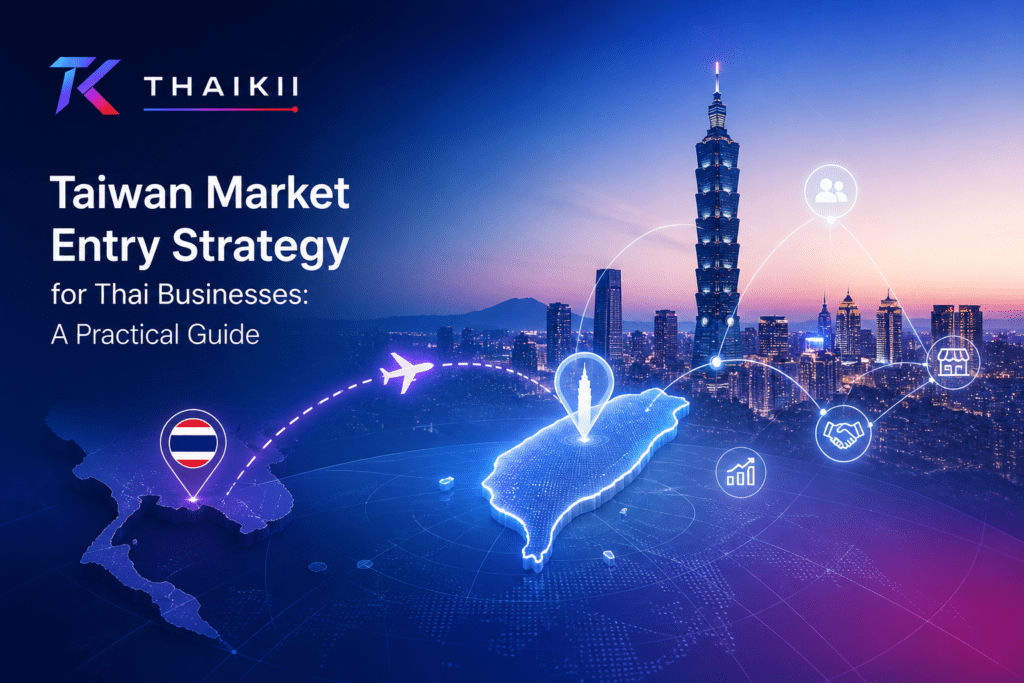
For Thai businesses looking to expand beyond Thailand, Taiwan is a highly attractive market. It is close to Southeast Asia, culturally open to international brands, and filled with consumers who value quality, trust, lifestyle, and brand reputation. For many Thai companies, Taiwan can also become a strategic first step before entering the broader Chinese-speaking market, including Mainland China, Hong Kong, and other Greater China business opportunities.
However, entering Taiwan is not simply about translating your website into Traditional Chinese or opening a social media account. A successful Taiwan market entry strategy requires localized branding, clear positioning, Chinese SEO, consumer education, platform selection, and long-term trust building.
Taiwan market entry strategy is the process of adapting a company’s brand, product, communication, and sales approach for Taiwanese consumers and business partners. It helps Thai companies move from basic awareness to real market connection.
This guide is especially useful for Thai businesses in food and beverage, tourism, hospitality, beauty, wellness, lifestyle products, real estate, education, B2B services, and creative industries that want to promote their brand to Taiwanese and Chinese-speaking customers.
Why Taiwan Is a Strategic Market for Thai Businesses
Taiwan is not the largest Chinese-speaking market, but it is one of the most valuable entry points for Thai brands. Compared with Mainland China, Taiwan is smaller, easier to understand, more transparent in many business categories, and often more suitable for testing a brand’s Chinese-language positioning.
For Thai companies, Taiwan offers several advantages. Taiwanese consumers are already familiar with Thailand through travel, food, culture, hospitality, beauty products, and lifestyle experiences. Many Taiwanese people have positive associations with Thai culture, including Thai cuisine, massage, resorts, wellness, temples, tropical design, and Bangkok’s modern lifestyle scene.
This gives Thai brands a natural starting point. However, positive country image does not automatically create sales. Taiwanese consumers may like Thailand, but they still need to understand why your specific brand is worth choosing.
That is where market entry strategy becomes important.
A Thai restaurant, skincare brand, hotel group, real estate company, wellness service, or B2B provider should not only say, “We are from Thailand.” The brand must explain what kind of Thai value it represents. Is it authentic local culture? Modern Bangkok lifestyle? Premium hospitality? Natural ingredients? Southeast Asian creativity? Professional cross-border expertise?
Taiwanese consumers respond better when the brand story is clear, practical, and trustworthy. A strong Taiwan entry strategy helps Thai businesses turn general interest in Thailand into specific interest in their brand.
Understanding Taiwanese Consumers Before Entering the Market
Taiwanese consumers are often careful, information-driven, and relationship-oriented. They may be open to new brands, but they usually need enough information before making a decision. This is especially true for mid- to high-value products, lifestyle services, professional services, real estate, travel packages, and imported products.
A common mistake is assuming that Taiwanese consumers will buy simply because a product looks exotic or foreign. In reality, Taiwanese consumers often want to know the product’s background, quality, price logic, customer reviews, safety, usage method, after-sales support, and whether the brand has local credibility.
This is why Thai businesses should prepare more than a product introduction. They need a complete communication structure.
For example, a Thai beauty brand entering Taiwan should not only introduce ingredients. It should explain the product’s function, skin type suitability, brand philosophy, ingredient origin, safety information, usage scenario, and comparison with other beauty products already familiar to Taiwanese consumers.
A Thai tourism company should not only promote beautiful destinations. It should explain who the trip is suitable for, what kind of experience is included, how transportation works, whether Mandarin support is available, and why the experience is different from regular travel packages.
A Thai B2B company should not only translate service descriptions. It should show case studies, professional capability, process clarity, and how cooperation with Taiwanese partners can reduce risk or increase business value.
Taiwanese customers do not only buy products. They buy confidence.
Traditional Chinese Content Is Not Just Translation
One of the most important steps in Taiwan market entry is building high-quality Traditional Chinese content. Taiwan uses Traditional Chinese, not Simplified Chinese. This is not only a technical difference in characters. The wording, tone, sentence structure, and marketing style are also different.
Many Thai companies start by translating English or Thai content into Chinese. While this may help audiences understand the basic meaning, it often does not create strong marketing results. The content may sound too literal, too formal, too foreign, or too disconnected from Taiwanese search behavior.
Good Traditional Chinese content should feel natural to Taiwanese readers. It should use terms that Taiwanese consumers actually use, follow local reading habits, and present information in a way that builds trust.
For example, if a Thai company wants to promote a wellness resort, a direct translation may describe it as “a luxury healing destination.” But a Taiwan-focused version may need to explain the travel experience, relaxation value, environment, service details, room type, nearby attractions, and who would benefit from staying there.
If a Thai food brand wants to enter Taiwan, the message should not only translate the product name. It should help Taiwanese consumers imagine the taste, cooking method, occasion, gift value, packaging style, and whether it fits home cooking, office snacks, family meals, or restaurant use.
In other words, Traditional Chinese content should not only describe. It should guide.
At THAIKII Marketing, we help Thai brands create Chinese-language content that is built for market communication, not just language conversion. This includes website copy, service pages, SEO articles, brand introductions, social media content, product descriptions, and campaign messaging designed for Taiwanese and broader Chinese-speaking audiences.
Building a Strong Brand Positioning for Taiwan
Before entering Taiwan, Thai businesses should clearly define their positioning. Without positioning, marketing content becomes scattered. The brand may post beautiful images, translate product details, and run ads, but the audience may still not understand what the brand stands for.
A strong Taiwan market positioning should answer several questions:
- What problem does the brand solve for Taiwanese customers?
- What makes the brand different from local and international competitors?
- Why should Taiwanese consumers trust a Thai brand in this category?
- What emotional or practical value does the brand bring?
- Which customer group should the brand target first?
For example, a Thai skincare brand can position itself around tropical botanical care, natural ingredients, and gentle daily beauty. A Thai hotel group can position itself around refined hospitality and curated travel experiences. A Thai food company can position itself around authentic Thai taste adapted for Taiwanese dining habits. A Thai real estate or business service provider can position itself around Southeast Asia market expertise and cross-border support.
The key is to avoid being too broad. “High quality Thai brand” is not enough. Taiwanese consumers need a more specific reason to remember the brand.
A clear position also helps SEO. When a brand knows its target audience, it can build content around the right search intent. Instead of writing generic articles, the brand can create content that answers real questions from Taiwanese users.
Chinese SEO: The Long-Term Foundation for Market Entry
For Thai businesses entering Taiwan, Chinese SEO is one of the most valuable long-term strategies. Paid ads may create short-term traffic, but SEO content can build long-term visibility and trust.
When Taiwanese consumers discover a new foreign brand, they often search online before making a decision. They may search for reviews, comparisons, product information, brand background, price, service process, and whether the company is reliable. If your brand has no Chinese content, or if the content is too thin, the customer may quickly move to another option.
A strong Chinese SEO strategy should include keyword research, localized titles, useful article topics, internal linking, service page optimization, FAQ sections, and content that answers practical questions.
For Thai businesses, useful Taiwan SEO topics may include:
- Thai brand recommendations
- Thai food products in Taiwan
- Thailand travel planning
- Thai wellness and spa culture
- Thai skincare products
- Thailand real estate information
- Taiwan market entry services
- Thai business expansion to Taiwan
- Chinese marketing for Thai brands
The exact keywords depend on the industry. The main point is that the content should be written based on how Taiwanese people search, not how the brand describes itself internally.
For example, a Thai company may describe itself as a “premium wellness solution provider,” but Taiwanese consumers may search for “泰國按摩品牌,” “泰國SPA推薦,” “曼谷高級飯店,” or “泰國保養品推薦.” If the website does not match these search behaviors, the brand may miss valuable traffic.
SEO also supports trust. A brand that has helpful Chinese articles, clear service pages, and professional market content appears more serious than a brand with only translated product pages.
Choosing the Right Marketing Channels in Taiwan
Taiwan’s digital landscape is diverse. Thai brands should not rely on only one channel. The right channel mix depends on the product category, target audience, budget, and market entry stage.
A corporate website is important because it acts as the brand’s official base. It should clearly explain who the company is, what it offers, why it is reliable, and how customers or business partners can contact the team. For B2B companies, service pages and case studies are especially important. For consumer brands, product pages, FAQs, and lifestyle articles can help reduce hesitation.
Social media is useful for awareness and engagement. Facebook and Instagram remain important for many Taiwanese audiences, while LINE is often used for customer communication and community management. YouTube can be valuable for deeper storytelling, especially for tourism, lifestyle, education, and professional services.
For some industries, influencer or KOL collaboration can also be effective. However, Thai businesses should choose influencers carefully. The goal is not only exposure. The right creator should be able to explain the product naturally, match the brand image, and speak to the intended audience.
Media exposure can also support credibility. A Thai brand entering Taiwan may benefit from articles, interviews, event coverage, or partnership announcements. These materials can strengthen the perception that the brand is serious about the Taiwan market.
The best channel strategy is not about being everywhere. It is about choosing the channels that match the customer journey.
Local Trust Matters More Than One-Time Exposure
Many foreign brands make the mistake of focusing only on launch exposure. They run an initial campaign, receive some attention, and then slow down content and communication. In Taiwan, this approach often leads to weak long-term results.
Taiwanese consumers usually need repeated contact before trusting a new brand. They may see the brand on social media, search for the website, read an article, check reviews, ask friends, compare competitors, and only then take action.
This means Thai businesses need a continuous content strategy.
A good Taiwan market entry plan should include launch content, educational content, product explanation, brand story, customer testimonials, seasonal campaigns, and ongoing SEO articles. This creates a stronger digital footprint and helps the brand appear more stable.
Trust can also be built through local partnerships. Depending on the industry, Thai companies may work with Taiwanese distributors, retailers, media partners, event organizers, influencers, consultants, or professional service providers. These partnerships help reduce the distance between the foreign brand and local customers.
For Thai companies that do not yet have a local office in Taiwan, strong Chinese-language communication becomes even more important. The website, articles, social media, and customer response process must work harder to build confidence.
How Taiwan Can Become a Gateway to the Greater China Market
For many Thai businesses, Taiwan can be a smart first step before entering the larger Chinese-speaking market. The Taiwan market allows brands to test Chinese messaging, understand consumer reactions, develop Traditional Chinese content, refine positioning, and build cross-border marketing experience.
However, companies should not assume that success in Taiwan automatically means success in Mainland China. The two markets are connected by language, but they differ greatly in platform ecosystem, consumer speed, commercial scale, regulatory environment, and competitive intensity.
Taiwan can help Thai brands prepare. It can serve as a learning market where the company develops Chinese-language assets, understands how Chinese-speaking customers respond, and identifies which product messages are strongest.
After that, the brand can decide how to adjust for Mainland China. Simplified Chinese content, platform-specific strategy, local partnerships, KOL marketing, e-commerce ecosystem planning, and compliance considerations may become more important.
This is why THAIKII Marketing sees Taiwan market entry not only as a local campaign, but as part of a broader Chinese-speaking market strategy. For Thai brands, the long-term opportunity may include Taiwan, China, Hong Kong, and overseas Chinese communities. But the strategy should be built step by step.
Common Mistakes Thai Businesses Should Avoid
Thai companies entering Taiwan often face similar challenges. One common mistake is relying too much on direct translation. The brand may have Chinese words, but the message does not feel local.
Another mistake is using the same content for Taiwan and Mainland China. Traditional Chinese and Simplified Chinese should be handled differently, especially when the brand wants to build credibility with Taiwanese audiences.
Some companies also focus too much on product features and not enough on customer context. Taiwanese consumers need to understand how the product fits their life, business, travel plan, or personal needs.
Another issue is starting marketing too late. If a Thai company waits until the product is ready to launch before preparing Chinese content, the timeline becomes rushed. A better approach is to prepare website structure, SEO articles, brand story, product descriptions, and social content before market launch.
Finally, some brands underestimate the importance of long-term content. A single launch campaign may bring attention, but it does not automatically build a market. Consistent Chinese content helps the brand stay visible and trustworthy.
How THAIKII Marketing Supports Thai Businesses Entering Taiwan
THAIKII Marketing helps Thai businesses enter Taiwan and Chinese-speaking markets through localized content, SEO strategy, brand communication, and cross-border marketing support. Our role is to help brands turn their Thai strengths into messages that Taiwanese and Chinese-speaking customers can understand, trust, and respond to.
We support Thai companies in several practical areas, including Chinese website content, English-to-Chinese and Thai-to-Chinese localization, SEO article planning, brand positioning, market entry content strategy, social media copywriting, service page writing, product storytelling, KOL communication concepts, and campaign messaging.
Our past experience in Chinese-language content creation, overseas market storytelling, digital marketing, lifestyle and real estate-related content, and cross-border brand communication gives us a strong understanding of how Taiwanese audiences read, search, compare, and make decisions.
We do not treat Chinese marketing as simple translation. We treat it as a bridge between the brand and the market.
For a Thai company, the original brand identity is valuable. The warmth, creativity, cultural richness, and business potential of Thailand should not be lost. But the message needs to be reshaped so that Taiwanese consumers can understand its value quickly.
That is the core of our work.
Preparing Your First Step Into Taiwan
For Thai businesses planning to enter Taiwan, the first step does not need to be overly complicated. A practical starting point may include a localized brand introduction, a Traditional Chinese website page, a small group of SEO articles, a social media content plan, and a clear contact process for Taiwanese customers or business partners.
The most important thing is to start with strategy, not only translation.
Before launching, Thai businesses should clarify their target audience, key product, brand positioning, pricing logic, market message, and first communication channel. With these foundations, Chinese content becomes much more effective.
Taiwan is a market that rewards clarity, trust, and consistency. A Thai brand that communicates with care can build strong recognition over time.
For companies that want to move further into Mainland China or other Chinese-speaking markets, Taiwan can also become an important foundation. The content, insights, and positioning developed for Taiwan can help the brand understand how to communicate with Chinese-speaking audiences more strategically.
The real opportunity is not just entering one market. It is building a cross-border brand that can speak to the Chinese-speaking world with confidence.
With years of cross-border marketing experience, THAIKII Marketing helps brands build meaningful connections with Chinese-speaking audiences across Taiwan, China, Hong Kong, and other key Asian markets.
From SEO strategy and social media management to Chinese website development, local offline events, and KOL collaborations, we provide flexible support based on each brand’s market goals, industry background, and target customers. Whether you are planning your first market entry or looking to strengthen your existing presence, our team can help you create a localized, practical, and results-oriented marketing approach.
Frequently Asked Questions (FAQs)
Taiwan is a valuable market for Thai businesses because Taiwanese consumers are familiar with Thai culture, food, travel, wellness, and lifestyle. It is also a useful first step for brands planning to reach broader Chinese-speaking audiences.
Not ideally. Taiwan and Mainland China have different platforms, consumer behavior, wording habits, and market expectations. A strong strategy should adapt the content for each market.
THAIKII Marketing helps Thai brands develop localized Chinese content, SEO strategy, website copy, brand messaging, social media content, and market entry communication for Taiwan and broader Chinese-speaking markets.
Discover more from Thaikii 泰奇行銷
Subscribe to get the latest posts sent to your email.