
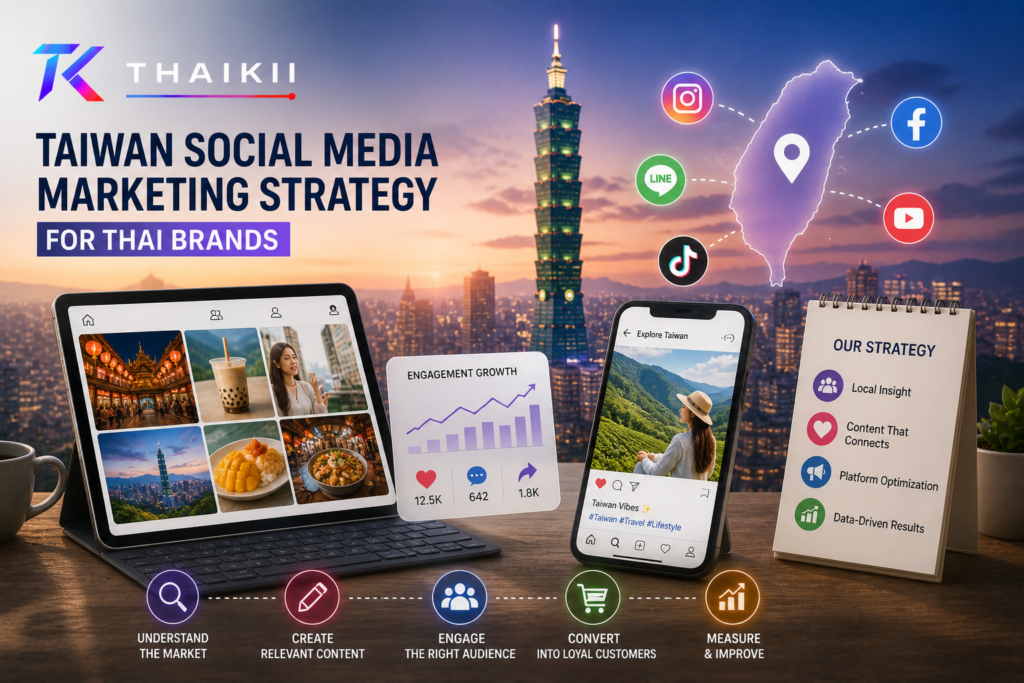
For Thai brands entering Taiwan, social media marketing is not only about posting beautiful photos or running ads. It is about building a localized communication system that helps Taiwanese customers understand your brand, trust your message, and take the next step.
Taiwanese consumers are highly active on social media. They use Facebook, Instagram, LINE, YouTube, Threads, TikTok-style short videos, blogs, forums, and search engines to discover brands and compare choices. For Thai companies in hospitality, tourism, wellness, property, food and beverage, beauty, lifestyle, and business services, Taiwan offers strong potential because Thai culture already carries positive associations among Taiwanese audiences.
However, interest in Thailand does not automatically become business results. A Thai hotel may be loved for its atmosphere, but Taiwanese travelers still need clear Chinese information before booking. A Thai property developer may have a strong project, but Taiwanese buyers need trust, location context, ownership explanations, and follow-up support. A Thai wellness or lifestyle brand may look attractive, but Taiwanese consumers still want to understand quality, usage, price, brand story, and customer experience.
This is where a Taiwan social media marketing strategy becomes essential. Thaikii Marketing helps Thai brands communicate with Taiwanese and Greater China audiences through Chinese content, localized social media planning, SEO-oriented storytelling, digital advertising, and lead-generation strategy. Based on our experience in cross-border marketing and Chinese-language content development, the key is not to copy a Thai campaign into Chinese. The key is to rebuild the message for how Taiwanese customers actually read, search, compare, and decide.
Why Social Media Matters for Thai Brands Entering Taiwan
Taiwan is a relationship-driven digital market. Consumers do not only respond to product features; they also respond to tone, credibility, story, visuals, social proof, and convenience. Social media allows Thai brands to create repeated contact points with potential customers before they make a decision.
For many Taiwanese consumers, Thailand represents relaxation, lifestyle, hospitality, food culture, travel memories, spa experiences, and warm service. These emotional associations are valuable. But a brand still needs to turn general affection into specific trust. Social media is where this trust can be built step by step.
A Taiwanese customer may first see a Thai brand on Instagram, later search for the brand in Chinese, then read an article, watch a video, check reviews, follow the Facebook page, add LINE, and finally make an inquiry. This journey may take days, weeks, or even months, especially for higher-value services such as property, premium travel, wellness programs, franchise partnerships, or business cooperation.
That means social media should not be treated as an isolated channel. It should connect with SEO, website content, landing pages, paid advertising, and lead management. When these elements work together, Thai brands can move from simple exposure to meaningful market entry.
Start with the Right Audience: Who Are You Reaching in Taiwan?
Before choosing platforms or posting content, Thai brands need to define their Taiwanese target audience clearly. “Taiwanese customers” is too broad. Different customer groups use different platforms, care about different messages, and respond to different types of content.
A Thai hotel may target independent travelers, family travelers, couples, luxury travelers, MICE groups, or wellness travelers. A Thai property company may target overseas buyers, lifestyle buyers, rental-focused buyers, high-net-worth clients, or business owners looking for regional diversification. A Thai restaurant brand may target Taiwanese tourists, food lovers, franchise partners, or local distributors. A Thai wellness company may target beauty consumers, retreat travelers, health-conscious professionals, or premium lifestyle customers.
Each audience requires a different message. Younger lifestyle consumers may respond to visual storytelling and short-form content. Professional buyers may prefer educational posts, case studies, and long-form explanations. High-consideration customers may need webinars, Chinese brochures, LINE consultation, and detailed FAQ content.
Thaikii Marketing usually begins by helping brands identify the correct audience segment and customer journey. This allows Thai brands to avoid wasting resources on generic social media activity that creates views but not real business value.
Platform Strategy: Facebook, Instagram, LINE, YouTube, and Beyond
A strong Taiwan social media marketing strategy should assign a clear role to each platform. The goal is not to use every channel at once, but to create a coordinated system.
Facebook remains useful in Taiwan for community communication, event promotion, real estate content, tourism discussion, lifestyle sharing, and older or more mature consumer groups. It is also effective for retargeting and building trust through longer captions, articles, customer stories, and event information.
Instagram is especially important for Thai brands with visual appeal. Hotels, restaurants, wellness spaces, spas, design products, fashion, beauty, lifestyle goods, and travel experiences can use Instagram to create desire and brand atmosphere. However, Instagram content should not only be beautiful. It should also communicate clear value, location, usage, customer benefits, and reasons to inquire.
LINE is one of the most important platforms for Taiwan lead management. Many Taiwanese users prefer to communicate through LINE after they become interested. For Thai brands, LINE can serve as a bridge between social media interest and actual consultation. It can support inquiry responses, campaign updates, event invitations, customer service, and retargeting.
YouTube is valuable for education and trust-building. If a Thai brand requires explanation, YouTube can be very powerful. Property developers can introduce areas and projects. Hotels can show the real guest experience. Wellness brands can explain treatments, product philosophy, or destination programs. B2B brands can use video to introduce company background and cooperation opportunities.
Threads, TikTok-style short videos, and other emerging platforms may help with awareness, especially for younger users. But they should be used carefully. Short-form content can create reach, but it may not generate qualified leads unless connected to landing pages, LINE, SEO articles, or remarketing campaigns.
Localized Chinese Content Is the Core of Social Media Success
Thai brands often have strong visual assets, but Taiwanese customers still need Chinese-language explanation. A beautiful image may catch attention, but the caption, headline, and landing page determine whether the customer understands the brand.
Localized Chinese content should not feel like machine translation. It should sound natural, clear, and relevant to Taiwanese readers. Taiwanese consumers usually prefer practical explanations, soft but professional tone, specific details, and credible comparisons. Overly direct selling language may work for some short campaigns, but it often reduces trust when the product or service requires deeper consideration.
For example, a Thai wellness brand should not only say “relax your body and mind.” It can explain the type of customer who may benefit, the difference between Thai wellness culture and ordinary spa service, how the experience fits into a short trip, and why Taiwanese travelers may want to include it in their Thailand itinerary.
A Thai property developer should not only post project photos. It should explain the location logic, nearby facilities, rental demand, management service, ownership process, and why Taiwanese buyers should pay attention to this area.
A Thai restaurant brand should not only show food photos. It can explain regional flavors, signature dishes, brand story, target customers, possible Taiwan collaboration models, and why Thai dining culture has strong potential among Taiwanese consumers.
Thaikii Marketing helps Thai brands turn their original strengths into Chinese content that Taiwanese customers can actually understand and trust.
Content Pillars for Thai Brands in Taiwan
A sustainable social media strategy needs content pillars. Without pillars, brands often post random content that looks active but does not build market position.
For Thai brands, content can usually be organized around several key directions: brand story, product or service explanation, customer experience, Thai culture, Taiwan-specific use cases, educational content, social proof, and campaign conversion.
Brand story introduces who you are and why your Thai background matters. Product explanation helps Taiwanese customers understand what you offer. Customer experience shows how people actually use or enjoy your service. Thai culture creates emotional connection. Taiwan-specific use cases make the brand feel relevant. Educational content builds authority. Social proof reduces hesitation. Campaign content drives inquiries.
A Thai hotel could combine destination guides, room highlights, Taiwanese traveler itineraries, guest stories, seasonal promotions, and cultural experiences. A Thai property developer could combine market education, project introductions, area guides, buyer FAQs, management explanations, and inquiry campaigns. A wellness brand could combine product philosophy, lifestyle education, service process, client scenarios, and retreat storytelling.
This approach gives social media a strategic role. Each post supports a larger market entry goal instead of existing only for likes.
Social Media Advertising: Build a Funnel, Not Just Traffic
Many brands make the mistake of running ads before preparing the customer journey. Paid ads can bring traffic, but they cannot solve unclear positioning, weak landing pages, poor Chinese content, or slow follow-up.
For Thai brands entering Taiwan, social media advertising should be built around a funnel. At the top of the funnel, ads introduce the brand and attract the right audience. In the middle, ads educate users through articles, videos, guides, or case studies. At the bottom, ads invite users to contact the brand, book a consultation, request details, join LINE, or register for an event.
Retargeting is especially important. A Taiwanese customer who watches a video, visits a landing page, or reads an article may not inquire immediately. Retargeting allows the brand to continue communication with people who already showed interest.
The advertising message should also match the customer’s stage. A first-time audience may need a simple introduction. A warmer audience may need proof and comparison. A high-intent audience may need a clear offer and easy contact method.
Thaikii Marketing helps Thai brands connect social media advertising with content strategy, landing pages, Chinese SEO, and lead management. This reduces the risk of spending money only to generate low-quality traffic.
Building Trust Through Social Proof and Local Context
Trust is one of the biggest challenges in cross-border marketing. Taiwanese customers may like Thailand, but they still want to know whether a brand is reliable.
Social proof can include customer reviews, media exposure, partner logos, influencer visits, user-generated content, case studies, professional photos, service process explanations, business history, and transparent contact information. For Thai brands, these proof points should be presented in Chinese and adapted to the concerns of Taiwanese customers.
Local context is also important. A Thai brand should show that it understands Taiwanese users, not just that it wants to sell to them. This can be done by creating Taiwan-specific content, answering common Taiwanese questions, explaining how the service fits Taiwanese travel habits or business needs, and providing convenient Chinese communication channels.
For example, a Thai hotel can explain why it is suitable for Taiwanese long weekends or family trips. A property brand can explain what Taiwanese buyers usually ask before viewing overseas projects. A wellness brand can explain how Taiwanese office workers may use short Thailand trips for rest and recovery. A B2B brand can explain how Thai products may be positioned for Chinese-speaking consumers.
When customers feel that the brand understands their situation, they are more likely to trust the communication.
Influencer and Creator Collaboration in Taiwan
Influencer marketing can be effective for Thai brands, but it should be planned strategically. Taiwan has many creators in travel, food, lifestyle, beauty, parenting, investment education, business, and wellness. The right creator can introduce a Thai brand to a relevant audience with a more natural voice.
However, Thai brands should not choose creators only by follower count. Audience quality, content style, credibility, engagement, platform fit, and brand alignment are more important. A niche creator with loyal followers may sometimes produce better results than a large account with general reach.
For hospitality, tourism, and lifestyle brands, visual creators and travel influencers can help communicate atmosphere. For property or B2B brands, expert-style creators, seminar hosts, or content partners may be more suitable. For food and beverage brands, restaurant reviewers, lifestyle bloggers, and short-video creators may help create awareness.
Influencer content should also be integrated into the broader marketing funnel. A creator post can drive awareness, but the brand still needs Chinese landing pages, LINE contact, retargeting ads, and follow-up content to convert interest into business opportunities.
Thaikii Marketing can support Thai brands in planning creator collaboration angles, campaign messages, content usage, and follow-up strategy for Taiwan-facing promotion.
From Social Media Interest to Actual Leads
The real value of social media marketing is not only visibility. It is whether the brand can turn attention into business conversations.
For Thai brands, lead conversion should be designed in advance. Interested Taiwanese users should have a simple next step: add LINE, fill out a form, download a guide, book a call, register for an event, request a brochure, or ask for project details. The call to action should be clear and repeated across different content formats.
Response quality matters as much as lead generation. If users ask questions in Chinese and receive slow or unclear replies, the campaign may lose momentum. Brands should prepare Chinese FAQ documents, response templates, consultation flows, and sales materials.
This is especially important for Thai property developers, hotels, wellness retreats, and B2B brands. A lead may need multiple touches before making a decision. A well-managed follow-up system can increase trust and reduce drop-off.
Thaikii Marketing’s cross-border approach focuses not only on attracting audiences, but also on helping brands build a practical pathway from content exposure to qualified inquiry.
How Thai Brands Can Measure Social Media Success in Taiwan
Success should not be measured only by likes or followers. For Taiwan market entry, brands should track metrics that connect to business goals.
Important indicators include website visits from social media, landing page conversion rate, LINE additions, inquiry volume, cost per lead, engagement quality, video watch time, content saves, message response rate, retargeting audience size, and keyword search growth.
For brand awareness campaigns, reach and engagement may matter. For lead-generation campaigns, qualified inquiries matter more. For SEO-connected social media strategy, brands should also observe whether social content helps drive branded searches and website visits.
The best strategy is to evaluate both short-term and long-term results. Paid campaigns may create immediate traffic, while content and SEO build long-term authority. Social media grows stronger when each campaign creates reusable assets: posts, videos, testimonials, articles, retargeting audiences, and customer insights.
Why Thaikii Marketing Is a Strategic Partner for Thai Brands
Thai brands entering Taiwan need more than translation. They need a partner that understands Chinese-language marketing, Taiwanese consumer behavior, cross-border branding, SEO content, social media communication, and lead-generation strategy.
Thaikii Marketing is built for this role. We help Thai brands promote themselves to Taiwan and Greater China audiences through localized digital marketing. Our experience includes cross-border content strategy, Chinese SEO article planning, international real estate marketing, lifestyle brand communication, Thai market observation, and Taiwan-facing social media structure.
We understand that Thai brands already have unique strengths. The challenge is to express those strengths in a way that Taiwanese customers can search for, understand, trust, and respond to. Whether your brand is in hospitality, tourism, property, wellness, food, lifestyle, or business services, the right Taiwan social media marketing strategy can help you build a stronger market presence.
Thaikii Marketing does not treat Taiwan as just another ad target. We treat it as a Chinese-speaking customer environment with its own culture, content rhythm, platform habits, and trust-building process.
Build a Taiwan Social Media Strategy That Supports Long-Term Growth
For Thai brands, Taiwan can be a powerful starting point for reaching Chinese-speaking customers. But success requires more than posting in Chinese or running a few ads. It requires a complete social media marketing strategy that connects brand positioning, localized content, platform selection, paid advertising, trust-building, influencer collaboration, lead management, and long-term SEO visibility.
The opportunity is clear. Taiwanese consumers already have strong interest in Thailand. They travel to Thailand, enjoy Thai food, appreciate Thai hospitality, and are open to Thai lifestyle and business experiences. But to turn this interest into measurable business growth, Thai brands need consistent, localized, and professional communication.
Thaikii Marketing helps Thai brands build that bridge. Through Chinese digital marketing and Taiwan-focused social media strategy, we support brands that want to expand beyond local recognition and create real business opportunities in Taiwan and the Greater China market.
With years of cross-border marketing experience, THAIKII Marketing helps brands build meaningful connections with Chinese-speaking audiences across Taiwan, China, Hong Kong, and other key Asian markets.
From SEO strategy and social media management to Chinese website development, local offline events, and KOL collaborations, we provide flexible support based on each brand’s market goals, industry background, and target customers. Whether you are planning your first market entry or looking to strengthen your existing presence, our team can help you create a localized, practical, and results-oriented marketing approach.
Frequently Asked Questions (FAQs)
There is no single platform that works for every brand. Facebook is useful for community communication and mature audiences, Instagram is strong for visual lifestyle brands, LINE is important for lead management, and YouTube helps build trust through deeper content. The best strategy usually combines several platforms with clear roles.
Yes. Chinese content is essential for Taiwanese customers. However, it should not be simple translation. The content should be localized for Taiwanese language habits, customer concerns, cultural context, and search behavior.
Social media ads can increase visibility and generate leads, but they work best when connected to a clear funnel. Thai brands should prepare localized content, landing pages, LINE contact, retargeting campaigns, and follow-up materials before investing heavily in ads.
Discover more from Thaikii 泰奇行銷
Subscribe to get the latest posts sent to your email.