
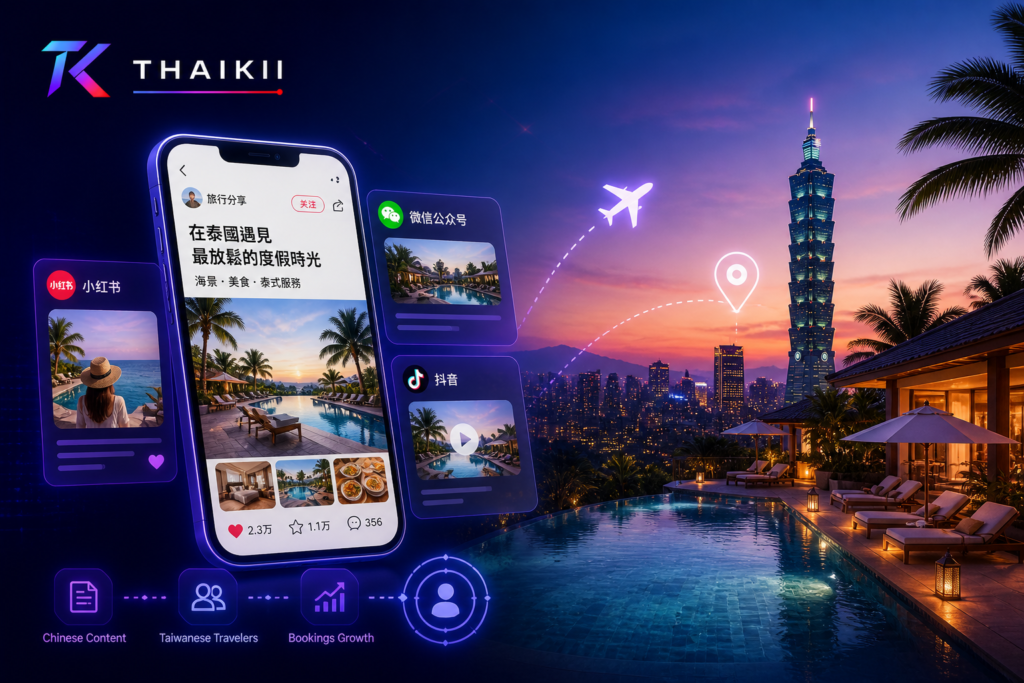
Taiwanese travelers are familiar with Thailand, but familiarity does not automatically create bookings. For Thai hotels, the real opportunity is no longer only about beautiful rooms, beach views, or competitive rates. It is about whether Taiwanese travelers can understand, trust, compare, and imagine their stay through Chinese-language content before they make a decision.
Chinese content is not simply translation. It is a market entry tool for Thai hotels that want to reach Taiwan, Hong Kong, and other Chinese-speaking travelers with clearer positioning, stronger trust signals, and more persuasive digital touchpoints.
This article is especially useful for Thai hotels, resorts, serviced apartments, boutique accommodations, wellness retreats, and hospitality groups that want to attract Taiwanese guests through Chinese SEO, social media, KOL collaboration, localized websites, and cross-border digital marketing.
Why Taiwanese Travelers Matter for Thai Hotels
Thailand has long been one of the most familiar Southeast Asian destinations for Taiwanese travelers. Bangkok, Chiang Mai, Phuket, Pattaya, Hua Hin, and Koh Samui are not unfamiliar names in Taiwan. Many Taiwanese travelers already associate Thailand with food, shopping, beaches, spa experiences, nightlife, temples, cultural activities, and high-value hospitality.
More importantly, Taiwan’s outbound travel market has recovered strongly. According to Taiwan’s Tourism Administration data reported by CNA, Taiwanese outbound travelers reached 18.94 million in 2025, up 12.43% from the previous year. This shows that Taiwanese consumers are again actively traveling overseas, and hotels that can communicate with them in the right language and platform environment have a stronger chance of converting attention into bookings.
For Thai hotels, Taiwan is attractive because travelers from Taiwan are often independent, digitally active, and willing to research before booking. They compare hotel reviews, transportation convenience, room types, breakfast quality, nearby restaurants, family-friendly facilities, and whether the hotel is suitable for couples, friends, parents, or children. A hotel that only provides English or Thai information may still receive bookings, but it may lose many travelers during the research stage.
This is where Chinese digital marketing becomes important. Taiwanese travelers do not only search for “Bangkok hotel” in English. They search in Traditional Chinese, read blog articles, watch YouTube reviews, browse Instagram posts, check Facebook recommendations, compare OTA comments, and ask friends or online communities. If a Thai hotel does not appear in these Chinese-language decision journeys, it becomes much harder to build trust before the booking moment.
Chinese Content Is Not Translation; It Is Travel Decision Design
Many Thai hotels already have English websites and booking pages. Some also use automatic translation to create Chinese pages. However, direct translation often fails because travelers do not make decisions through literal information alone.
A Taiwanese traveler may not only want to know that a hotel is “near BTS.” They want to know which station, how long it takes to walk, whether the area is convenient at night, whether it is suitable for first-time Bangkok travelers, and whether the surrounding district is better for shopping, nightlife, family trips, or a quiet vacation. A direct translation can explain the location, but localized Chinese content can explain the meaning of the location.
For example, a Thai hotel may describe itself as a “lifestyle hotel in the city center.” In Taiwan-facing content, this can be expanded into a more useful message: a convenient hotel for travelers who want easy access to shopping malls, massage shops, cafés, night markets, BTS transport, and airport transfers. The content should help Taiwanese readers quickly understand how the hotel fits into their travel plan.
Good Chinese content for Thai hotels should answer questions such as:
- Which type of Taiwanese traveler is this hotel best for?
- Is the location suitable for first-time visitors?
- How easy is it to travel from the airport?
- Is the hotel better for couples, families, business travelers, or friends?
- What nearby experiences can guests enjoy within 10 to 20 minutes?
- Does the hotel offer a strong value compared with similar hotels in Bangkok, Phuket, or Chiang Mai?
These are not just content questions. They are conversion questions.
What Taiwanese Travelers Look for Before Booking Thai Hotels
Taiwanese travelers usually care about convenience, safety, comfort, and “whether the experience feels worth it.” Price matters, but it is rarely the only factor. A hotel that communicates clear value can often compete better than a hotel that only competes on discount.
For Bangkok hotels, Taiwanese travelers often care about transportation access, proximity to BTS or MRT, shopping districts, night markets, restaurants, cafés, and massage shops. For Phuket, Pattaya, Hua Hin, or Koh Samui hotels, they may focus more on beach access, airport transfer, resort atmosphere, breakfast, pool quality, family facilities, and nearby attractions. For Chiang Mai, they may care about old town access, local culture, cafés, wellness, nature tours, and slow travel.
Chinese content should not only list facilities. It should connect facilities with travel situations. A swimming pool is not just a swimming pool; it may be a family-friendly afternoon activity. A spa is not just a spa; it may be a reason to choose the hotel for a relaxing short vacation. A restaurant is not just a dining outlet; it may reduce the stress of finding food after a late flight.
The best hotel content helps travelers picture the trip before they arrive. This is especially important for Taiwanese travelers because many travel decisions are influenced by emotional imagination, social sharing, and peer recommendations. If the Chinese content can make the hotel feel easy to understand, easy to trust, and easy to share, the hotel will have a stronger advantage in the Taiwan market.
Localized SEO: Helping Taiwanese Travelers Find Your Hotel Earlier
SEO is one of the most important long-term channels for Thai hotels that want to attract Taiwanese guests. Paid ads can bring traffic quickly, but SEO content can continue to attract travelers over time, especially when people search for destination guides, hotel recommendations, itinerary ideas, and neighborhood comparisons.
A Thai hotel targeting Taiwan should not only optimize for its hotel name. It should build Chinese content around traveler intent. For example, travelers may search for terms such as “Bangkok hotel recommendation,” “Bangkok family hotel,” “Phuket resort recommendation,” “Chiang Mai boutique hotel,” “Thailand honeymoon hotel,” “Bangkok hotel near BTS,” or “Thailand hotel for Taiwanese travelers.”
The key is to create content that matches the search journey. A traveler may not know your hotel at the beginning. They may first search for which district to stay in, then compare hotels, then read reviews, then check prices. If your hotel only appears at the final booking stage, you are competing mostly on price. If your hotel appears earlier through useful Chinese content, you can shape the traveler’s perception before competitors do.
For Thai hotels, useful SEO article topics may include:
- Where to Stay in Bangkok for First-Time Taiwanese Travelers
- Bangkok Hotel Area Guide: Sukhumvit, Siam, Silom, and Riverside
- How to Choose a Phuket Resort for Couples and Families
- Chiang Mai Boutique Hotels and Slow Travel Experiences
- Thai Hotel Booking Guide for Taiwanese Travelers
These articles should not be written like generic travel content. They should naturally guide readers toward the hotel’s strengths, while still providing real value. This is how SEO content becomes both helpful and commercial.
Social Media Content: Turning Hotel Features into Shareable Stories
Taiwanese travelers are highly influenced by social media content. Facebook, Instagram, YouTube, Threads, blogs, and community discussions all play a role in shaping travel interest. For hotels, social media should not only be used to post room photos and seasonal promotions. It should translate hotel features into stories that Taiwanese travelers want to save, share, and discuss.
A room photo may show design. A better post explains who the room is suitable for and what type of trip it supports. A breakfast photo may look attractive, but a stronger caption can describe how guests can start a relaxed Bangkok morning before heading to Siam, Chatuchak, or a spa appointment. A pool image may be visually pleasing, but a more localized post can frame it as a quiet escape after a day of shopping or sightseeing.
For Taiwan-facing social media, the tone should be clear, warm, and practical. Taiwanese audiences usually respond better to content that feels useful rather than overly exaggerated. A Thai hotel can highlight beauty and lifestyle, but it should also provide concrete travel information: distance, nearby attractions, transportation tips, suitable guest types, and suggested itineraries.
This is also where Traditional Chinese matters. For Taiwanese travelers, Traditional Chinese content feels more familiar and trustworthy than Simplified Chinese content. While both are Chinese-language markets, Taiwan has its own vocabulary, reading habits, and cultural preferences. A hotel that wants to reach Taiwan should not treat all Chinese-speaking travelers as one identical audience.
KOL and Influencer Marketing for Thai Hotels
KOL marketing can be highly effective for Thai hotels, especially when the goal is to build trust quickly in a new market. Taiwanese travelers often rely on creators for hotel reviews, destination inspiration, short videos, and itinerary planning. However, successful KOL campaigns require more than inviting influencers to stay for one night and post beautiful photos.
The hotel should first define the target audience. A family resort should work with parent-child travel creators. A romantic pool villa should work with couple travel or lifestyle creators. A wellness resort should work with creators who focus on spa, yoga, slow living, or premium travel. A city hotel in Bangkok may work well with creators who focus on shopping, food, nightlife, or first-time Thailand travel.
Content planning is also important. The creator should not only show the room. They should explain the stay experience from the perspective of a Taiwanese traveler: how to arrive, what the neighborhood feels like, what kind of guest should choose this hotel, what makes the hotel convenient, and how the price compares with the experience.
ThaiKii Marketing can support Thai hotels by helping them identify suitable Chinese-speaking creators, design campaign angles, prepare Chinese content briefs, review messaging, and connect KOL content with SEO pages, social media posts, and booking funnels. Instead of treating KOL marketing as one-time exposure, Thai hotels should see it as part of a larger content ecosystem.
Website Localization: Your Chinese Page Should Sell, Not Just Explain
A hotel’s Chinese landing page should do more than repeat the English website. It should be designed around the Taiwanese traveler’s decision process. The page should quickly answer who the hotel is for, where it is located, why the area is convenient, what room types are suitable, what nearby experiences are available, and how guests can book.
A strong Chinese hotel landing page may include a clear headline, short introduction, room highlights, location explanation, nearby itinerary suggestions, guest type recommendations, FAQ, and a call-to-action. The copy should be written in natural Traditional Chinese for Taiwan, not machine-translated Chinese.
For example, instead of simply writing “located in the heart of Bangkok,” the content can explain what this means for a Taiwanese traveler: easy access to shopping malls, BTS stations, cafés, massage shops, restaurants, and airport connections. Instead of only saying “family-friendly facilities,” the content can explain why parents may feel more comfortable staying there.
This approach improves both SEO and conversion. Search engines can better understand the page, and travelers can better understand the hotel.
Paid Ads: Using Chinese Campaigns to Reach the Right Travelers
Paid advertising can help Thai hotels reach Taiwanese travelers during peak travel seasons, long weekends, school holidays, summer vacations, Lunar New Year, and special campaign periods. However, ads must be localized carefully.
A direct English-to-Chinese ad may not perform well because it may not match Taiwanese travel motivations. Ads should be built around specific needs: first-time Bangkok travel, family vacations, romantic getaways, shopping trips, beach holidays, wellness retreats, or premium hotel experiences.
The landing page must also match the ad message. If an ad promotes a “Bangkok hotel for first-time travelers,” the landing page should explain location, transportation, nearby attractions, room options, and booking advantages for first-time visitors. If an ad promotes a “Phuket resort for couples,” the page should focus on privacy, sea views, dining, spa, and romantic experiences.
ThaiKii Marketing can help Thai hotels build Chinese ad copy, audience targeting, landing pages, and content funnels for Taiwan and Greater China campaigns. The goal is not only to increase traffic, but to attract the right travelers with the right message.
How ThaiKii Marketing Helps Thai Hotels Enter the Taiwan Market
ThaiKii Marketing focuses on helping Thai brands and hospitality businesses communicate with Chinese-speaking markets through localized digital marketing. For Thai hotels, this means building a bridge between Thai hospitality value and Taiwanese traveler expectations.
Our experience includes Chinese content strategy, SEO article planning, localized website content, social media messaging, KOL collaboration, brand positioning, and campaign planning for Thai businesses that want to reach Taiwan and the Greater China market. We understand that hotel marketing is not only about translation. It is about turning location, service, design, facilities, and guest experience into content that Taiwanese travelers can understand and trust.
For Thai hotels, we can support:
- Chinese SEO content for hotel websites and blogs
- Traditional Chinese landing pages for Taiwanese travelers
- Social media content planning for Taiwan-facing campaigns
- KOL and influencer collaboration strategy
- Chinese copywriting for ads, hotel introductions, and promotions
- Digital marketing strategy for Taiwan, Hong Kong, and Chinese-speaking audiences
The most important value is localization. A Thai hotel may already have excellent service, beautiful rooms, and strong hospitality. ThaiKii Marketing helps turn those strengths into Chinese-language content that fits the Taiwan market.
Why Now Is the Right Time for Thai Hotels to Build Chinese Content
Thailand remains one of Asia’s most competitive travel destinations, but competition among hotels is also becoming more intense. Travelers have more choices, more platforms, and more information than ever before. Hotels that invest early in Chinese content can build long-term visibility before the booking decision happens.
At the same time, Thailand’s tourism industry has faced changes in visitor mix and traveler confidence. Reuters reported that Thailand continued to target Chinese tourists in 2025, while also focusing on measures such as traveler safety to support tourism recovery. For Thai hotels, this means communication, trust, and clear market-specific messaging are more important than before.
Taiwanese travelers are not only looking for cheap hotel deals. Many are looking for convenience, comfort, safety, memorable experiences, and content they can trust. A hotel that speaks to them in the right Chinese tone can stand out even in a crowded market.
Turning Taiwanese Interest into Hotel Bookings
Thai hotels already have many natural advantages: warm hospitality, strong service culture, attractive destinations, food, wellness, shopping, beaches, and good value. But in digital marketing, having advantages is not enough. Those advantages must be translated into the traveler’s language, search behavior, and decision-making logic.
For Taiwanese travelers, Chinese content can reduce uncertainty, increase trust, and make the hotel easier to choose. A well-designed content strategy can help the hotel appear earlier in search results, perform better on social media, work more effectively with KOLs, and convert more visitors into bookings.
ThaiKii Marketing helps Thai hotels communicate with Taiwanese and Chinese-speaking travelers through localized content, SEO, social media, KOL strategy, and digital campaigns. For hotels that want to grow beyond OTA dependency and build stronger direct market awareness, Chinese content is not just an add-on. It is a practical market entry strategy.
With years of cross-border marketing experience, THAIKII Marketing helps brands build meaningful connections with Chinese-speaking audiences across Taiwan, China, Hong Kong, and other key Asian markets.
From SEO strategy and social media management to Chinese website development, local offline events, and KOL collaborations, we provide flexible support based on each brand’s market goals, industry background, and target customers. Whether you are planning your first market entry or looking to strengthen your existing presence, our team can help you create a localized, practical, and results-oriented marketing approach.
Frequently Asked Questions (FAQs)
Thai hotels need Chinese content because many Taiwanese travelers research hotels, destinations, and itineraries in Traditional Chinese before booking. Localized Chinese content helps them understand the hotel’s location, room types, nearby attractions, transportation convenience, and travel value more clearly.
Yes. Traditional Chinese is the standard writing system used in Taiwan, and Taiwanese readers also have different vocabulary, tone preferences, and travel decision habits. If a Thai hotel wants to attract Taiwanese guests, Traditional Chinese content usually feels more natural and trustworthy than generic Simplified Chinese content.
ThaiKii Marketing helps Thai hotels with Chinese SEO, Traditional Chinese website content, Taiwan-facing social media strategy, KOL collaboration, digital advertising copy, and localized brand communication. The goal is to help Thai hotels attract Taiwanese and Chinese-speaking travelers with clearer, more persuasive content.
Discover more from Thaikii 泰奇行銷
Subscribe to get the latest posts sent to your email.