
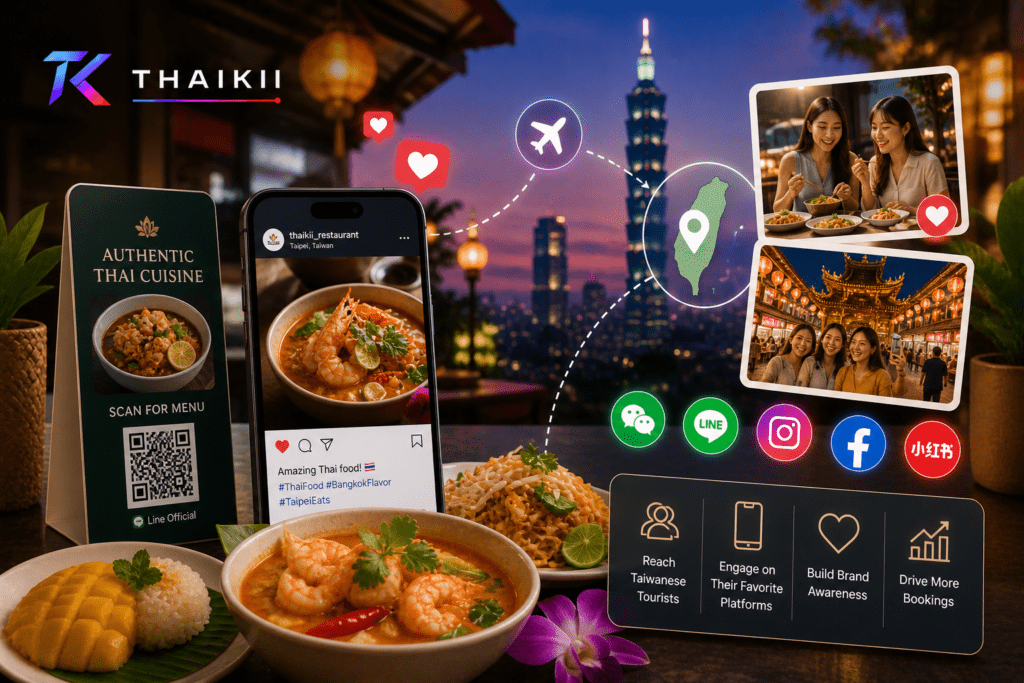
Thai restaurants can attract more Taiwanese tourists by building Chinese-language visibility before travelers arrive, creating social media content that matches Taiwanese dining behavior, and turning every restaurant visit into a shareable online experience.
Restaurant marketing for Taiwanese tourists is not only about translation. It is a full digital localization strategy that connects search intent, social media discovery, menu storytelling, influencer content, and lead generation into one customer journey.
This article is especially useful for Thai restaurant owners, hospitality groups, hotel F&B teams, food courts, café brands, Thai dessert shops, and lifestyle dining brands that want to reach Taiwanese travelers and expand their visibility across Taiwan and the Greater China market.
Why Taiwanese Tourists Matter for Thai Restaurants
Thailand has long been one of the most familiar and emotionally attractive destinations for Taiwanese travelers. For many visitors from Taiwan, Thailand is not just a place for beaches, temples, nightlife, or shopping. It is also a food destination. Thai cuisine has strong brand recognition in Taiwan: tom yum, green curry, pad Thai, mango sticky rice, Thai milk tea, grilled pork skewers, seafood, and night market culture are already part of the Taiwanese traveler’s imagination.
This creates an important opportunity for Thai restaurants. Taiwanese tourists often make dining decisions before and during their trip through Chinese-language searches, social media recommendations, Google Maps reviews, short videos, travel blogs, YouTube vlogs, and influencer content. If a restaurant only communicates in Thai or English, it may still attract walk-in customers, but it will miss a large part of the planning-stage demand from Taiwanese travelers.
Taiwan’s outbound travel market has recovered strongly. According to Taiwan’s Tourism Administration data reported by CNA and Taipei Times, Taiwanese outbound travelers reached 18.94 million in 2025, up 12.43% from the previous year. This shows that overseas travel has returned to a strong growth track for Taiwanese consumers.
For Thailand specifically, Taiwanese arrivals remain an important visitor segment. Bangkok Post reported that Thailand welcomed more than 670,000 visitors from Taiwan in the first eight months of 2025, while another tourism report from The Nation listed Taiwan among Thailand’s top 10 source markets in October 2025.
For restaurants, this means one thing: Taiwanese tourists are not a small side market. They are a valuable audience with strong food interest, high digital usage, and a habit of sharing travel experiences online.
Taiwanese Tourists Do Not Discover Restaurants in Only One Way
Many Thai restaurants still think of tourist marketing as a simple process: open a Facebook page, post menu photos, wait for customers to come. This is no longer enough.
Taiwanese tourists usually move through several discovery stages. Before traveling, they may search for “Bangkok must-eat restaurants,” “Thai seafood restaurant near Siam,” “Phuket local food recommendation,” or “Chiang Mai café guide” in Chinese. They may also look for food content on Instagram, Facebook, YouTube, Google Maps, LINE communities, travel blogs, or Taiwanese media platforms.
During the trip, their decisions become more location-based. They search nearby restaurants, check Google reviews, compare photos, look at menus, and often choose restaurants that feel easy to understand, visually appealing, and trustworthy. After the meal, they may post on Instagram Stories, write Google reviews, upload TikTok or Reels clips, or share recommendations with friends.
This means the restaurant brand must appear in multiple moments:
- Before the trip, it needs Chinese SEO and travel content.
- During the trip, it needs Google Maps optimization, Chinese menu clarity, and social proof.
- After the visit, it needs review generation, shareable experiences, and follow-up content.
For Thai restaurants that want long-term visibility among Taiwanese tourists, the goal is not only to be “found.” The goal is to be remembered, saved, recommended, and shared.
Chinese-Language SEO Is the Foundation of Restaurant Visibility
For Taiwanese tourists, search behavior is still one of the most important restaurant discovery channels. A Thai restaurant may be famous locally, but if Chinese-language search results do not explain who it is suitable for, what dishes are recommended, where it is located, and why Taiwanese travelers should visit, the brand may not appear in the planning stage.
Chinese-language SEO for Thai restaurants should not only translate the English menu. It should answer real travel questions from Taiwanese users. For example, a Taiwanese traveler may want to know whether the restaurant is close to BTS, whether it is suitable for families, whether the food is too spicy, whether there are air-conditioned seats, whether reservations are needed, whether the restaurant accepts credit cards, and what dishes are most beginner-friendly.
A strong SEO article for a Thai restaurant may include:
Restaurant story and brand background.
Signature dishes explained in Traditional Chinese.
Location guide for Taiwanese tourists.
Dining budget and recommended ordering style.
Nearby attractions or shopping areas.
Google Maps and reservation information.
FAQ for first-time visitors.
This type of content helps search engines understand the restaurant and helps Taiwanese tourists make decisions faster.
At THAIKII, our experience in Chinese-language content marketing is built around this exact logic. We do not treat Chinese copywriting as direct translation. We restructure content based on search intent, Taiwanese wording habits, travel decision behavior, and conversion goals. For a Thai restaurant brand, this means your story, menu, and location can be turned into searchable assets rather than short-lived social posts.
Social Media Should Make the Restaurant Easy to Imagine
Taiwanese tourists are visual decision-makers. They do not only ask, “Is the food good?” They also ask, “Does this place feel worth going to?” “Will my friends like seeing this on social media?” “Is it convenient for my itinerary?” “Does the restaurant look clean, stylish, authentic, or local?”
Taiwan’s digital environment makes this especially important. DataReportal reported that Taiwan had 22.1 million internet users at the start of 2025, with internet penetration at 95.3%, and 18.4 million social media user identities, equal to 79.4% of the population.
For Thai restaurants, social media content should therefore do more than show food photos. It should build a complete dining imagination.
A Thai seafood restaurant can show the atmosphere of a dinner after a beach trip. A Bangkok rooftop restaurant can show the feeling of ending a shopping day with city lights. A Thai dessert café can show mango sticky rice, coconut ice cream, and Thai tea in a way that feels easy to share. A local street food brand can explain why the dish is loved by locals and how Taiwanese tourists can order it without feeling confused.
The content should be practical, but also emotional. Taiwanese tourists like useful recommendations, but they also respond to a sense of place, mood, lifestyle, and story.
Instead of posting only “special promotion today,” a restaurant should create content such as:
- “What Taiwanese tourists should order on their first Thai seafood dinner.”
- “Three Thai dishes that are flavorful but not too spicy.”
- “Where to eat after shopping near Siam or Asok.”
- “A Thai dessert guide for first-time visitors from Taiwan.”
- “Why this local Thai dish is different from the version you may have eaten in Taiwan.”
These topics are not only social media ideas. They can also become SEO articles, short videos, Google Business posts, KOL scripts, and newsletter content.
Google Maps and Reviews Are Critical for Tourist Conversion
For restaurant marketing, Google Maps may be more important than many brands realize. When Taiwanese tourists are already in Thailand, they often search by location. They may type “restaurant near me,” “Thai food near BTS,” “seafood restaurant Bangkok,” or Chinese search terms directly into Google Maps.
At this stage, the restaurant is no longer competing only on brand image. It is competing on convenience, review quality, photo quality, menu clarity, and trust.
A restaurant that wants to attract Taiwanese tourists should make sure its Google Business Profile is well managed. The restaurant name, address, opening hours, phone number, reservation link, menu, photos, and service options should be accurate. The photo section should include food, entrance, seating area, menu, payment options, and signature dishes. If possible, the restaurant should also encourage Chinese-speaking visitors to leave reviews in Traditional Chinese.
Chinese reviews are especially useful because they reduce uncertainty. A Taiwanese tourist may trust another Taiwanese traveler’s review more than a generic rating. Reviews that mention “not too spicy,” “good service,” “easy to reach,” “suitable for family,” or “near BTS” can directly influence decision-making.
For many Thai restaurant brands, review strategy is still passive. They wait for customers to write reviews. A better approach is to design a simple review journey. The restaurant can place a small QR code on the bill, train staff to politely invite satisfied customers to review, and create a small post-meal message in Traditional Chinese. The tone should be natural, not aggressive.
A good review system can turn every Taiwanese customer into a long-term digital asset.
KOL Marketing Works Best When It Feels Useful, Not Forced
Taiwanese tourists are influenced by food bloggers, travel creators, YouTubers, Instagram creators, and short-video influencers. However, restaurant KOL marketing should not be treated as a one-time photo exchange.
The most effective KOL content usually has a clear angle. It may focus on itinerary planning, hidden local restaurants, luxury dining, family-friendly food, romantic restaurants, café culture, or budget-friendly local meals. The influencer’s audience must match the restaurant’s positioning.
A Thai fine dining restaurant should not use the same creator strategy as a street food shop. A family restaurant near a tourist area should not use the same message as a cocktail bar. A Thai dessert brand targeting Taiwanese women travelers may need a different visual language from a seafood restaurant targeting group travelers.
KOL content should also connect with search and lead generation. After a creator posts content, the restaurant should be ready with Chinese landing pages, reservation links, Google Maps optimization, and retargeting content. Otherwise, the exposure may generate attention but not measurable results.
This is where THAIKII can help Thai restaurant brands build a more complete marketing system. Our value is not only finding creators. We help brands shape the message, localize the content, connect social media with Chinese-language search behavior, and design a conversion path for Taiwanese and Greater China audiences.
Menu Localization Is More Than Translation
Food translation is one of the most underestimated parts of restaurant marketing. A dish name may be technically translated, but still fail to create desire.
For Taiwanese tourists, a good Chinese menu should explain flavor, ingredients, spice level, portion size, and recommended ordering style. Some Thai dishes are familiar to Taiwanese consumers, while others need more storytelling.
For example, simply translating a dish as “spicy soup” is not enough. Taiwanese tourists may want to know whether it is sour, herbal, seafood-based, coconut-based, or suitable for people who cannot eat very spicy food. A dish with fermented flavors may need careful explanation. A local specialty may need a short cultural note. A premium seafood dish may need price transparency and serving suggestions.
Good menu localization can increase order value. When customers understand the dishes better, they are more willing to order signature items, shareable dishes, desserts, drinks, and add-ons.
For Thai restaurants targeting Taiwanese tourists, the menu should ideally include:
- Traditional Chinese dish names.
- Short flavor descriptions.
- Spice level guidance.
- Signature dish icons.
- Recommended set combinations.
- Clear allergy or ingredient notes.
- Photo support for unfamiliar dishes.
This is especially important for restaurants that want to attract first-time visitors, families, older travelers, or group tourists.
Build Restaurant Content Around Travel Scenarios
A restaurant is not only a place to eat. For tourists, it is part of the travel itinerary.
This is why Thai restaurant marketing should not only describe food. It should connect the restaurant with travel scenarios. A Taiwanese traveler may choose a restaurant because it fits a specific moment: after landing in Bangkok, before going to a night market, after visiting a temple, before returning to the hotel, during a shopping day, or on the last night of the trip.
Restaurant content can be built around these moments.
For example, a restaurant near Siam can create content about “where Taiwanese tourists can eat after shopping in Bangkok.” A restaurant near the riverside can promote itself as a dinner choice after visiting temples and river attractions. A café in Chiang Mai can connect with slow travel, digital nomads, and photo-friendly spaces. A Phuket seafood restaurant can connect with family travel, island tours, and sunset dining.
This scenario-based strategy is important because tourists rarely make dining decisions in isolation. They think in routes, timing, convenience, weather, budget, and group needs.
When THAIKII designs content for Thai brands, we often think from the traveler’s journey rather than the brand’s internal perspective. For Taiwanese and Chinese-speaking audiences, the best content usually answers the hidden question: “How does this brand fit into my trip or lifestyle?”
Lead Generation for Restaurants: Not Just Reservations
For many Thai restaurants, the first goal is simple: get more Taiwanese tourists to visit. But a stronger marketing strategy can go further.
Lead generation for restaurants can include reservation inquiries, LINE contacts, group dining requests, tour group partnerships, event bookings, private dining requests, hotel concierge referrals, and brand collaboration opportunities. For restaurant groups or franchise brands, lead generation may also include business partnerships, media exposure, or future expansion inquiries.
A Thai restaurant that wants more Taiwanese customers should consider building a simple Chinese-language landing page with clear calls to action. The page can include signature dishes, location, opening hours, reservation method, Google Maps link, group booking contact, and social media links.
For restaurants targeting travel agencies or corporate groups, the landing page can also include private room information, group menu options, Chinese-speaking support, invoice information, and transportation details.
This is where digital marketing becomes more than branding. It becomes a sales support system.
The Greater China Opportunity for Thai Restaurant Brands
Taiwan is often a strong starting point for Thai restaurant brands because Taiwanese consumers are familiar with Thailand, open to Thai cuisine, and active in social media sharing. However, a well-built Chinese-language marketing strategy can also support broader Greater China visibility.
For Thai restaurant groups, hotel restaurants, dessert brands, café brands, and packaged food brands, the same content infrastructure can be adapted for Taiwan, Hong Kong, and selected Chinese-speaking audiences. The wording, platform mix, and compliance considerations may differ, but the foundation is similar: clear Chinese positioning, localized storytelling, trusted social proof, and conversion-oriented digital assets.
Thai cuisine already has strong cultural appeal. The next step is to make the brand easier to discover, understand, visit, and share.
At THAIKII, our role is to help Thai brands cross this gap. We understand both Thai market context and Chinese-language audience behavior. We help brands avoid the common mistake of direct translation and instead create marketing content that feels natural to Taiwanese and Greater China consumers.
How THAIKII Helps Thai Restaurants Reach Taiwanese Tourists
THAIKII provides Chinese digital marketing support for Thai brands that want to reach Taiwan and the Greater China market. For restaurant brands, this can include SEO articles, Chinese website content, landing pages, social media planning, KOL collaboration, Google Business optimization, campaign copywriting, and localized brand storytelling.
Our past experience across real estate, lifestyle, tourism-related content, and cross-border brand marketing allows us to understand how Taiwanese audiences search, compare, and make decisions. We know that Taiwanese consumers often need more than a beautiful image. They need context, trust, practical information, and a reason to choose one brand over another.
For Thai restaurants, this means we can help turn your restaurant from a local dining option into a searchable, shareable, and trusted destination for Taiwanese tourists.
What Thai Restaurants Should Do First
The first step is not to create more random posts. The first step is to review the current customer journey.
- Can Taiwanese tourists find your restaurant in Chinese search results?
- Does your Google Maps profile show your best photos and accurate information?
- Do you have Traditional Chinese content explaining your signature dishes?
- Are your social media posts designed around traveler needs?
- Can a Taiwanese customer easily reserve, locate, order, and review your restaurant?
If the answer is no, then the restaurant does not only need more marketing. It needs better localization.
Thai restaurants that invest early in Chinese-language visibility will have a stronger chance to capture tourist demand before competitors. The brands that win will not necessarily be the ones with the biggest advertising budget. They will be the ones that understand how Taiwanese tourists discover, trust, and share restaurant experiences.
With years of cross-border marketing experience, THAIKII Marketing helps brands build meaningful connections with Chinese-speaking audiences across Taiwan, China, Hong Kong, and other key Asian markets.
From SEO strategy and social media management to Chinese website development, local offline events, and KOL collaborations, we provide flexible support based on each brand’s market goals, industry background, and target customers. Whether you are planning your first market entry or looking to strengthen your existing presence, our team can help you create a localized, practical, and results-oriented marketing approach.
Frequently Asked Questions (FAQs)
Thai restaurants can attract Taiwanese tourists by building Traditional Chinese SEO content, improving Google Maps visibility, creating social media content for Taiwanese travel scenarios, working with suitable KOLs, and making menus easier to understand for Chinese-speaking visitors.
No. Direct translation is not enough. Restaurant marketing for Taiwanese tourists requires localization, including Taiwanese wording habits, search behavior, menu explanation, platform selection, review strategy, and travel decision logic.
Google Search, Google Maps, Facebook, Instagram, YouTube, LINE-related communication, travel blogs, and short-video platforms can all be useful depending on the restaurant’s target audience. The best strategy is usually a combination of SEO, social media, and review optimization.
Discover more from Thaikii 泰奇行銷
Subscribe to get the latest posts sent to your email.