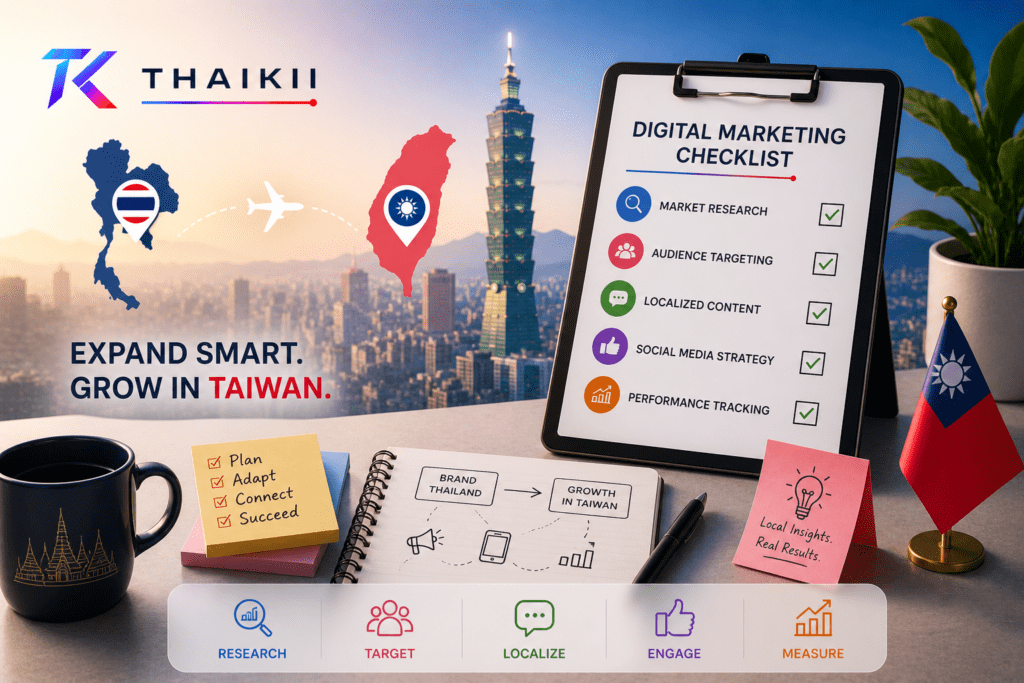
For Thai brands planning to expand into Taiwan, digital marketing is not just a promotional tool. It is the bridge between brand awareness, market trust, localized communication, and actual customer conversion.
Taiwan is one of the most attractive entry points for Thai companies that want to reach Chinese-speaking consumers. It has a mature digital environment, high social media usage, strong interest in travel, wellness, food, lifestyle, beauty, hospitality, and overseas brands. More importantly, Taiwan can also become a strategic testing ground before a Thai brand moves further into Hong Kong, Singapore, Malaysia’s Chinese-speaking communities, or selected Chinese-language markets.
This article provides a practical digital marketing checklist for Thai businesses considering Taiwan market entry. It is designed for Thai property developers, hotels, wellness brands, restaurants, lifestyle companies, tourism operators, F&B groups, and consumer brands that want to build stronger visibility among Taiwanese and Greater China customers.
Thaikii Marketing works with cross-border branding, Chinese content marketing, SEO strategy, social media communication, and localized digital promotion. Based on our experience observing both Thai market strengths and Taiwanese consumer behavior, the key challenge is not simply translating Thai brand messages into Chinese. The real challenge is building a communication system that Taiwanese customers can understand, trust, search for, and act on.
Why Taiwan Is a Strategic Market for Thai Brands
Thailand already has strong brand recognition among Taiwanese consumers. For many people in Taiwan, Thailand is associated with tourism, hospitality, relaxation, food culture, wellness, property opportunities, beauty services, and lifestyle inspiration. This gives Thai brands a natural emotional advantage when entering the Taiwan market.
However, having positive impressions does not automatically create sales. Taiwanese consumers still need clear information, Chinese-language content, localized trust signals, transparent pricing, service explanations, reviews, and convenient communication channels before making decisions.
This is especially important for higher-value products and services. A Taiwanese customer may love Thailand, but before booking a wellness retreat, buying a condominium, choosing a Thai restaurant brand, cooperating with a hotel, or purchasing lifestyle products, they usually search online, compare options, read Chinese content, check social proof, and evaluate whether the brand feels reliable.
That is why digital marketing should be part of the market entry strategy from the beginning. For Thai brands, Taiwan is not only a sales destination. It is a Chinese-language branding environment where search visibility, content quality, social media credibility, and lead management all affect long-term growth.
Checklist 1: Define Your Taiwan Market Entry Goal Before Running Ads
Many Thai companies begin with a simple question: “How can we promote our brand in Taiwan?” But before launching social media campaigns or paid ads, the brand needs to define what kind of expansion it wants.
A Thai hotel may want more Taiwanese travelers. A property developer may want qualified leads from overseas buyers. A restaurant group may want brand recognition before franchise discussions. A wellness brand may want to attract high-intent customers looking for retreats, spa services, or premium lifestyle experiences. A consumer brand may want online sales, distributor leads, or partnership opportunities.
Each goal requires a different digital marketing structure. A campaign designed for tourism bookings will not be the same as a campaign designed for B2B partnerships. A property advertising funnel will not be the same as a lifestyle brand awareness campaign.
Before entering Taiwan, Thai brands should clarify three questions: What kind of Taiwanese customer do we want to reach? What action do we want them to take? What information do they need before they feel confident enough to contact us?
At Thaikii Marketing, we often help brands organize these questions into a practical communication framework. Instead of starting with random posting or broad advertising, we focus on building a market entry path: awareness, education, trust, inquiry, and conversion.
Checklist 2: Localize the Brand Message for Taiwanese Consumers
Thai brands often have strong storytelling elements: warmth, hospitality, craftsmanship, tropical lifestyle, wellness culture, food experience, design, and destination appeal. These are valuable advantages. But the message needs to be adapted for the Taiwanese market.
Direct translation is not enough. Taiwanese consumers read Chinese content differently from Thai or English audiences. They usually prefer clear explanations, practical benefits, credible details, transparent comparisons, and a balanced tone. Overly exaggerated advertising language may reduce trust, especially in sectors like real estate, wellness, medical tourism, franchise cooperation, and premium services.
A localized brand message should answer what Taiwanese customers care about. For example, a Thai hotel should not only say it is beautiful or relaxing. It should explain why it is suitable for Taiwanese travelers, what kind of trip style it supports, how transportation works, what nearby attractions matter, and what makes the experience different from other Thai destinations.
A Thai property developer should not only promote design or investment potential. Taiwanese buyers will want to understand location, rental demand, ownership structure, management services, expected use cases, legal process, and long-term market positioning.
A Thai wellness brand should not only describe “healing” or “natural ingredients.” It should explain the service logic, product usage, quality standards, target customers, and lifestyle value in a language that feels familiar to Taiwanese readers.
Thaikii Marketing helps Thai brands reshape their positioning into Chinese-language market narratives. This allows the brand to preserve its Thai identity while making the message easier for Taiwanese and Greater China customers to understand.
Checklist 3: Build a Chinese SEO Foundation Before You Depend on Paid Advertising
Paid advertising can create short-term traffic, but SEO builds long-term market presence. For Thai brands entering Taiwan, Chinese SEO is one of the most important digital assets.
Taiwanese consumers often search before they contact a company. They may search for terms like Thai hotel recommendations, Bangkok property, Thailand wellness retreat, Thai restaurant brand, Thailand business cooperation, Thailand travel planning, or Thai lifestyle products. If your brand has no Chinese search presence, your potential customers may find competitors, media articles, forums, or unrelated content instead.
A strong SEO foundation usually includes a localized website structure, Chinese landing pages, keyword-focused articles, service pages, brand introduction pages, FAQ content, and internal linking. The goal is not simply to rank for one keyword. The goal is to create a digital environment where Taiwanese customers can move from curiosity to trust.
For example, a Thai property company entering Taiwan may need articles about Bangkok property trends, foreign buyer considerations, rental management, location comparison, lifestyle value, and overseas purchasing process. A Thai wellness brand may need content about Thai spa culture, retreat planning, natural wellness experiences, premium travel, and product usage. A hotel group may need Chinese articles targeting Taiwanese traveler search behavior.
Thaikii Marketing places strong emphasis on SEO because cross-border customers usually need time to make decisions. When Chinese-language content continues to appear in search results, it helps the brand build authority even before the customer contacts the company.
Checklist 4: Create Content That Educates, Not Just Promotes
Taiwanese consumers are highly familiar with digital content. They can quickly recognize whether a brand is only trying to sell or genuinely helping them make a better decision. That is why educational content is essential for Thai brands entering Taiwan.
Educational content does not mean boring content. It means giving potential customers useful context. A Thai restaurant can explain regional Thai cuisine, ingredient differences, dining culture, and suitable customer occasions. A hotel can explain travel styles, family-friendly planning, wellness vacations, destination comparison, and seasonal recommendations. A property developer can explain ownership structure, area selection, rental demand, lifestyle value, and buyer concerns. A wellness brand can explain product philosophy, customer use cases, and the difference between Thai wellness culture and general beauty marketing.
This kind of content helps customers feel that the brand understands their questions. It also improves SEO performance because search engines reward useful content that matches real search intent.
For Thai brands, one of the most effective approaches is to combine brand storytelling with practical market education. The brand should show its Thai character, but also explain why that character matters to Taiwanese customers.
Thaikii Marketing’s experience in cross-border content strategy allows us to develop article topics, landing pages, social media posts, and campaign narratives that fit both search behavior and brand positioning.
Checklist 5: Choose the Right Social Media Platforms for Taiwan
Social media is central to Taiwan’s digital environment, but platform strategy should be selective. Not every brand needs to use every platform.
Facebook remains useful for community-based communication, event promotion, older consumer segments, overseas property discussions, travel sharing, and interest-based audiences. Instagram is important for lifestyle, hospitality, food, fashion, wellness, beauty, and visual storytelling. LINE is highly relevant for customer communication and lead nurturing in Taiwan. YouTube can support deeper brand education, especially for property, tourism, hospitality, and complex services. Threads, TikTok, and short-form video platforms may be useful for brand awareness, but they need a content style that matches the platform.
For brands that want to reach Chinese-speaking audiences beyond Taiwan, platform planning may become more complex. Different regions use different channels, and the same Chinese message may not work across Taiwan, Hong Kong, Singapore, Malaysia, and China.
This is where market entry partners become valuable. Thaikii Marketing understands that Taiwan-focused communication should not be treated as a generic “Chinese campaign.” Taiwanese users have their own language style, cultural references, trust expectations, and content rhythm.
A good social media plan should define what each platform is responsible for. SEO captures search demand. Facebook and Instagram build familiarity. LINE manages inquiries. YouTube or long-form content builds trust. Paid ads accelerate visibility. Together, they create a complete digital funnel.
Checklist 6: Prepare Landing Pages That Convert Taiwanese Leads
Many cross-border campaigns fail because the ad is active, but the landing page is weak. When Taiwanese users click an ad or social post, they need to land on a page that answers their questions clearly.
A good landing page for Taiwan market entry should include a localized headline, clear service or product explanation, key benefits, trust signals, contact method, FAQ section, and a strong call to action. The page should not be overloaded with vague slogans. It should guide the visitor toward a specific action, such as booking a consultation, requesting project details, joining a LINE account, downloading a guide, or contacting the sales team.
For Thai brands, a Chinese landing page is often the first serious trust point. If the page feels poorly translated, incomplete, or too foreign to navigate, customers may hesitate even if they are interested.
The landing page should also reflect the customer’s stage. A first-time Taiwanese customer may not be ready to buy immediately. They may need a brochure, a comparison article, a market guide, or a consultation. That is why conversion design should include both immediate contact options and softer lead-generation tools.
Thaikii Marketing helps brands design landing page structures that fit Taiwanese customer behavior, especially for industries where trust and explanation are important.
Checklist 7: Use Paid Advertising with a Funnel Strategy
Paid advertising can be powerful, but Thai brands should avoid using it as a standalone shortcut. Taiwan market entry requires a funnel strategy.
At the awareness stage, ads can introduce the brand, highlight Thai identity, and attract the right audience. At the education stage, ads can promote articles, videos, comparison guides, or event invitations. At the conversion stage, ads can send users to inquiry pages, consultation forms, LINE contact points, or booking pages. At the retargeting stage, ads can reconnect with users who visited the website but did not inquire.
This is particularly important for high-consideration businesses. A person may not buy property, book a premium wellness retreat, or discuss brand cooperation after seeing one ad. They need repeated exposure and useful information.
Paid media should also be tested carefully. Taiwanese audiences may respond differently to messages about price, lifestyle, exclusivity, convenience, safety, culture, or professional service. The campaign should not assume that a message successful in Thailand will automatically perform well in Taiwan.
Thaikii Marketing supports Thai brands by connecting advertising strategy with Chinese content, SEO pages, localized messaging, and lead-generation design. This allows advertising budgets to work more efficiently.
Checklist 8: Build Trust with Proof, Not Just Promises
Trust is one of the most important factors in Taiwan market expansion. Thai brands may have strong products or services, but Taiwanese customers need proof.
Trust signals can include media features, customer reviews, case studies, professional photos, business background, founder story, service process, location details, transparent pricing, certifications, partnership records, client testimonials, and clear contact information.
For property and hospitality brands, visual proof is especially important. Customers want to see real photos, maps, room types, surrounding areas, transportation information, management details, and customer experience. For wellness and lifestyle brands, they want to understand product quality, service standards, brand philosophy, and usage scenarios. For B2B expansion, Taiwanese partners want to know whether the Thai brand has market readiness, operational stability, and long-term cooperation potential.
Thaikii Marketing’s role is to help organize these trust materials into a communication system. A strong brand does not only say “we are reliable.” It shows reliability through content, structure, language, and customer experience.
Checklist 9: Prepare a Chinese Lead Management System
Digital marketing does not end when a customer submits a form. In cross-border business expansion, lead follow-up is often where opportunities are won or lost.
Taiwanese customers usually expect fast, polite, and clear communication. If they ask a question in Chinese but receive a slow, unclear, or overly generic response, trust may decline. For higher-value services, the follow-up process should include prepared Chinese responses, FAQ documents, consultation scripts, brochure materials, and a clear next step.
LINE is especially important in Taiwan. Many users prefer to ask questions through LINE rather than email. For some industries, LINE Official Account can become the center of customer communication, event invitations, remarketing, and relationship management.
Thai brands entering Taiwan should prepare not only marketing content but also customer service content. This includes inquiry forms, response templates, sales decks, Chinese brochures, event registration pages, and post-inquiry follow-up messages.
Thaikii Marketing helps brands connect marketing traffic with practical lead handling. The goal is not only to generate inquiries, but to improve the quality and conversion potential of those inquiries.
Checklist 10: Think Beyond Taiwan: Use Taiwan as a Chinese-Language Growth Gateway
For many Thai brands, Taiwan can be more than one market. It can become a learning base for Chinese-language branding.
Taiwanese consumers are sophisticated, digitally active, and open to Thai culture. If a Thai brand can successfully communicate with Taiwanese customers, it can gain valuable insights into Chinese-language positioning, content preferences, product education, and cross-border trust building.
This experience may later support expansion into other Chinese-speaking segments. Of course, each market still requires its own localization. The language, platforms, regulations, consumer mindset, and media behavior may differ. But Taiwan can provide a relatively accessible starting point for Thai brands to test Chinese messaging and build regional credibility.
Thaikii Marketing is positioned exactly at this intersection. We help Thai brands communicate with Taiwan and Greater China audiences through Chinese digital marketing, localized content, SEO planning, social media strategy, and lead-generation systems.
For Thai companies that already have strong products, beautiful experiences, or market potential, the next step is to make the brand understandable and searchable in Chinese.
What Thai Brands Should Prepare Before Working with a Taiwan Marketing Partner
Before starting a market entry project, Thai brands can prepare several basic materials. These include brand introduction, product or service details, target customer profile, existing website, photos and videos, customer reviews, past media coverage, pricing information, partnership goals, and preferred markets.
However, the brand does not need to have everything perfect before entering Taiwan. In many cases, the role of a market entry partner is to help organize scattered materials into a clear digital strategy.
The most important thing is to define the business direction. Are you looking for Taiwanese travelers, Chinese-speaking buyers, lifestyle consumers, franchise partners, distributors, investors, or brand collaboration opportunities? Once the target is clear, content and digital marketing can be structured around that goal.
Thaikii Marketing works with brands that want more than simple translation. We focus on market-facing communication: how Taiwanese customers search, how they compare, what they trust, what content helps them decide, and how a Thai brand can build long-term visibility in the Chinese-speaking digital environment.
Why Thai Brands Need a Specialized Taiwan Market Entry Partner
Taiwanese digital marketing requires language precision, cultural understanding, platform knowledge, SEO planning, and practical sales awareness. A general marketing agency may understand advertising, but cross-border expansion requires more than campaign execution.
Thai brands need a partner that understands both the charm of Thai businesses and the decision-making habits of Taiwanese customers. The goal is not to remove Thai identity. The goal is to translate Thai strengths into messages that Taiwanese customers can trust.
Thaikii Marketing brings together cross-border content strategy, Chinese SEO, social media planning, and Taiwan-facing brand communication. Our experience across Thai market observation, international real estate content, lifestyle branding, digital media, and Chinese-language audience development allows us to help Thai companies create practical entry strategies.
For Thai brands entering Taiwan, the opportunity is real. Taiwanese consumers already have curiosity and affection for Thailand. But to turn that affection into business results, brands need localized content, clear digital structure, and consistent communication.
Make Taiwan Market Entry a System, Not a One-Time Campaign
Thailand to Taiwan business expansion should not be treated as a single advertisement or a translated brochure. It should be built as a digital marketing system.
A strong system includes localized positioning, Chinese SEO content, social media storytelling, landing pages, paid advertising, trust-building materials, lead management, and continuous optimization. When these pieces work together, Thai brands can move from being “interesting” to being “trusted,” and from being “visible” to being “chosen.”
For Thai companies ready to reach Taiwanese and Greater China customers, Thaikii Marketing can help build this bridge. We support brands that want to communicate clearly, grow sustainably, and create stronger market opportunities through Chinese digital marketing.
With years of cross-border marketing experience, THAIKII Marketing helps brands build meaningful connections with Chinese-speaking audiences across Taiwan, China, Hong Kong, and other key Asian markets.
From SEO strategy and social media management to Chinese website development, local offline events, and KOL collaborations, we provide flexible support based on each brand’s market goals, industry background, and target customers. Whether you are planning your first market entry or looking to strengthen your existing presence, our team can help you create a localized, practical, and results-oriented marketing approach.
Frequently Asked Questions (FAQs)
Taiwan is a strong entry point for Thai brands because Taiwanese consumers are familiar with Thailand and interested in Thai travel, food, wellness, hospitality, lifestyle, and property-related opportunities. Taiwan also has a mature digital environment, which makes SEO, social media, content marketing, and lead generation highly important for market entry.
The best channels depend on the brand’s goal. SEO is important for long-term visibility. Facebook and Instagram are useful for brand awareness and lifestyle communication. LINE is important for customer follow-up and lead management. Paid ads can accelerate traffic, while landing pages and Chinese content help convert interest into inquiries.
These brands should provide clear Chinese content that answers practical questions. Property brands need to explain location, ownership, management, and buyer concerns. Hotels should explain travel experience, transportation, room types, and trip styles. Wellness brands should explain service value, product quality, and suitable customer scenarios.
Discover more from Thaikii 泰奇行銷
Subscribe to get the latest posts sent to your email.