
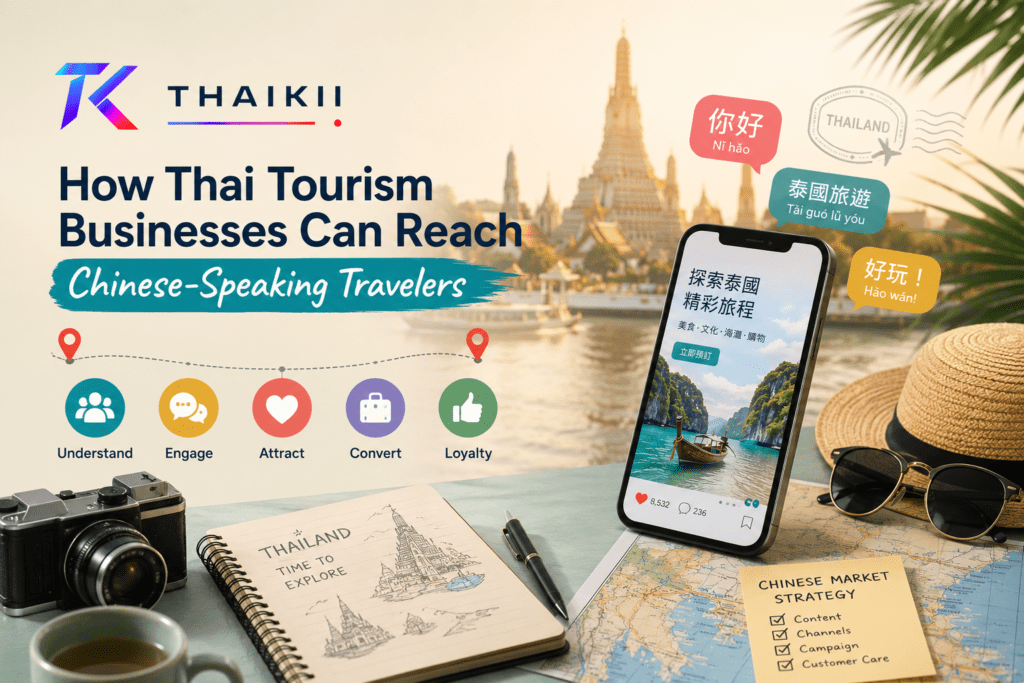
Thai tourism businesses can reach Chinese-speaking travelers by building a localized Chinese-language digital presence, creating trusted content for Taiwan and China audiences, and working with a cross-border marketing partner that understands both Thai tourism products and Chinese-speaking consumer behavior.
Chinese-speaking traveler marketing is a digital strategy that helps hotels, tour operators, attractions, restaurants, wellness brands, and local experience providers in Thailand communicate with travelers from Taiwan, China, Hong Kong, Macau, Singapore, and other Chinese-speaking markets.
This strategy is especially suitable for Thai tourism businesses that want to increase direct inquiries, improve brand visibility, reduce reliance on single booking platforms, and build long-term recognition among Chinese-speaking travelers before they arrive in Thailand.
Why Chinese-Speaking Travelers Still Matter to Thailand’s Tourism Industry
Thailand has always been one of the most attractive destinations in Asia for Chinese-speaking travelers. From Bangkok’s shopping malls and rooftop bars to Chiang Mai’s cultural experiences, Phuket’s island holidays, Pattaya’s entertainment scene, and the growing wellness tourism market across Thailand, the country offers a wide range of travel experiences that match the preferences of different Chinese-speaking segments.
However, reaching these travelers today is very different from the past.
Before, many tourism businesses relied heavily on travel agencies, group tours, third-party booking platforms, or walk-in traffic. Today, Chinese-speaking travelers often research destinations long before they make a booking. They compare hotels, restaurants, spas, attractions, transportation options, local experiences, and even photo spots through online content. They may check Google, Instagram, Facebook, YouTube, TikTok, Xiaohongshu, WeChat, travel blogs, and online reviews before deciding where to go.
For Thai tourism businesses, this means that having a good product is no longer enough. A hotel may have a beautiful room, a restaurant may have excellent food, and a tour operator may provide a unique experience, but if Chinese-speaking travelers cannot find, understand, or trust the brand online, the business may lose valuable demand before the customer even arrives in Thailand.
This is where localized Chinese-speaking market promotion becomes important. Thaikii helps Thai businesses communicate with Chinese-speaking travelers in a way that is not only translated, but also culturally adapted, search-friendly, and commercially effective.
Understanding the Chinese-Speaking Traveler Is the First Step
Many Thai businesses think of “Chinese-speaking travelers” as one single audience. In reality, this market includes several different groups with different behaviors, expectations, budgets, and content habits.
Travelers from Taiwan may value lifestyle quality, design, food culture, service details, safety, independent travel information, and transparent communication. Many Taiwanese travelers are comfortable with Google search, Facebook, Instagram, YouTube, blogs, LINE, and online travel platforms. They often look for practical information, authentic recommendations, and content written in a tone that feels natural to Taiwanese readers.
Travelers from China may use different digital ecosystems, including Xiaohongshu, WeChat, Douyin, Mafengwo, Ctrip, Fliggy, and other Chinese platforms. They may respond strongly to visual content, influencer recommendations, lifestyle storytelling, user-generated posts, and destination narratives that highlight convenience, atmosphere, uniqueness, and shareability.
Chinese-speaking travelers from Hong Kong, Macau, Singapore, and Malaysia may have their own language habits, payment preferences, travel styles, and decision-making processes. Some may be more familiar with English, while others may still prefer Chinese-language content when comparing options.
For Thai tourism businesses, the key is not to treat all Chinese-speaking travelers the same. The better strategy is to identify which market you want to prioritize, then build the right message, content format, platform strategy, and customer journey around that audience.
Translation Is Not Enough: Localization Creates Trust
One of the most common mistakes Thai tourism businesses make is believing that Chinese marketing simply means translating an English or Thai website into Chinese. Translation can help, but it is only the first layer.
Real localization means adjusting the message so that it matches the way Chinese-speaking travelers search, compare, and make decisions.
For example, a direct translation of a hotel description may say that the property is “conveniently located near public transportation.” A localized version for Taiwanese travelers may explain how many minutes it takes to walk to the BTS station, which shopping areas are nearby, whether the location is suitable for first-time Bangkok visitors, and what type of travelers the hotel is best for.
A spa business may describe itself as “luxury and relaxing,” but Chinese-speaking travelers may want to know more concrete details: Is the treatment suitable for couples? Is the environment quiet? Are there private rooms? Is the location easy to reach? Can travelers book in advance? Are there Chinese-friendly instructions?
A local tour business may offer a meaningful cultural experience, but without Chinese-language storytelling, travelers may not understand why the experience is special. Good localization turns a service into a story, and a story into a reason to book.
Thaikii’s role is to help Thai businesses move beyond basic translation. We help brands explain their value in a way that feels natural, trustworthy, and persuasive to Chinese-speaking travelers.
Build a Chinese-Language Website That Can Convert
A Chinese-language website is one of the most important assets for Thai tourism businesses that want long-term visibility. Social media platforms are useful, but a website allows a business to control its brand story, rank on search engines, answer customer questions, collect inquiries, and support paid advertising campaigns.
For Chinese-speaking travelers, a good website should not only look professional. It should answer the questions travelers actually have before making a decision.
A tourism website targeting Chinese-speaking audiences should usually include Chinese-language pages for the brand story, service details, location, booking process, pricing guidance, frequently asked questions, transportation information, nearby attractions, customer experience, and contact methods. For hotels and resorts, room types, facilities, check-in information, family-friendly details, and nearby lifestyle points are important. For restaurants, menu highlights, reservation process, opening hours, atmosphere, location, and recommended occasions are valuable. For tour operators, itinerary details, meeting points, group size, included services, safety notes, and language support matter.
SEO is also important. Chinese-speaking travelers may search for terms such as “Bangkok private tour,” “Bangkok hotel near BTS,” “Phuket island tour Chinese service,” “Chiang Mai cultural experience,” or “Thailand wellness retreat.” If your website does not include the right keywords in natural Chinese-language content, your business may not appear when potential travelers are actively researching.
Thaikii helps Thai businesses plan Chinese website content from a marketing perspective, not just a language perspective. This includes keyword planning, page structure, content writing, SEO optimization, and conversion-focused messaging.
Use Content Marketing to Create Demand Before Travelers Arrive
Many travelers do not book immediately when they first discover a tourism business. They may save posts, read several articles, watch videos, compare options, discuss with friends, and return to the brand later. This is why content marketing is especially useful for tourism businesses.
Content marketing helps your brand appear during the research stage. It also allows you to educate travelers, shape expectations, and build emotional interest.
For example, a Bangkok hotel can publish content about the best areas to stay in Bangkok for first-time Taiwanese travelers. A restaurant can create articles about Thai dining culture, recommended dishes, or where to eat after shopping in Bangkok. A wellness brand can explain the difference between Thai massage, aromatherapy treatments, spa packages, and wellness retreats. A tour operator can create destination guides about floating markets, temples, local communities, night markets, or family-friendly experiences.
Good content does not always need to sell directly. In fact, the most effective tourism content often starts by helping the traveler make a better decision. Once the reader trusts the information, the brand naturally becomes part of the decision-making process.
Thaikii’s content approach is built around search intent, user behavior, and commercial relevance. We help Thai tourism businesses create content that attracts Chinese-speaking readers while gradually guiding them toward inquiry, booking, or brand engagement.
Social Media Strategy Must Match Each Market
Social media is one of the most powerful tools for reaching Chinese-speaking travelers, but different markets require different platforms and content styles.
For Taiwan, Facebook, Instagram, YouTube, Google search, blogs, LINE, and short-form video platforms can all play a role. Taiwanese travelers often respond well to practical guides, lifestyle visuals, real travel experiences, comparison-style posts, and clear information about transportation, price range, location, and suitability.
For China, platforms such as Xiaohongshu, WeChat, Douyin, and Ctrip-related ecosystems may be more relevant. Chinese travelers often rely heavily on visual discovery, influencer sharing, social proof, and platform-native content. A business that performs well on Google or Instagram may still need a different content strategy to reach mainland Chinese users effectively.
For Chinese-speaking travelers from Southeast Asia, the strategy may require a mix of Facebook, Instagram, TikTok, Google, and Chinese-language search behavior.
The main point is that one content format cannot serve every market equally. A polished English Instagram post may not persuade Taiwanese travelers. A simplified Chinese platform post may not feel natural to Taiwanese readers. A general travel ad may not explain enough for family travelers, premium travelers, or first-time visitors.
Thaikii helps Thai businesses choose the right channel mix based on target market, brand positioning, budget, and business goals. Instead of pushing every brand onto every platform, we focus on where the highest-quality audience is most likely to discover, trust, and contact the business.
Why Taiwan Is a Valuable Starting Point for Thai Tourism Brands
For many Thai tourism businesses, Taiwan can be a strong starting point for Chinese-language market expansion. Taiwanese travelers are familiar with Thailand, but their expectations are also becoming more sophisticated. They are not only looking for cheap travel packages; many are interested in design hotels, boutique experiences, food culture, wellness, family travel, cultural tours, shopping, and customized itineraries.
Taiwanese consumers also tend to research thoroughly before making travel decisions. They read reviews, compare blogs, watch videos, save social media posts, and ask for recommendations in communities. This creates an opportunity for Thai businesses that invest in high-quality Chinese content.
Another advantage is that traditional Chinese content can support not only Taiwan, but also Hong Kong, Macau, and certain Chinese-speaking communities. If written properly, it can become a long-term asset for brand visibility.
For Thai businesses that are new to Chinese-language marketing, starting with Taiwan can be a practical approach. It allows the brand to test messaging, build Chinese-language assets, understand traveler questions, and gradually expand toward broader Chinese-speaking markets.
Thaikii understands the Taiwan market from both a language and business perspective. We help Thai tourism brands communicate in a way that feels credible to Taiwanese readers while still preserving the uniqueness of Thai culture, hospitality, and local experience.
The Role of Influencers, Media, and Community Promotion
Influencer marketing can be useful for Thai tourism businesses, but it should be planned carefully. Not every influencer brings the same value. Follower count alone does not guarantee high-quality bookings or brand trust.
For Chinese-speaking traveler marketing, the best influencer strategy depends on the business type. A luxury resort may need lifestyle creators with premium travel credibility. A restaurant may benefit from food creators with strong visual storytelling. A tour operator may need creators who can explain the itinerary clearly and show the actual experience. A wellness brand may need creators who can communicate relaxation, service quality, and environment in a trustworthy way.
Media exposure and community promotion are also important. Chinese-speaking travelers often trust content that appears in multiple places. A traveler may first see a short video, then search the brand name, read an article, check reviews, and finally send an inquiry. This means that influencer marketing should not be isolated. It should connect with website content, search visibility, social media updates, and customer service.
Thaikii helps Thai businesses develop integrated promotion strategies. Our experience in cross-border content, Chinese-language audience communication, and tourism-related brand storytelling allows us to connect different channels into one coherent customer journey.
Paid Advertising Works Better When the Content Foundation Is Ready
Paid advertising can help tourism businesses reach Chinese-speaking travelers faster, but ads work best when the brand already has a strong content foundation.
If a traveler clicks an ad and lands on a page with poor Chinese translation, unclear service details, no trust-building content, or difficult contact options, the business may waste its advertising budget. On the other hand, if the website is localized, the offer is clear, and the brand has useful content, paid ads can accelerate results.
For tourism businesses, paid campaigns may promote seasonal packages, hotel offers, spa experiences, local tours, restaurant reservations, event-based travel, or destination campaigns. However, the campaign message must match the audience’s stage of decision-making.
A traveler who is just researching “where to stay in Bangkok” needs educational content. A traveler searching for “Bangkok airport transfer private tour” may be closer to booking. A traveler looking for “Phuket family resort with kids facilities” needs specific details. Good advertising strategy starts by understanding these different intentions.
Thaikii can help Thai tourism brands plan campaigns that connect search intent, landing pages, social media content, and inquiry conversion. This makes the marketing budget more focused and more measurable.
Customer Service and Booking Communication Matter
Marketing does not end when a traveler sends a message. For Chinese-speaking travelers, the inquiry and booking experience can strongly influence final decisions.
If the response is slow, unclear, or only available in English, some travelers may hesitate. If the brand can provide clear Chinese-language responses, booking steps, payment information, cancellation rules, location details, and arrival instructions, the traveler is more likely to feel confident.
This is especially important for higher-value tourism products such as private tours, boutique hotels, wellness retreats, wedding services, premium dining, customized travel, and family travel arrangements. These customers often have more questions before booking. They may ask about transportation, child-friendly services, special requests, weather concerns, dietary restrictions, or language support.
A strong Chinese-speaking marketing strategy should include not only visibility, but also customer journey design. Thaikii helps businesses think through how travelers move from discovery to inquiry, from inquiry to booking, and from booking to post-travel sharing.
How Thaikii Helps Thai Tourism Businesses Grow in Chinese-Speaking Markets
Thaikii is built to support cross-border marketing between Thailand and Chinese-speaking markets. We understand that many Thai businesses have strong products, but may not know how to communicate effectively with Taiwan, China, and other Chinese-speaking audiences.
Our experience includes Chinese-language content planning, digital marketing strategy, SEO writing, website localization, brand storytelling, social media positioning, and cross-market communication. We do not simply translate words. We help Thai businesses turn their services into messages that Chinese-speaking travelers can understand, trust, and act on.
For tourism businesses, this may include:
- Chinese website localization and SEO content planning
- Travel article writing and destination storytelling
- Taiwan market entry marketing strategy
- Chinese social media content direction
- Influencer and media collaboration planning
- Lead-generation landing pages
- Brand positioning for Chinese-speaking travelers
- Campaign planning for hotels, restaurants, tours, wellness, attractions, and local experiences
Because Thaikii works from a cross-cultural marketing perspective, we help bridge the gap between Thai business strengths and Chinese-speaking consumer expectations. A Thai tourism business may know its own product very well, but the challenge is explaining that value in the right language, on the right platform, with the right message.
That is the gap Thaikii was created to solve.
Practical Marketing Direction for Thai Tourism Businesses
For Thai tourism businesses that want to attract more Chinese-speaking travelers, the first step is not always a large advertising budget. A better starting point is to review whether the brand has the right digital foundation.
Can Chinese-speaking travelers find your business online? Can they understand your service clearly? Does your content answer their main questions? Does your website look trustworthy? Are your social media channels presenting the experience in a way that fits the target market? Is your booking process easy enough for travelers who may not speak Thai or English fluently?
If the answer is unclear, then there is likely room for improvement.
A practical first-stage strategy may include building a Chinese-language landing page, optimizing service descriptions, writing several SEO travel articles, improving social media presentation, preparing Chinese FAQ content, and testing one or two marketing campaigns for Taiwan or China. Once the foundation is stable, the business can expand into influencer collaboration, paid media, platform-specific promotion, and long-term brand campaigns.
This step-by-step approach helps businesses avoid wasting money on scattered marketing activities. It also allows them to build assets that continue to create value over time.
Turning Chinese-Speaking Interest Into Real Travel Demand
Thailand already has strong appeal among Chinese-speaking travelers. The real question is whether each tourism business can turn that broad interest into direct attention, trust, inquiries, and bookings.
The businesses that succeed in the next stage of tourism marketing will not be the ones that only wait for travelers to arrive. They will be the ones that appear early in the travel planning process, communicate clearly in the traveler’s language, build trust through useful content, and create a smooth path from discovery to booking.
For Thai tourism businesses, Chinese-speaking market promotion is not just about language. It is about understanding how travelers think, where they search, what they compare, and what makes them feel confident enough to choose one brand over another.
Thaikii helps Thai tourism brands make that connection. Whether you are a hotel, tour operator, restaurant, spa, attraction, local experience provider, or destination-related business, a well-planned Chinese-speaking marketing strategy can help your brand reach more travelers from Taiwan, China, and the broader Chinese-speaking market.
With years of cross-border marketing experience, THAIKII Marketing helps brands build meaningful connections with Chinese-speaking audiences across Taiwan, China, Hong Kong, and other key Asian markets.
From SEO strategy and social media management to Chinese website development, local offline events, and KOL collaborations, we provide flexible support based on each brand’s market goals, industry background, and target customers. Whether you are planning your first market entry or looking to strengthen your existing presence, our team can help you create a localized, practical, and results-oriented marketing approach.
Frequently Asked Questions (FAQs)
Thai tourism businesses can attract Taiwanese travelers by creating traditional Chinese content, improving Google search visibility, providing practical travel information, using Facebook and Instagram strategically, and making the booking process clear and trustworthy.
Yes. A localized Chinese website helps travelers understand the service, compare options, and contact the business more easily. It also supports SEO, advertising, and long-term brand credibility.
Yes, but it should be planned carefully. The best influencer strategy depends on the business type, target audience, content style, and campaign goal. It works best when connected with website content, social media, and clear booking channels.
Discover more from Thaikii 泰奇行銷
Subscribe to get the latest posts sent to your email.